




 Home
Home
 News
News
 Colleges




 Courses
 Admission
 Lectures
 Online Test
 Past Papers
 Date Sheets
 Results
 Study Abroad
 Jobs
Jobs
 Tutors
 More
More


 Apps
Apps





MCQ's Test For ECAT Chemistry Chapter 23 Aldehydes and Ketones
Try The MCQ's Test For ECAT Chemistry Chapter 23 Aldehydes and Ketones
-
Total Questions30
-
Time Allowed30
ECAT Chemistry Chapter 23 Aldehydes and Ketones
00:00

Question # 1
Acetone reacts with HCN to form a cyanohydrin. It is an example of
Question # 2
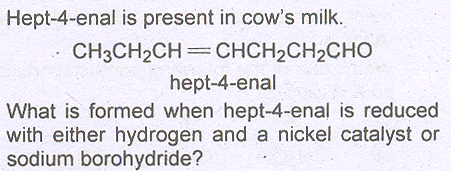
Question # 3
Cannizzaro reaction is not given by
Question # 4
In carboxyl group the bond between C and oxygen is:
Question # 5
Isopropyl alcohol on oxidation forms
Question # 6
What is formed when propanone is refluxed with an anhydrous solution of NaBH4
Question # 7
Self condensation of acetaldehyde in the presence of dilute alkalies gives
Question # 8
Acetaldehyde is used to make
Question # 9
Which of the following organic compounds exhibits positive Fehling test as well as iodoform test?
Question # 10
Which of the following reagent will react with both aldehyde and ketones?
Question # 11
Chromic acid used to oxidize
Question # 12
Aldehydes give reactions :
Question # 13
Which of the following is hypnotic?
Question # 14
For which one of the following pairs of compounds can the members be distinguished by means of Tollen's test
Question # 15
Which reaction yields Bakelite?
Question # 16
The carbon atom of a carbonyl group is
Question # 17
Which is not true about acetophenone?
Question # 18
Aldehyde and small methyl ketones form crystalline ______ ppts with saturated sodium bisulphate solution
Question # 19
Cannizzaro's reaction is type of reaction:
Question # 20
When vapours of isopropyl alcohol are passed over heated copper, the major product obtained is
Question # 21
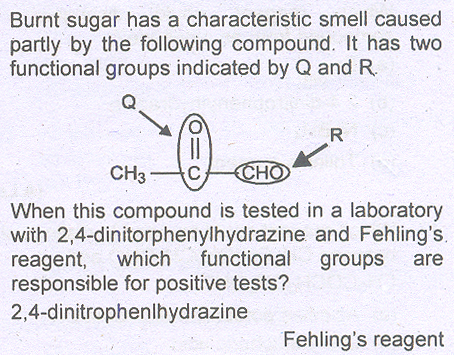
Question # 22
From which of the following tertiary butyl alcohol is obtained by the action of methyl magnesium iodide?
Question # 23
Which of the following will have the highest boiling point?
Question # 24
Which compound would undergo nucleophilic addition
Question # 25
Tollen's reagent is
Question # 26
Aniline reacts with which of these to form Schiff base?
Question # 27
Distillation of calcium salts of acetic acid and formic acids gives acetaldehyde. What compound would be obtained if only calcium salt of acetic acid is distilled
Question # 28
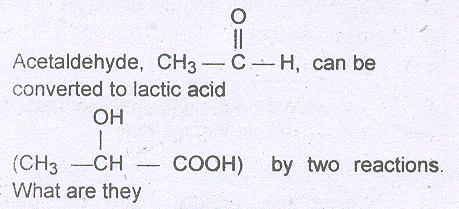
Question # 29
Calcium acetate when dry distilled gives
Question # 30
Reaction of Grignard's reagent eith aldehyds other formaldehyde gives: Reaction of Grignard's reagent with formaldehyde gives:





Top Scorers Of ECAT Chemistry Chapter 23 Aldehydes and Ketones MCQ`s Test
-
M M Umer Arain 10 - Dec - 2024 00 Min 27 Sec 110/120 -
M Mian araf Araf 16 - May - 2024 02 Min 13 Sec 110/120 -
F Farzand Shah Farzand Shah 24 - May - 2024 02 Min 44 Sec 110/120 -
J Jiya Khan 10 - Mar - 2024 07 Min 12 Sec 110/120 -
N Nasreen Sardar 13 - Jun - 2023 01 Min 36 Sec 105/120 -
M M Ahmad 12 - Mar - 2024 06 Min 24 Sec 85/120 -
Z Zaman Shehzad 24 - May - 2024 08 Min 02 Sec 80/120 -
H Hadi Fart 02 - Jun - 2024 10 Min 33 Sec 75/120 -
H hadia ejaz 31 - May - 2024 10 Min 57 Sec 75/120 -
H Huzaifa Asim 30 - May - 2024 00 Min 03 Sec 70/120 -
W Warisha Zehra 17 - Oct - 2023 05 Min 42 Sec 70/120 -
R Rabbia Munir 10 - Mar - 2024 06 Min 44 Sec 70/120 -
F Fariha Rani 17 - Jul - 2023 04 Min 46 Sec 65/120 -
M Mehreen Ather 23 - Dec - 2024 19 Min 27 Sec 65/120 -
F Fatima Sajid 29 - Jan - 2024 20 Min 34 Sec 65/120
ECAT Chemistry Chapter 23 Important MCQ's
| Sr.# | Question | Answer |
|---|---|---|
| 1 | Reaction of Grignard's reagent with ketones gives: Reaction of Grignard's reagent with formaldehyde gives: |
A. Pri-alcohol
B. Sec-Alcohol
C. Ter-alcohol
D. Carboxylic
|
| 2 | Formaldehyde is used to make |
A. Plastics
B. Medicine
C. Antiseptic
D. All of these
|
| 3 | Aldehydes and ketones are carbonyl compounds. Which of them react both with NaBH4and with Tollen's reagent |
A. Both aldehydes and ketones
B. Aldehydes only
C. Ketones only
D. Neither aldehydes nor ketones
|
| 4 | Propyne on hydrolysis in presence of H2SO4and HgSO4gives |
A. Acetaldehyde
B. Acetone
C. Formaldehyde
D. None
|
| 5 | Formalin is an aqueous solution of |
A. Furfural
B. Fluorescein
C. Formaldehyde
D. Formic acid
|
| 6 | Iodoform test is given by: |
A. Formaldehyde and Higher ketones
B. Formaldehyde
C. Acetaldehyde and methyl ketones
D. Acetaldehyde
|
| 7 | Formula of acetone is: |
A. HCHO
B. CH3CHO
C. CH3OCH3
D. CH3OC2H5
|
| 8 |

|
A. Q and R Q and R
B. R only Q and R
C. Q and R R only
D. Q only R only
|
| 9 | The color of ppts formed by Fehling's test is |
A. Brick red
B. Red
C. Yellow
D. Orange
|
| 10 | In which reaction, aromatic aldehyde is treated with acid anhydride in the presence of corresponding salt of the acid to give unsaturated aromatic acid? |
A. Friedel-Crafts reaction
B. Perkin's reaction
C. Wurtz reaction
D. None of these
|

Test Questions