




 Home
Home
 News
News
 Colleges




 Courses
 Admission
 Lectures
 Online Test
 Past Papers
 Date Sheets
 Results
 Study Abroad
 Jobs
Jobs
 Tutors
 More
More


 Apps
Apps





MCQ's Test For ECAT Chemistry Chapter 22 Alcohols, Phenols and Ethers
Try The MCQ's Test For ECAT Chemistry Chapter 22 Alcohols, Phenols and Ethers
-
Total Questions30
-
Time Allowed30
ECAT Chemistry Chapter 22 Alcohols, Phenols and Ethers
00:00

Question # 1
When sodium metal reacts with alcohols
Question # 2
Dow's process is used for the preparation of
Question # 3
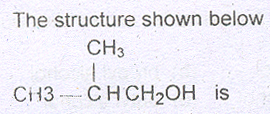
Question # 4
Alcohols of low molecular weight are
Question # 5
Sodium phenoxide reacts with CO2at 400 K and 4.7 atm pressure to give
Question # 6
Which of the following cannot be produced by acidic dehydration of alcohols?
Question # 7
Either, an organic compound has close resemblance in structure and thus a derivative of:
Question # 8
Methanol and ethanol can be distinguished by
Question # 9
How many alcohol (including both structural isomers and stereoisomers) can have the molecular formula C4H10O
Question # 10
Which of the following is produced when an aqueous solution of butan-2-ol is refluxed with dil acidified KMnO4
Question # 11
Which is a reagent for Lucas test
Question # 12
Alcohols reacts with Grignard reagent to form
Question # 13
The organic compounds which are derivative of hydrocarbons of oxygen are:
Question # 14
In Lucas test primary alcohol make as oily layer
Question # 15
Which compound has the maximum repulsion with water?
Question # 16
Na reacts with phenol to produce
Question # 17
Rectified spirit contains alcohol about
Question # 18
Which of the following is used as anesthetics
Question # 19
During dehydration of alcohols to alkenes by heating with conc. H2SO4, the initial step is
Question # 20
Phenol was discovered by:
Question # 21
The boiling point of glycerol is more than propanal because of
Question # 22
Which isomers of C5H11OH gives, on dehydration, the greatest number of different alkenes
Question # 23
Diethyl ether is obtained by Williamsons synthesis using
Question # 24
Glucose in the presence of zymase is converted into
Question # 25
Phenol is also known as
Question # 26
Rectified spirit contains alcohol about:
Question # 27
Which is not property in ether:
Question # 28
Ethyl alcohol is industrially prepared from ethylene by
Question # 29
Alcohals can be distinguished using test:
Question # 30
If an electrophile attacks then ______ bond breaks first





Top Scorers Of ECAT Chemistry Chapter 22 Alcohols, Phenols and Ethers MCQ`s Test
-
M M Umer Arain 08 - Dec - 2024 00 Min 08 Sec 120/120 -
F Farzand Shah Farzand Shah 24 - May - 2024 02 Min 27 Sec 115/120 -
U Unaiza Usman 23 - Feb - 2024 03 Min 09 Sec 95/120 -
M Mehreen Ather 19 - Dec - 2024 09 Min 56 Sec 95/120 -
Z zahida kalsoom 25 - Feb - 2024 11 Min 28 Sec 90/120 -
H Huzaifa Asim 30 - May - 2024 02 Min 45 Sec 85/120 -
Z Zaman Shehzad 24 - May - 2024 07 Min 20 Sec 85/120 -
M Meerab Ihtisham 05 - Jun - 2024 16 Min 13 Sec 80/120 -
A Ayra Arshad 06 - Jul - 2024 04 Min 36 Sec 75/120 -
H Haniya Ali 14 - Mar - 2024 11 Min 32 Sec 75/120 -
M Muhammad Faizan 20 - Feb - 2024 14 Min 54 Sec 75/120 -
C Computer mail 08 - Feb - 2026 06 Min 59 Sec 72/120 -
A Ayan Khan 06 - Aug - 2024 05 Min 31 Sec 70/120 -
K Kazim Ali 17 - May - 2024 12 Min 49 Sec 70/120 -
A Abdullah 08 - Mar - 2024 04 Min 10 Sec 65/120
ECAT Chemistry Chapter 22 Important MCQ's
| Sr.# | Question | Answer |
|---|---|---|
| 1 | Use of ethanol as: |
A. Drink
B. Solvent and fuel
C. In beverage
D. All of these
|
| 2 | How many alcohol (including both structural isomers and stereoisomers) can have the molecular formula C4H10O |
A. 3
B. 4
C. 5
D. 6
|
| 3 | Alcohols react with carboxylic acid to produce the class of compounds known as |
A. Grignard's reagent
B. Esters
C. Amides
D. None of these
|
| 4 | The malt-sugar in the presence of yeast or invertase gives |
A. Fructose
B. Glucose
C. Lignin
D. Alcohol
|
| 5 | Ethanol can be converted into ethanoic acid : |
A. Hydrogenation
B. Hydration
C. Oxidation
D. Fermentation
|
| 6 | Which is a reagent for Lucas test |
A. ZnCl2+ Conc. HCl
B. Zn
C. Na
D. Br
|
| 7 | Hydrolytic coversion of sucrose into glucose and fructose is known as |
A. Induction
B. Inversion
C. Insertion
D. Inhibition
|
| 8 | Scientific study of fermentation was first made by |
A. Buchner
B. Liebig
C. Biot
D. Pasteur
|
| 9 | According to Lewis concept ethers behave as: |
A. Acid
B. Base
C. Acid as well as a base
D. None of them
|
| 10 | Alcohols reacts with Grignard reagent to form |
A. Alkanes
B. Alkenes
C. Alkynes
D. All
|

Test Questions