




 Home
Home
 News
News
 Colleges




 Courses
 Admission
 Lectures
 Online Test
 Past Papers
 Date Sheets
 Results
 Study Abroad
 Jobs
Jobs
 Tutors
 More
More


 Apps
Apps





MCQ's Test For ECAT Pre General Science Mathematics Chapter 3 Logic
Try The MCQ's Test For ECAT Pre General Science Mathematics Chapter 3 Logic
-
Total Questions30
-
Time Allowed30
ECAT Pre General Science Mathematics Chapter 3 Logic
00:00

Question # 1
A declarative statement which may be true or false but not both is called a
Question # 2
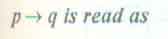
Question # 3

Question # 4
The conjunction of 3>5, and 5<9, is
Question # 5
-p is the
Question # 6
A statement which is already false is called
Question # 7
Deductive logic in which every statement is regarded as true or false and there is no other possibility is called:
Question # 8
To draw conclusions front premises believed to be true, this way of reasoning is called
Question # 9
For reasoning, we have to use
Question # 10
To draw conclusions from some experiments or few contacts only is called:
Question # 11
Deduction is mostly used in
Question # 12
Logic in which there is scope of third or fourth possibility is called.
Question # 13
The conditional statement "If p then q" is logically equivalent to the statement.
Question # 14
We often consult doctors or lawyers on the basis of their good
Question # 15
All men are mortal. We are men, therefore, we are also mortal. This is a useful example of
Question # 16

Question # 17
Which of the following statement, is true
Question # 18
The disjunction of two statements p and q, is denoted symbolically as
Question # 19
According to Aristotle, in proposition there could be
Question # 20
Basic principles of deductive logic were laid down by
Question # 21
10 is a even number or 0 is a natural number, then truth value of this disjunction is
Question # 22
A daclarative statement which may be true or false but not both is called a
Question # 23
The greater part of our knowledge,is based on
Question # 24
While witting his hooks on geometry, Euclid used
Question # 25
Basic-principles of deductive logic were laid down by:
Question # 26
Disjunction of p and q is
Question # 27
A statement which is already false is called
Question # 28
A conjunction is considered to he true only if both its components are
Question # 29

Question # 30
The greater part of our knowledge, is based on





Top Scorers Of ECAT Pre General Science Mathematics Chapter 3 Logic MCQ`s Test
-
F fatema naveed 17 - Jun - 2026 07 Min 52 Sec 116/120 -
A Abdullah Baloch 02 - Nov - 2024 10 Min 53 Sec 50/120 -
S Sad ullah 04 - Aug - 2018 07 Min 30 Sec 15/120 -
H Hamza Imran 05 - Jul - 2023 01 Min 35 Sec 0/120 -
A Amna Naseer 14 - Mar - 2023 02 Min 24 Sec 0/120 -
H Haider ali 02 - Feb - 2021 03 Min 37 Sec 0/120 -
S Shoaib Hussain 30 - Mar - 2023 06 Min 09 Sec 0/120
ECAT Mathematics Chapter 3 Important MCQ's
| Sr.# | Question | Answer |
|---|---|---|
| 1 |

|
A. hypothesis
B. implication
C. consequent
D. conditional
|
| 2 | A conjunction is considered to he true only if both its components are |
A. false
B. equilvalent
C. equal
D. true
|
| 3 | While writing his books on geometry, Euelid used |
A. Inductive method
B. Deductive method
C. Implication
D. proposition
|
| 4 | Disjunction of p and q is |
A. p or q
B. p and q
C. p if q
D. p implies q
|
| 5 |

|
A. p and q
B. p or q
C. p implies q
D. p is equivalent to q
|
| 6 | If p is false, ~ p is |
A. true
B. not true
C. equal to p
D. conjuction
|
| 7 | The symbol ∃ stand for |
A. Such that
B. This implies that
C. For all
D. There exist
|
| 8 | Basic-principles of deductive logic were laid down by: |
A. Euelid
B. Leibniz
C. Aristotle
D. Newton
|
| 9 | Conjunction of two statements p and q is denoted symbolically as | |
| 10 | A conjunction is considered to be true only if both its components are |
A. False
B. Equivalent
C. Equal
D. True
|

Test Questions