




 Jobs Home
 Cities
 Govt Depts
 Comapnies
 Industries
 Professions




New Jobs in National Disaster Management Authority
- Job posted on
06-Sep-2026
- Number of vacancies
1
-
Last date to apply
21-Sep-2026
- Job location
Islamabad
- Job type
Temporary/Contract
- Job status
Full Time
- Job Announced Executive Director General Manager Assistant Manager Deputy Manager Junior Clerk Naib Qasid
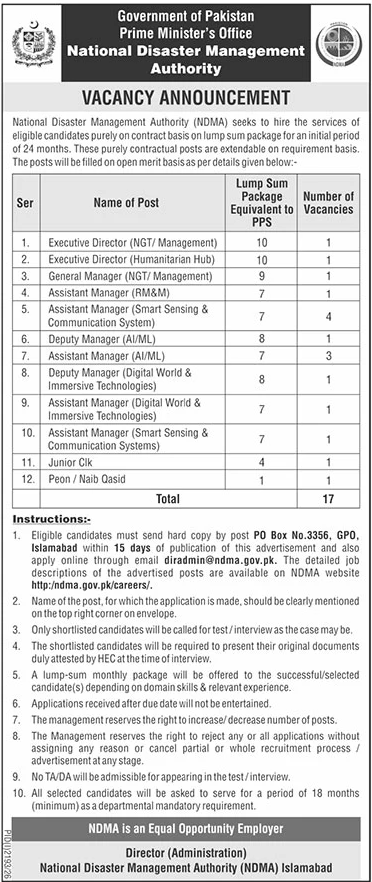
NDMA Islamabad invites applications on a contract basis for 17 positions (ranging from Executive Director to Peon) with lump-sum packages, requiring online and hard-copy submissions within 15 days.
- Apply for this job
- Prepare for this job
- Share this job
- Have a question about this job? Ask in the discussion area.
-
22 Jul 26 National Disaster Management Authority
-
Senior Manager
-
1 Jobs
-
Last Date
05-Aug-26
-
-
19 Jul 26 National Disaster Management Authority
-
Chief Internal Auditor
-
1 Jobs
-
Last Date
02-Aug-26
-
-
15 Jun 26 National Disaster Management Authority
-
Manager
-
3 Jobs
-
Last Date
30-Jun-26
-
-
15 May 26 National Disaster Management Authority
-
Research Associate
-
2 Jobs
-
Last Date
21-May-26
-
-
26 Apr 26 National Disaster Management Authority
-
Manager
-
1 Jobs
-
Last Date
11-May-26
-
-
19 Apr 26 National Disaster Management Authority
-
Assistant Company Secretary
-
1 Jobs
-
Last Date
03-May-26
-
-
19 Mar 26 National Disaster Management Authority
-
GIS developer
-
1 Jobs
-
Last Date
25-Mar-26
-
-
18 Mar 26 National Disaster Management Authority
-
Manager Technicla Team Lead Natcat Data Centr...
-
1 Jobs
-
Last Date
01-Apr-26
-
-
29 Jan 26 National Disaster Management Authority
-
Deputy Manager
-
2 Jobs
-
Last Date
25-Feb-26
-
National Disaster Management Authority: Career Opportunities for 2026
The National Disaster Management Authority (NDMA) is Pakistan's lead federal agency for orchestrating a unified national effort to manage disasters. Operating under the visionary leadership of the Prime Minister, the NDMA's mandate encompasses the entire disaster management cycle, from proactive policy formulation and risk mitigation to coordinated emergency response and sustainable recovery. As climate change intensifies the frequency and severity of hazards like monsoonal floods, glacial lake outbursts, and extreme heatwaves, the Authority's role has never been more critical. Its work directly impacts millions of lives, safeguarding national infrastructure and building community resilience across all provinces and territories.
Looking ahead to 2026, the NDMA is strategically expanding its human resource capacity to meet evolving challenges. Career opportunities are being shaped by a new five-year National Disaster Risk Reduction Framework, which emphasizes technological integration, climate adaptation, and urban resilience. The hiring forecast for the coming year anticipates vacancies not only in Islamabad headquarters but also in regional and provincial coordination cells. Prospective openings are expected in specialized domains such as Geographic Information Systems (GIS) and remote sensing for hazard mapping, climate finance and project management, public health emergency preparedness, and advanced emergency logistics and supply chain management. These roles are designed to build a more agile, data-driven, and professionally robust institution.
Anticipated NDMA Job Vacancies and Application Pathways for 2026
Securing a position with the National Disaster Management Authority requires navigating a structured and competitive federal recruitment process. For the 2026 cycle, job vacancies will be formally advertised through the official NDMA website (www.ndma.gov.pk) and in leading national newspapers such as Dawn, The News, and Jang. Crucially, all federal government vacancies, including those for NDMA posts at BPS-16 and above, are also centrally announced by the Federal Public Service Commission (FPSC). Aspiring candidates must vigilantly monitor both the NDMA and FPSC portals. Notifications will detail specific positions—such as Disaster Risk Reduction Specialist, Operations Coordinator, or Mitigation Expert—alongside essential eligibility criteria including required qualifications, experience, age limits, and domicile requirements.
The application process is exclusively online, typically through the FPSC's dedicated application portal or a specified system on the NDMA website. It is imperative for applicants to prepare digital copies of all attested academic transcripts, professional experience certificates, a computerized national identity card (CNIC), and domicile certificate well in advance. The selection process is rigorous and multi-stage, often comprising a written examination testing professional knowledge and analytical abilities, followed by a detailed interview before a panel of experts. For technical and high-level policy roles, candidates may also be required to present on a given scenario or complete a practical assessment. Successful candidates undergo thorough background verification and medical fitness tests before receiving a formal offer of employment for these critical national security roles.