








Admissions in different Institutes for BS Economics
| Date Posted | Institute Name | City | Program Name | Admission Image |
|---|---|---|---|---|
| 15-Nov-2026 |
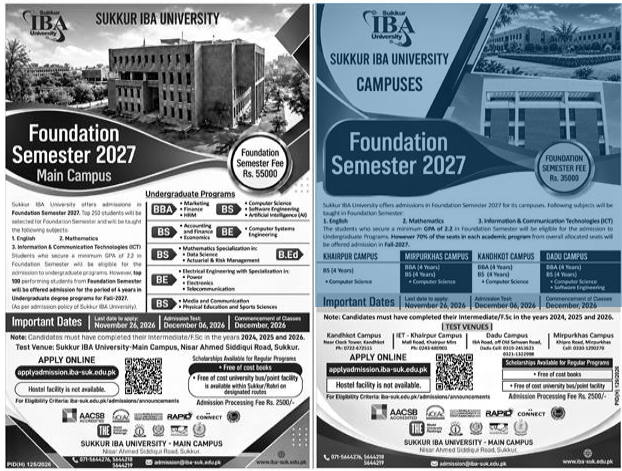
 International Islamic University IIU Islamabad |
Islamabad |
|
|
| 10-Nov-2026 |
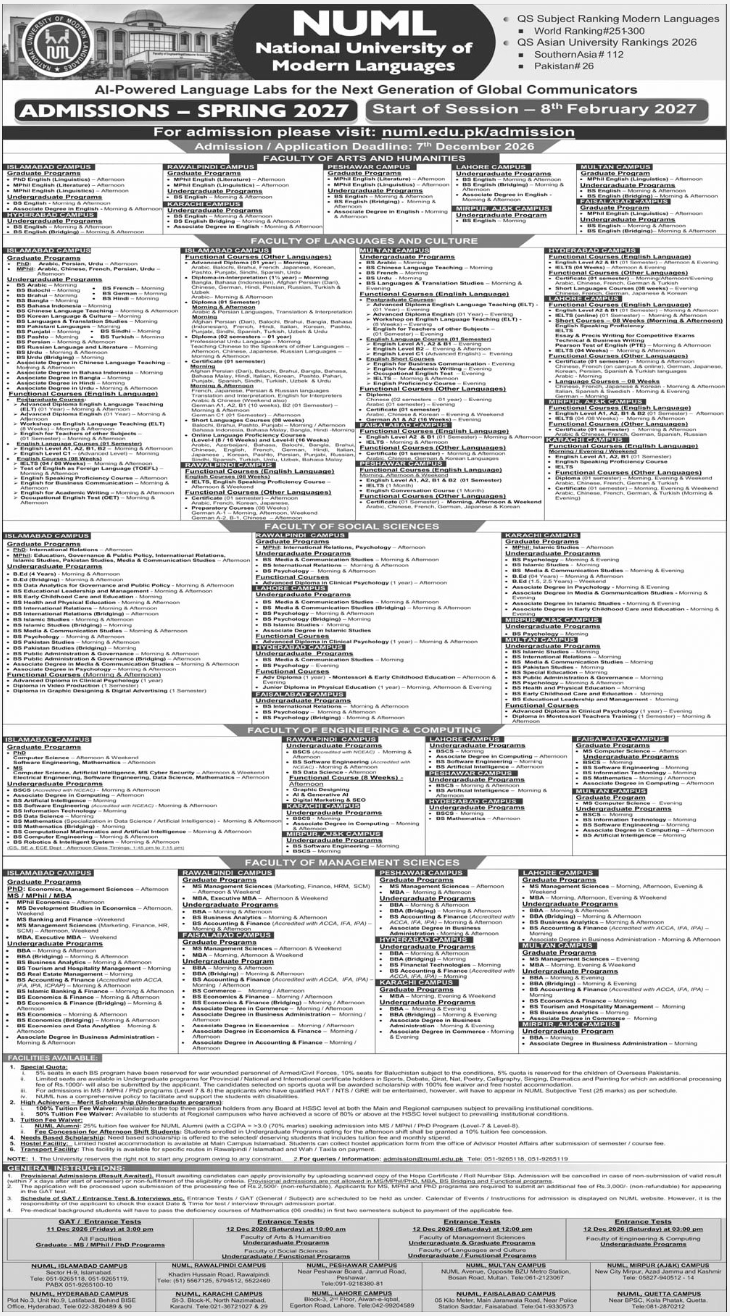
 National University Of Modern Languages Islamabad |
Islamabad |
|
|
| 20-Oct-2026 |
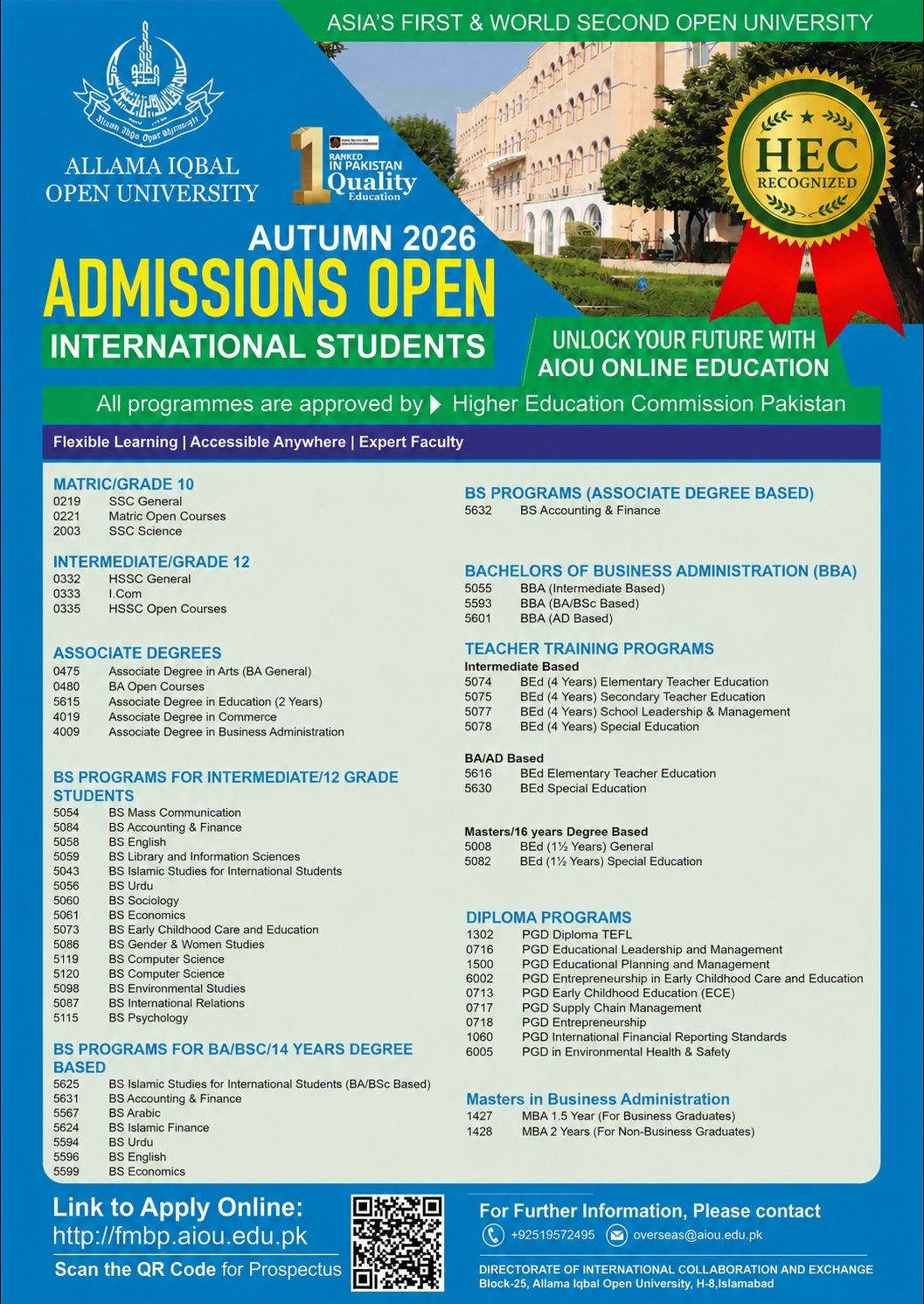
 Allama Iqbal Open University AIOU Islamabad |
Islamabad |
|
|
| 20-Oct-2026 |
 Federal Urdu University Of Arts, Science And Technology Islamabad |
Islamabad |
|
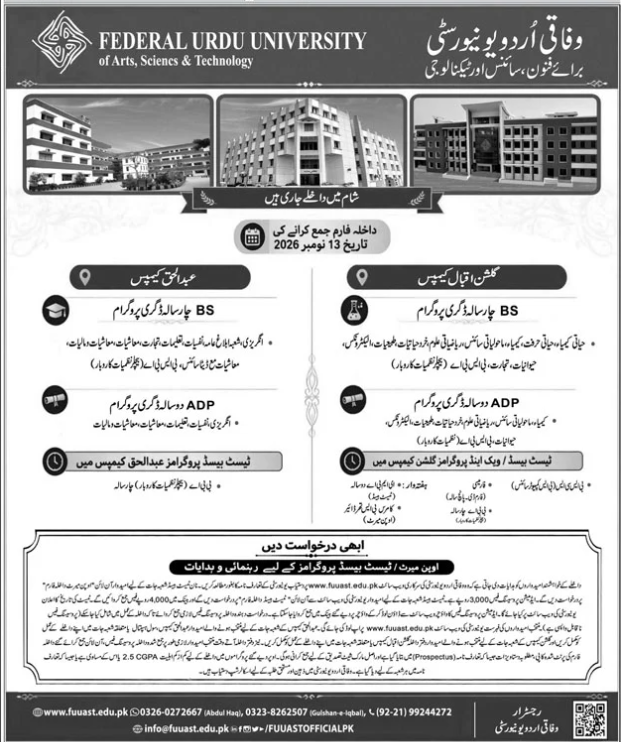
|
| 27-Sep-2026 |
 Iqra University Islamabad |
Islamabad |
|
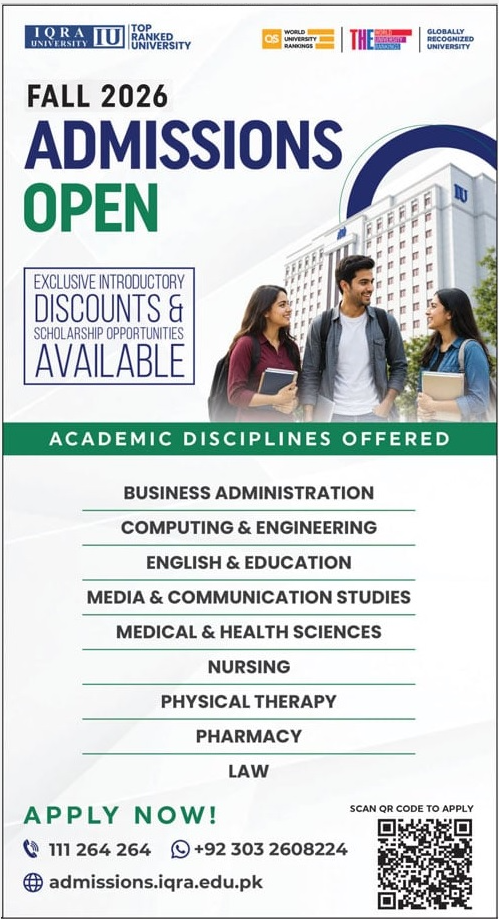
|
| 01-Sep-2026 |
 Foundation University Islamabad |
Islamabad |
|

|
| 31-Aug-2026 |
 Quaid-i-Azam University Islamabad |
Islamabad |
|

|
| 22-Jul-2026 |
 Islamabad.jpg) Shaheed Zulfikar Ali Bhutto Institute of Science and Technology (SZABIST) Islamabad |
Islamabad |
|

|
| 03-Feb-2026 |
 National Defence University Islamabad |
Islamabad |
|
|
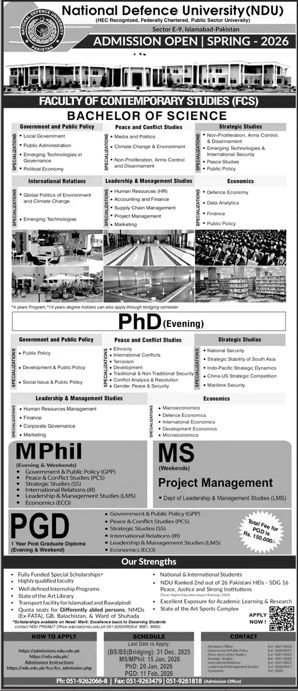
| 13-Jan-2026 |
 National Defense University (NDU) Islamabad |
Islamabad |
|
|
BS Economics Admissions in Islamabad 2026 – Universities, Eligibility & Last Dates
Students looking for BS Economics admission in Islamabad 2026 can explore undergraduate programmes at universities including Quaid-i-Azam University (QAU), National University of Sciences and Technology (NUST), COMSATS University Islamabad, International Islamic University Islamabad (IIUI), National University of Modern Languages (NUML) and Bahria University.
These institutions offer Economics programmes with different eligibility requirements, admission schedules, fee structures and selection procedures. Students who have completed FA, FSc, ICS, I.Com, A-Levels or an accepted equivalent qualification may be eligible, depending on the university's criteria.
This page provides information about BS Economics universities in Islamabad, recent admission announcements, eligibility requirements, admission procedures and merit lists. Students can also explore BS Economics admissions across Pakistan to compare universities in other cities.
Latest BS Economics Admissions in Islamabad 2026
Universities in Islamabad announce BS Economics admissions according to their academic calendars. Some institutions offer Fall admissions, while others also announce Spring admission sessions.
The following table highlights recent admission information available as of 19 November 2026.
|
University |
Programme |
Recently reported last date |
Admission information |
|---|---|---|---|
|
International Islamic University Islamabad |
BS Economics |
8 January 2027 |
Recent admission notice listed on Ilmkidunya |
|
National University of Modern Languages |
BS Economics |
7 December 2026 |
Deadline reported by Eduvision; verify official notice |
|
COMSATS University Islamabad |
BS Economics |
18 December 2026 |
Recent undergraduate admission notice |
|
Quaid-i-Azam University |
BS Economics |
Fall 2026 round previously advertised |
Check the next admission session |
|
NUST Islamabad |
BS Economics |
Fall 2026 round previously advertised |
Check NET-2027 admission schedule |
|
Bahria University Islamabad |
BS Economics |
Fall 2026 round previously advertised |
Confirm the next campus admission cycle |
These are reported deadlines, not independently confirmed live application statuses. Admission dates may be revised, and different campuses or programmes may follow separate schedules. Students should confirm the relevant BS Economics programme and final application date through the official university admission portal before applying.
For additional opportunities, check latest bachelor admissions in Islamabad.
Universities Offering BS Economics in Islamabad
Islamabad has several universities offering undergraduate Economics education. Students should compare institutions according to academic requirements, entrance tests, programme content, fees and available facilities.
Quaid-i-Azam University Islamabad
Quaid-i-Azam University is a public-sector university offering Economics education. Its BS Economics programme provides students with an understanding of economic theory, quantitative methods, policy analysis and economic development.
Students interested in BS Economics admission at Quaid-i-Azam University should review the university's admission notices, academic requirements and merit selection procedures.
Applications are submitted through the university's designated admission system. Interested candidates can also follow the Quaid-i-Azam University admission updates.
National University of Sciences and Technology (NUST)
NUST Islamabad offers a BS Economics programme and uses a structured undergraduate admission process. Students normally apply through its recognised admission routes, including the NUST Entry Test (NET).
NUST requires at least 60% aggregate marks in SSC and HSSC, or equivalent qualifications, under its published undergraduate eligibility rules.
Students considering NUST should prepare for the appropriate admission test and review the official eligibility criteria before registering. NUST's undergraduate admission updates also provide information about NET-2027.
COMSATS University Islamabad
COMSATS University Islamabad offers BS Economics as part of its undergraduate academic programmes. Students can study economic principles alongside quantitative and analytical subjects that support research and professional decision-making.
A recent admission listing identifies 18 December 2026 as the closing date for the relevant COMSATS admission round. Applicants should confirm the Islamabad campus, programme availability, entry-test requirements and application deadline through the university's admission portal.
International Islamic University Islamabad
International Islamic University Islamabad offers BS Economics, providing an option for students interested in economic theory and its applications in business, policy and development.
An admission notice listed on Ilmkidunya reports 8 January 2027 as the last date for a recent BS Economics admission round.
Students should verify the current programme prospectus, eligibility criteria and application instructions before submission.
National University of Modern Languages (NUML)
NUML Islamabad offers BS Economics and related undergraduate programmes. It is another option for students seeking Economics education in the federal capital.
A third-party admission listing reports 7 December 2026 as a deadline. Students should check the official NUML admission schedule, because examination dates and programme-specific application requirements may differ.
Bahria University Islamabad
Bahria University offers BS Economics at its Islamabad E-8 Campus. The programme provides exposure to economic analysis, financial concepts, statistical methods and policy-related subjects.
Before applying, students should review the current campus prospectus, semester fee structure, admission requirements and selection procedure.
Students comparing these institutions can also browse the BS Economics universities in Pakistan for a wider selection of educational institutions.
BS Economics Admission Eligibility Criteria in Islamabad
Applicants interested in admission in BS Economics in Islamabad generally need to complete 12 years of education or an accepted equivalent qualification.
However, minimum marks, subject requirements and admission tests can differ between universities.
|
Eligibility requirement |
General information |
|---|---|
|
Required qualification |
FA, FSc, ICS, I.Com, A-Levels or equivalent, subject to university rules |
|
Minimum marks |
Often 45%–50% at various institutions; NUST requires at least 60% in SSC and HSSC |
|
Mathematics background |
Requirements differ; check the specific programme |
|
Entry test |
Required by some universities |
|
A-Level applicants |
IBCC equivalence may be required |
|
Merit selection |
Based on the university's approved admission criteria |
|
Degree duration |
Four years, generally eight semesters |
Meeting the minimum marks requirement does not automatically guarantee admission. Applicants may need a higher merit aggregate, depending on the university and number of available seats.
Students should compare academic requirements and other admission conditions through the BS Economics admission guide.
How to Apply for BS Economics Admission in Islamabad
The admission process varies between institutions, but most universities follow several common stages.
-
Choose a university: Shortlist institutions offering BS Economics and check whether admissions are accepting applications.
-
Check eligibility: Review minimum marks, accepted qualifications, programme requirements and the admission-test policy.
-
Register online: Open the university's official admission portal and create an applicant account.
-
Complete the form: Enter personal details, previous qualifications and the selected degree programme accurately.
-
Upload documents: Submit clear copies of the academic and identity documents requested by the institution.
-
Pay the processing fee: Follow the university's specified payment instructions and retain the receipt.
-
Complete the selection process: Appear in an entry test or interview where required, and monitor the merit list.
-
Confirm admission: If selected, complete document verification and submit the admission fee before the stated deadline.
Students should retain copies of their submitted applications, payment receipts and admission-related messages.
Documents Required for BS Economics Admission
Universities commonly request academic and identity documents during application submission or enrolment.
|
Document |
Purpose |
|---|---|
|
Matric certificate or result card |
Verification of secondary education |
|
Intermediate certificate or result card |
Verification of academic eligibility |
|
CNIC or B-Form |
Applicant identification |
|
Recent photographs |
Application and student record |
|
Parent or guardian CNIC |
Required by some institutions |
|
Domicile certificate |
Required for certain quotas or institutions |
|
IBCC equivalence certificate |
For applicable foreign or equivalent qualifications |
|
Entry-test result |
Where a university requires an admission test |
Some universities allow students awaiting their final results to submit provisional applications, subject to specified conditions. Students must check the relevant university's current policy.
BS Economics Fee Structure in Islamabad
The BS Economics fee structure in Islamabad varies across universities. Public-sector and private-sector institutions may have different tuition rates, admission charges and additional semester expenses.
The amount payable can also depend on the programme, campus, fee category and academic session.
|
University |
Fee information |
|---|---|
|
Quaid-i-Azam University |
Check the current fee schedule for the applicable admission category |
|
NUST Islamabad |
Review the current School of Social Sciences and Humanities fee schedule |
|
COMSATS University Islamabad |
Check the current BS Economics programme fees |
|
International Islamic University Islamabad |
Review the applicable semester and admission charges |
|
NUML Islamabad |
Check the current fee schedule for BS Economics |
|
Bahria University Islamabad |
Review the E-8 Campus fee schedule and credit-hour charges |
Students should calculate the complete cost of education, including tuition, admission charges, transport, accommodation and other university dues.
For additional details, visit the BS Economics fee structure in Pakistan.
BS Economics Subjects and Course Structure
BS Economics generally takes four years to complete and consists of eight semesters. The degree combines economic theory with mathematical, statistical and analytical knowledge.
Common subjects include:
|
Subject |
Main learning area |
|---|---|
|
Microeconomics |
Consumer decisions, businesses and markets |
|
Macroeconomics |
Inflation, national income, employment and growth |
|
Mathematics for Economics |
Mathematical methods used in economic analysis |
|
Statistics |
Data collection, interpretation and analysis |
|
Econometrics |
Applying statistical techniques to economic data |
|
Development Economics |
Economic development and poverty |
|
International Economics |
Trade and global economic relationships |
|
Monetary Economics |
Money, banking and monetary policy |
|
Public Finance |
Government revenue, taxation and expenditure |
|
Research Methods |
Economic research and analytical techniques |
The exact course outline and elective subjects depend on the university.
Students can explore the BS Economics subjects and semester-wise course outline to understand the academic content before applying.
BS Economics Merit List 2026 in Islamabad
Universities generally release merit lists after completing their application and assessment processes.
Applicants are selected according to the institution's approved criteria, which may include previous examination marks, admission-test scores and other specified requirements.
Merit lists may be released in several stages if additional seats become available. Students should check the selected university's admission portal regularly and complete the required fee payment within the deadline.
Ilmkidunya also provides BS Economics merit list updates for students seeking admission results and selection information.
Career Opportunities After BS Economics
BS Economics graduates can pursue careers in banking, economic research, public policy, business analysis, financial services and development organisations.
Possible roles include research assistant, economic analyst, banking officer, data analyst and policy research assistant. Eligibility for individual positions depends on the employer, academic requirements and relevant skills.
Students who want to continue their education may explore postgraduate programmes in Economics, Finance, Development Studies or related disciplines.
For additional career guidance, visit the BS Economics jobs and career opportunities page.
How to Choose the Right University for BS Economics in Islamabad
Before submitting an application, students should consider several factors beyond the university's name.
Programme recognition: Confirm the institution's recognition status and the programme's current approval information.
Academic curriculum: Review the balance between Economics, Mathematics, Statistics and research-based courses.
Admission requirements: Check the minimum qualifying marks, test schedule and merit calculation method.
Affordability: Compare tuition fees, additional charges and the total expected cost of completing the degree.
Facilities and location: Consider the campus, accommodation, transport and access to academic resources.
Future opportunities: Explore internships, research facilities and the relevance of the curriculum to career or postgraduate goals.
Comparing these factors can help applicants select a university that matches their educational needs and financial circumstances.
Cities with Admissions in BS Economics
Related Disciplines of BS Economics



More on BS Economics
Free Admission Advice for bs economics
Frequently Asked Questions
Which universities offer BS Economics in Islamabad?
Universities offering BS Economics include Quaid-i-Azam University, NUST, COMSATS University Islamabad, International Islamic University Islamabad, NUML and Bahria University. Students should confirm current programme availability before applying.
What is the last date for BS Economics admission in Islamabad 2026?
Deadlines vary by university and session. Recent listings report 18 December 2026 for COMSATS, 7 December 2026 for NUML and 8 January 2027 for International Islamic University Islamabad. These dates should be verified on the official university portals before application.
What percentage is required for BS Economics admission?
The minimum percentage varies by institution. Some universities accept applicants with 45%–50% marks, while NUST's published undergraduate policy requires at least 60% in SSC and HSSC or equivalent examinations. Selection may require a higher merit aggregate.
Can FA students apply for BS Economics in Islamabad?
Yes, FA students can apply to universities that accept their qualification and subject combination. Applicants should check each university's eligibility criteria, particularly if Mathematics or specific subjects are required.
Is an entry test compulsory for BS Economics?
Not at every university. NUST uses the NET route for undergraduate admission, while other universities may use their own tests, merit-based selection or additional assessments. The current programme prospectus provides the applicable rules.
What is the duration of BS Economics in Pakistan?
The standard BS Economics degree takes four years and generally consists of eight semesters, covering compulsory, major and elective courses.
How can I check the BS Economics merit list in Islamabad?
Students can check merit lists through the official admission portals of the universities where they have applied. They can also visit Ilmkidunya's BS Economics merit list page for available updates and relevant university listings.
Question: Can students apply for BS Economics while waiting for their Intermediate results?
Some universities permit provisional applications using earlier examination results. Final admission depends on meeting the university's qualification, marks and document-submission requirements within its specified deadline.