








Admissions in different Institutes for BS Economics
| Date Posted | Institute Name | City | Program Name | Admission Image |
|---|---|---|---|---|
| 24-Nov-2026 |
 Sindh Madressatul Islam University |
Karachi |
|
|
| 18-Nov-2026 |
 Institute Of Business Administration (IBA) Karachi |
Karachi |
|
|
| 15-Nov-2026 |
 University Of Karachi |
Karachi |
|
|
| 11-Nov-2026 |
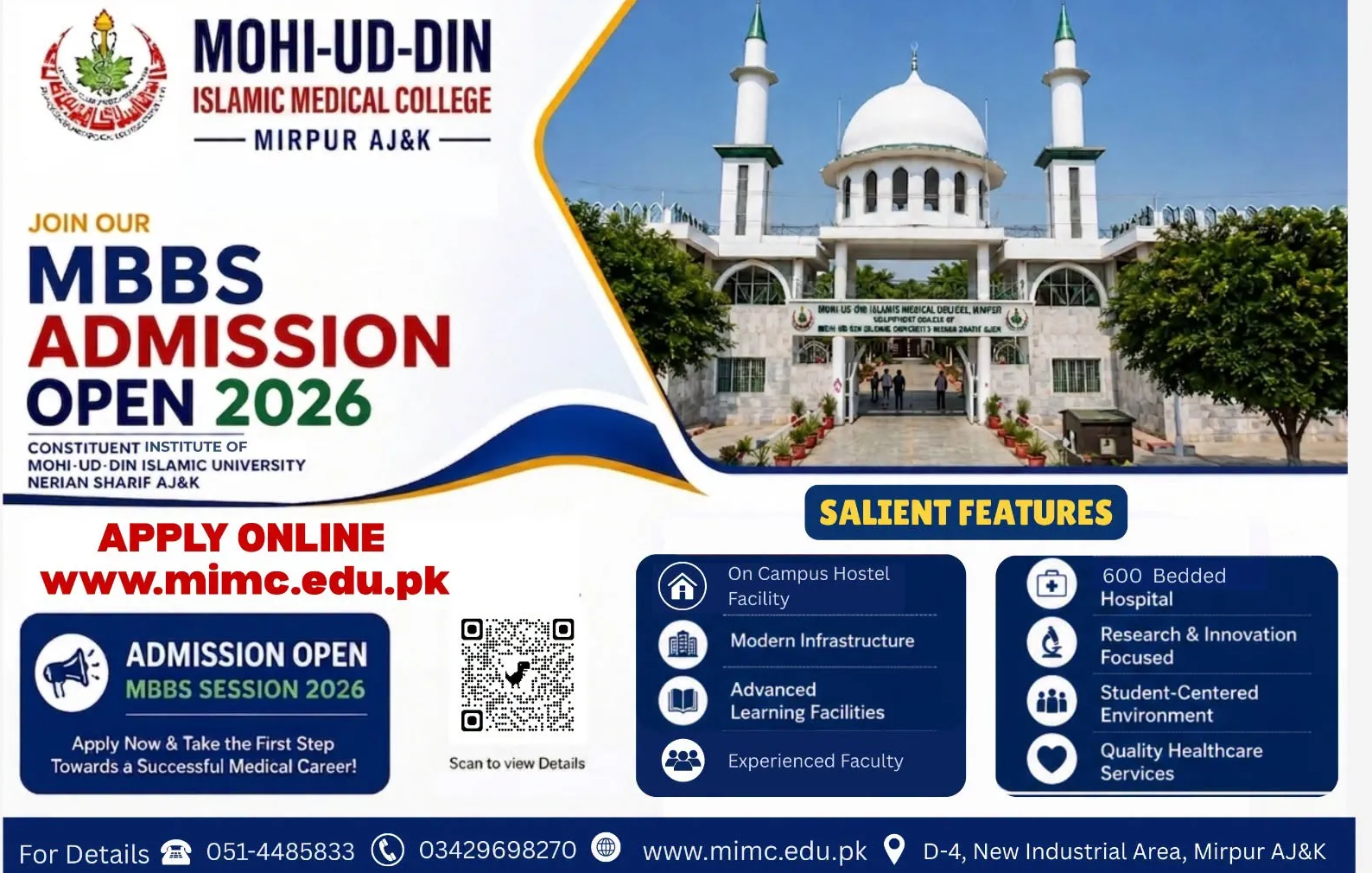
 Iqra University Karachi |
Karachi |
|
|
| 25-Oct-2026 |
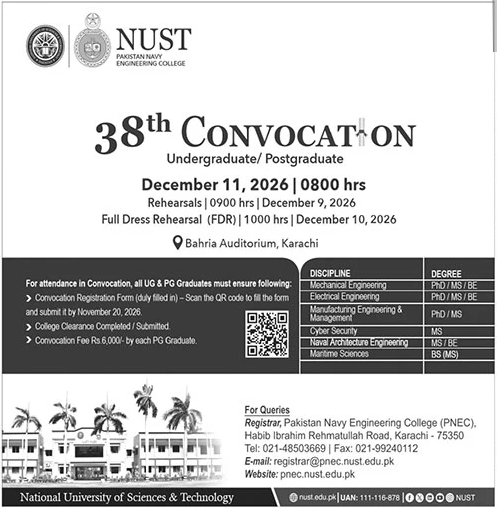
 National University of Sciences and Technology (NUST) Karachi |
Karachi |
|
|
| 01-Sep-2026 |
 Jinnah University For Women Karachi |
Karachi |
|

|
| 21-Aug-2026 |
 Sir Syed University of Engineering and Technology, Karachi |
Karachi |
|

|
| 31-Jul-2026 |
 Shaheed Zulfiqar Ali Bhutto University Of Law Karachi |
Karachi |
|

|
| 14-Jul-2026 |
 Mohammad Ali Jinnah University Karachi |
Karachi |
|

|
| 28-Jun-2026 |
 Usman Institute of Technology Karachi UIT University |
Karachi |
|

|
BS Economics Admissions in Karachi 2026 – Universities, Eligibility & Last Dates
Students looking for BS Economics admission in Karachi 2026 can explore undergraduate economics programs at public and private universities, including the University of Karachi, IBA Karachi, Sindh Madressatul Islam University (SMIU), and Jinnah University for Women. These institutions provide economics education with different admission requirements, fee structures, and selection procedures.
A BS Economics degree generally takes four years and eight semesters to complete. Students study economic theory, statistics, mathematical economics, public policy, research methods, and the Pakistani economy.
Admission dates vary by university. As of November 19, 2026, several 2026 admission deadlines have passed, while some universities have announced application schedules for 2027. Students should check the latest university notices before applying.
For admission opportunities outside Karachi, explore BS Economics admissions in Pakistan.
BS Economics Admission 2026 in Karachi – Latest Updates
Karachi offers several undergraduate pathways for students interested in economics, finance, research, and economic policy. Applications are usually submitted through university admission portals during the relevant intake period.
|
Admission Information |
Details |
|---|---|
|
Degree |
Bachelor of Science in Economics |
|
Program duration |
4 years |
|
Academic semesters |
8 |
|
Study location |
Karachi, Sindh |
|
Basic qualification |
Intermediate or equivalent |
|
Admission selection |
Academic merit and/or entrance assessment, depending on university |
|
University sectors |
Public and private |
|
Admission year |
2026, with upcoming 2027 intake information |
|
Application method |
University-specific online or prescribed admission process |
|
Official deadline |
Varies by university and intake |
Students should check the program name carefully when applying. BS Economics, BS Economics & Finance, and BS Economics & Data Science are related but distinct degrees.
Universities Offering BS Economics in Karachi
Students can compare the following Karachi institutions offering economics degrees or related specializations.
|
University |
Sector |
Economics Program |
Admission Guidance |
|---|---|---|---|
|
University of Karachi (UOK) |
Public |
BS Economics; BS Economics & Finance |
Check current morning/evening admission notices |
|
Institute of Business Administration (IBA Karachi) |
Public |
BS Economics and related interdisciplinary degrees |
Follow the published intake schedule and aptitude-test process |
|
Sindh Madressatul Islam University (SMIU) |
Public |
BS Economics |
Check the current undergraduate admission portal |
|
Jinnah University for Women |
Private |
BS Economics |
Review current admissions and entrance assessment notices |
|
SZABIST University Karachi |
Private |
BS Economics with Data Science |
Confirm the specific program and intake requirements |
The listed universities do not necessarily have applications open simultaneously. Students should confirm the exact program, campus, admission round and closing date before paying an application fee.
University of Karachi BS Economics Admission
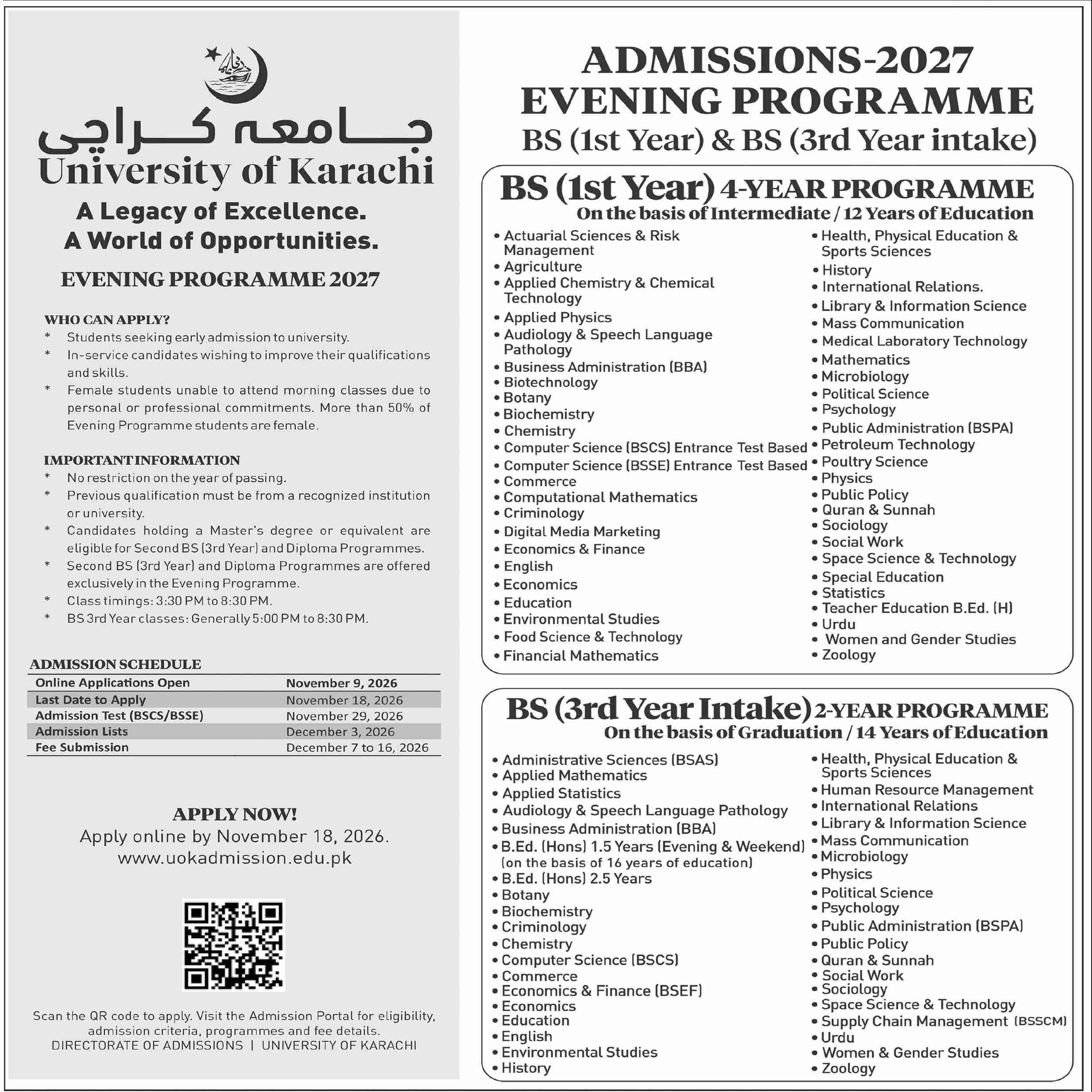
The University of Karachi offers BS Economics through its Department of Economics. The university lists both morning and evening study options, subject to the applicable admission arrangements.
Its curriculum covers economic principles, quantitative methods, and the application of economics to national and international issues. Students interested in finance may also consider the university's separate BS Economics & Finance program.
For admission, applicants should review the current university prospectus, eligibility conditions, admission category, and merit-list instructions. Students should not assume that the deadline for one admission category also applies to every other category.
IBA Karachi BS Economics Admission
IBA Karachi offers a four-year BS Economics degree that combines economic theory with analytical and quantitative skills. The program includes microeconomics, macroeconomics, statistics, mathematics, and advanced economic studies.
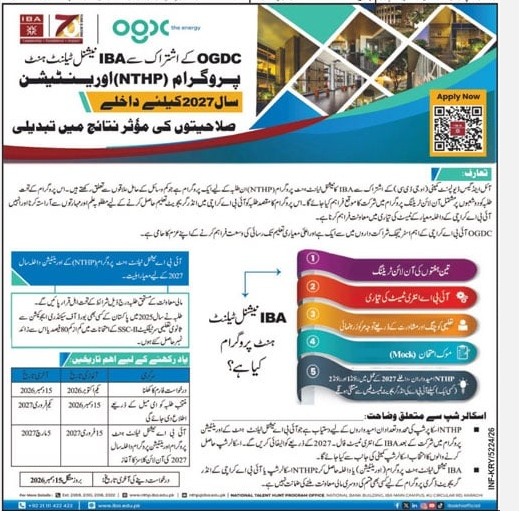
IBA has also announced its Fall 2027 admission schedule for the School of Economics and Social Sciences.
|
Fall 2027 First-Round Event |
Officially Published Date |
|---|---|
|
Online applications available |
October 1, 2026 |
|
Application deadline |
December 9, 2026 |
|
Admit cards |
December 14–16, 2026 |
|
Aptitude test |
December 20, 2026 |
|
Aptitude-test result |
December 30, 2026 |
|
Classes begin |
August 23, 2027 |
These dates belong to the Fall 2027 first-round intake, not Fall 2026. Students can check the IBA Karachi official admission schedule for updates and additional rounds.
Sindh Madressatul Islam University BS Economics Admission
Sindh Madressatul Islam University offers BS Economics through its academic programs in business and related disciplines.
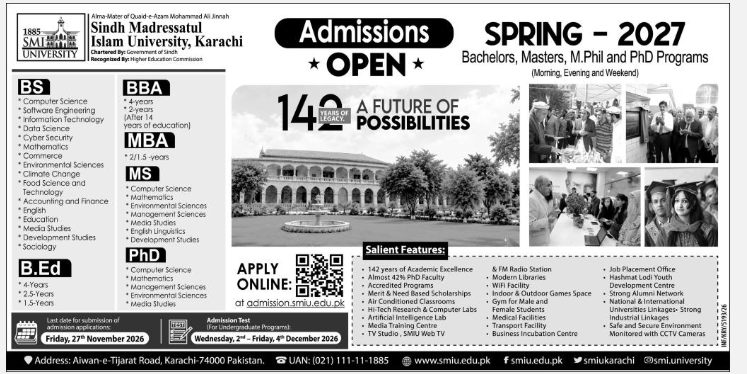
The program introduces students to economic concepts, analysis, and their application to business and public-sector decisions. SMIU has published undergraduate admission and eligibility information for its Spring 2027 intake.
Students planning to apply should check the official SMIU undergraduate programs and eligibility information before submitting an application.
Jinnah University for Women BS Economics Admission
Jinnah University for Women offers a four-year BS Economics program in Karachi. Its economics curriculum covers economic theory, the economy of Pakistan, and related analytical subjects.
The university has also published an admission-test announcement for 2027 that includes Economics among the listed disciplines. Students should consult the university's admission policy and schedule for application and assessment details.
Other Economics-Related Programs in Karachi
Students interested in combining economics with another field can consider degrees such as BS Economics & Finance or BS Economics & Data Science.
Before selecting a program, compare the subjects, quantitative requirements, fee structure, and career opportunities. A specialized economics degree may have a different curriculum and admission process from a standard BS Economics program.
BS Economics Admission Last Date in Karachi
There is no single BS Economics admission last date in Karachi because every university establishes its own admission calendar.
|
University |
Deadline Information |
|---|---|
|
University of Karachi |
A third-party 2026 BS Economics listing reported November 18, 2026; this date has passed |
|
IBA Karachi |
December 9, 2026 for Fall 2027 first-round applications |
|
Sindh Madressatul Islam University |
Spring 2027 information published; exact deadline requires confirmation |
|
Jinnah University for Women |
2027 entrance-test notice published; application deadline requires confirmation |
|
SZABIST University Karachi |
Confirm the relevant program-specific deadline through its admission portal |
Important: A previous admission advertisement is not proof that applications are currently open. Always use the latest notice for your chosen university and intake.
Students can also browse Karachi university admission announcements to look for additional opportunities.
BS Economics Eligibility Criteria in Karachi
Students generally need Intermediate or an equivalent qualification to apply for a four-year BS Economics program.
The minimum percentage, accepted subject combinations, age conditions, admission-test requirements, and equivalence rules may differ by institution.
Academic Qualifications
|
Qualification |
General Admission Guidance |
|---|---|
|
FA |
May qualify, subject to university policy |
|
FSc Pre-Engineering |
May qualify, subject to university policy |
|
FSc Pre-Medical |
May qualify, subject to university policy |
|
ICom |
May qualify, subject to university policy |
|
ICS |
May qualify, subject to university policy |
|
A-Level |
May qualify with the required equivalence documentation |
Students from Arts, Commerce, and Science backgrounds should read the relevant university's admissions criteria rather than assuming all Intermediate groups are accepted automatically.
Minimum Marks and Merit Requirements
There is no universal minimum percentage that applies to every Karachi university offering BS Economics.
Universities may calculate admission merit using Intermediate marks, an aptitude test, previous academic qualifications, or other published selection components.
Meeting the minimum eligibility criteria does not guarantee admission. Selection also depends on available seats and the institution's merit policy.
Entry Test Requirements
Some universities conduct aptitude or admission tests as part of their undergraduate selection process.
Students should verify the test syllabus and pattern for their chosen institution. Depending on the university, preparation may involve English comprehension, quantitative reasoning, mathematics, and analytical skills.
Applicants can also explore BS Economics admission guidance for broader information about university selection procedures.
How to Apply for BS Economics in Karachi
The application process differs by institution, but students can generally follow these steps:
-
Choose a university: Compare available BS Economics programs, fees, location, and admission policies.
-
Check eligibility: Review the university's current academic requirements and accepted qualifications.
-
Read the admission notice: Confirm the application deadline, test schedule, and documents.
-
Complete the application: Register through the official university admission portal or follow its prescribed application method.
-
Upload or submit documents: Provide academic records and identification details as required.
-
Pay the application fee: Use the payment method mentioned by the university.
-
Complete any assessment: Take the admission test or attend other selection stages if required.
-
Check the merit list: Follow the university's result and selection announcements.
-
Confirm enrollment: Submit final documents and admission fees within the stated deadline.
Keep a copy of your application, payment receipt, and admission-test instructions until your enrollment is completed.
Documents Required for BS Economics Admission
Students may be asked to provide the following documents when applying.
| Document | Purpose |
|---|---|
| Matric certificate or marks sheet | Previous academic record |
| Intermediate result card or certificate | Academic qualification and merit |
| CNIC or B-Form | Identity verification |
| Parent or guardian CNIC | Where required by the institution |
| Recent photographs | Application record |
| Domicile or PRC | Where required for admission category or quota |
| IBCC equivalence certificate | Where applicable for equivalent qualifications |
| Admission-test result | If the university requires one |
| Application fee receipt | Payment confirmation |
The exact document list must be checked against the current university prospectus. Some institutions may request additional records or original documents during verification.
BS Economics Fee Structure in Karachi
The BS Economics fee structure in Karachi depends on the university, admission category, semester, and applicable fee schedule.
Public and private universities have different tuition arrangements. Additional charges may include admission fees, registration, examination fees, security deposits, and student services.
Students should calculate the complete first-semester cost rather than comparing tuition charges alone.
Before submitting an application, verify:
-
Current semester tuition fee.
-
One-time admission and registration charges.
-
Refundable security deposit, if applicable.
-
Examination and other mandatory charges.
-
Scholarships or financial assistance.
-
Fee differences between morning and evening programs, where applicable.
For broader cost guidance, visit the BS Economics fee structure in Pakistan.
BS Economics Subjects and Course Outline
BS Economics students learn how individuals, businesses, governments, and markets make economic decisions. The degree also develops skills in interpreting data, understanding financial systems, and evaluating economic policies.
|
Major Subject |
What Students Learn |
|---|---|
|
Microeconomics |
Consumer behavior, firms, and market decisions |
|
Macroeconomics |
Inflation, national income, employment, and growth |
|
Mathematics for Economics |
Mathematical techniques used in economic analysis |
|
Statistics |
Data interpretation, probability, and statistical methods |
|
Econometrics |
Using statistical methods to study economic relationships |
|
Development Economics |
Growth, poverty, inequality, and development |
|
International Economics |
Trade, exchange rates, and global economic relationships |
|
Public Finance |
Government spending, taxation, and fiscal policy |
|
Monetary Economics |
Money, banking, and monetary policy |
|
Research Methods |
Research design, evidence evaluation, and reporting |
Specific subjects and semester arrangements vary by university.
Students can view the BS Economics subjects and semester-wise course outline for more information.
BS Economics Merit Lists in Karachi
Universities generally publish selection results after processing applications and completing any required assessments.
An applicant's selection may depend on academic marks, test performance, admission category, and available seats.
Students should check the official university website regularly after the admission process. Missing a fee-submission deadline may affect a selected applicant's admission offer.
For further information, visit the BS Economics merit lists page.
Career Scope After BS Economics in Karachi
BS Economics graduates can explore careers in banking, finance, market research, business analysis, public policy, and development organizations.
Karachi's banking, commercial, corporate, and financial sectors provide relevant areas for internships and graduate-level employment. Individual vacancies depend on employers' experience, skill, and qualification requirements.
|
Career Field |
Potential Entry-Level Roles |
|---|---|
|
Banking and finance |
Banking officer, credit analyst |
|
Research |
Research assistant, junior research analyst |
|
Business and market analysis |
Market research assistant, business analyst |
|
Data and statistics |
Junior data analyst, statistical assistant |
|
Development sector |
Project assistant, policy research assistant |
|
Government |
Relevant economics and statistical posts, subject to recruitment criteria |
Students interested in stronger quantitative opportunities can develop practical skills in Excel, statistical software, R, Python, and report writing.
Further study through MS or MPhil programs may support advanced research, specialist economics positions, and academic careers.
Read more about BS Economics jobs and career opportunities in Pakistan.
How to Choose the Right BS Economics University in Karachi
Choosing a university requires more than comparing admission deadlines.
Students should examine its recognized university status, degree curriculum, academic facilities, tuition fees, commute, teaching arrangements, and available financial support.
Those interested in economic policy or research should pay attention to econometrics, statistics, and research-focused courses. Students aiming for banking or business-related careers may wish to compare programs offering financial economics and related electives.
For a broader comparison, explore universities offering BS Economics in Pakistan.
Cities with Admissions in BS Economics
Related Disciplines of BS Economics



More on BS Economics
Free Admission Advice for bs economics
Frequently Asked Questions
Which universities offer BS Economics in Karachi?
Universities offering BS Economics include the University of Karachi, IBA Karachi, Sindh Madressatul Islam University, and Jinnah University for Women. Other institutions offer related specializations, including Economics & Finance and Economics with Data Science. Students should verify the current admission intake before applying.
What is the last date for BS Economics admission in Karachi in 2026?
Admission deadlines depend on the university. IBA Karachi has published December 9, 2026 as the application deadline for its Fall 2027 first-round BS Economics intake. This is an upcoming 2027 intake, not a Fall 2026 deadline. Other university deadlines should be checked individually.
Can FA students apply for BS Economics in Karachi?
FA students may qualify for BS Economics admission, depending on the university's accepted subject combinations and minimum academic requirements. Applicants should review the official prospectus for their chosen university.
Is an entry test compulsory for BS Economics admission?
Not every university follows the same admission process. Some require an aptitude or entrance test, while others use academic merit or additional selection methods. IBA Karachi publishes a specific aptitude-test schedule for its undergraduate admissions.
How many years does BS Economics take in Karachi?
A standard BS Economics degree takes four academic years and generally consists of eight semesters. The exact course and credit-hour requirements are determined by the university.
What is the fee for BS Economics in Karachi?
Fees vary between public and private universities and may change by admission session. Students should obtain the latest approved fee schedule and compare tuition, admission charges, registration fees, and other required expenses.
Can I apply for BS Economics after ICom or ICS?
Students with ICom or ICS backgrounds may be eligible, depending on the university's admission criteria. The institution may also specify minimum marks, subject requirements, or entrance assessments.
What jobs can I get after completing BS Economics?
Graduates can pursue suitable entry-level opportunities in banking, research, finance, business analysis, data analysis, and development organizations. Additional technical skills, internship experience, and postgraduate qualifications may improve access to specialized roles.