




 Jobs Home
 Cities
 Govt Depts
 Comapnies
 Industries
 Professions




New Jobs in Ministry of Industries and Production Govt of Pakistan
- Job posted on
06-Oct-2026
- Number of vacancies
1
-
Last date to apply
21-Oct-2026
- Job location
Islamabad
- Job type
Temporary/Contract
- Job status
Full Time
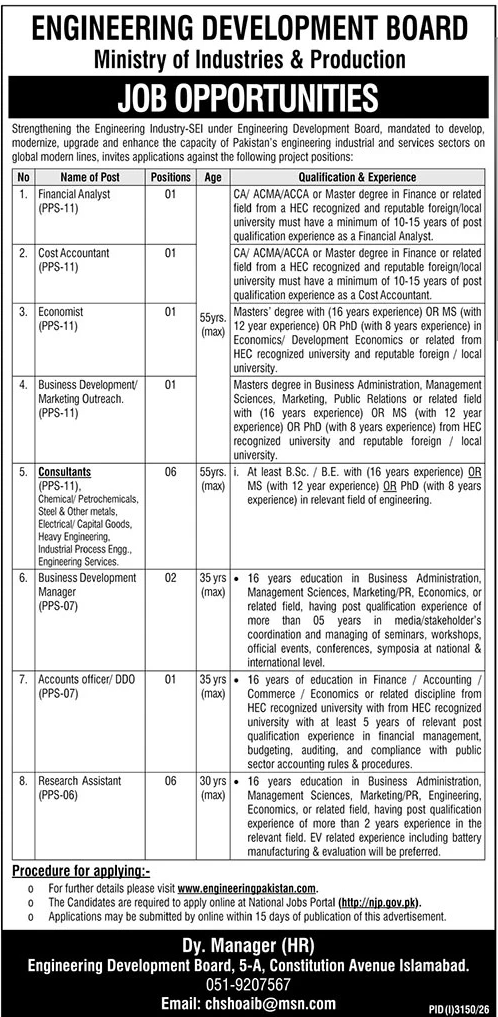
- Job Announced Financial anayst Cost Accountant Economist Business Development Officer Consultant Account Officer Business Development Manager Research Assistant
The Engineering Development Board (EDB), Ministry of Industries & Production, is inviting online applications for multiple project positions (PPS-06 to PPS-11)
- Apply for this job
- Prepare for this job
- Share this job
- Have a question about this job? Ask in the discussion area.
-
-
Project Manage
-
1 Jobs
-
Last Date
14-Jun-26
-
-
-
Manager
-
2 Jobs
-
Last Date
21-Jan-26
-
Ministry of Industries and Production Govt of Pakistan: Career Opportunities for 2026
The Ministry of Industries and Production (MoIP) is a key federal institution driving Pakistan's industrial growth and economic policy. For 2026, the Ministry is expanding its recruitment drive to attract talented professionals who can contribute to initiatives like import substitution, export diversification, and enhancing the competitiveness of the national industrial sector. This focus opens significant new job opportunities for economists, engineers, project managers, and policy experts dedicated to national development.
Prospective candidates should monitor the official Ministry website and the Federal Public Service Commission (FPSC) portal regularly for the latest announcements regarding Ministry of Industries and Production Govt of Pakistan jobs. The 2026 hiring cycle is expected to include positions across various pay scales, from entry-level roles to senior management, within the Ministry's headquarters in Islamabad and its various attached departments nationwide.
The application process for these coveted public sector careers typically involves a structured procedure. Interested individuals must submit a detailed application form, often online through the FPSC or MoIP's designated portal, along with attested copies of their educational certificates, experience letters, and a valid CNIC. It is crucial to meet the specific eligibility criteria, including age limits, required qualifications, and domicile, as mentioned in each vacancy notice for Ministry of Industries and Production Govt of Pakistan vacancies.
Following the initial application screening, shortlisted candidates are usually called for a written test to assess their technical knowledge and analytical abilities. Successful candidates in the written examination then proceed to a comprehensive interview conducted by a selection board. This interview evaluates the candidate's expertise, problem-solving skills, and overall suitability for a career in industrial policy and production management within the federal government.
A career at the MoIP offers more than just stable government employment; it provides a platform to directly influence Pakistan's economic future. Employees engage in high-impact work, from formulating national industrial policies to managing strategic public sector enterprises, ensuring professional growth and the satisfaction of contributing to tangible national development goals. These Ministry of Industries and Production Govt of Pakistan careers are ideal for those seeking meaningful work in the heart of the country's industrial planning and execution machinery.