


 Home
Home
 News
News
 Colleges




 Courses
 Admission
 Lectures
 Online Test
 Past Papers
 Date Sheets
 Results
 Study Abroad
 Jobs
Jobs
 Tutors
 More
More


 Apps
Apps





Surah Ikhlas
surah ikhlas centers around the unity and solidarity of God and that everything and everybody needs Him for their reality and their necessities. surah al ikhlas depicts God as not having any accomplices, not in His embodiment, His credits or His activities.
This surah e ikhlas was uncovered in light of the Quraysh who came to the Prophet Muhammad (s) and requested that he depict his Master.
Surah Ikhlas PDF
surah al ikhlas in english pdf explains this Surah Benefits
Recounting it is equivalent to presenting 33% of the Quran
-
Consistent recitation of this section in all states will make an individual deserving of having the chief heavenly messenger Gabriel take part in his burial service supplication
-
God will give the benefit of this World and the Great beyond to the person who discusses it
-
An individual's transgressions and that of his folks and kids will be pardoned
-
Recounting it increments food and ousts destitution
As per notable observers, the Quraysh came to the Prophet (s) in Makkah and requested that he portray his Master so they could be aware and love Him. Furthermore, that is the point at which this surah ikhlas pdf was uncovered.
-
One of the Excellencies of this Surah is that 33% of the Quran is thought of Pundits have referenced numerous clarifications for why it is so.
-
One of the clarifications given is that all Quranic lessons depend on three standards, Solidarity and Unity of God, Prophet-hood and the Great beyond and this part manages one of those standards; from the start to the end it depicts this one rule which is that of the Solidarity and Unity of God.
Surah Ikhlas ka Wazifa
Advantages of Surah Ikhlas or surah ikhlas wazifa benefits
Various hadith have been portrayed that show the ideals of Surah Ikhlas and we will specify a couple of them here:
- 33% of the Quran
The Blessed Prophet once asked the devotees: is there anybody of you who can't recount 33% of the Quran in an evening? One of the people who were available said: O Prophet of God! Who can do as such? In answer, the Prophet said: discuss (the section of) Qul Huwallahu Ahad.
Surah Al Ikhlas
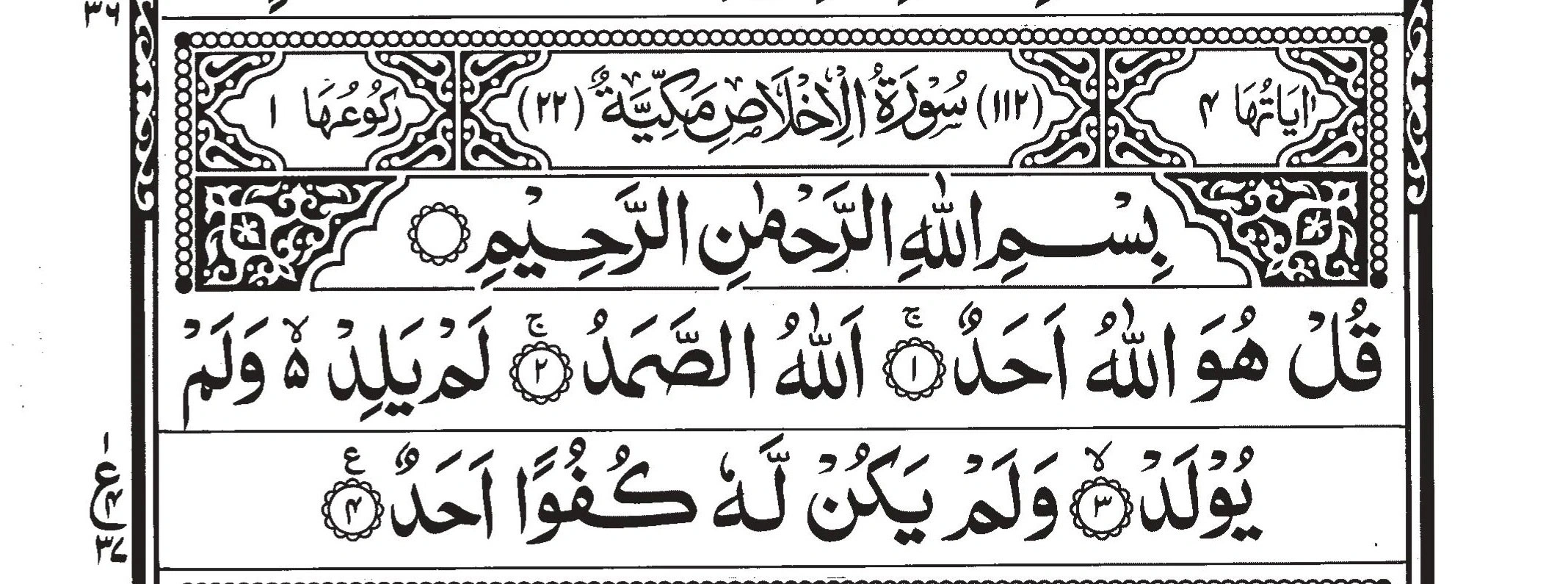
Surah Ikhlas Translation
surah ikhlas english translation explains about the Jibraeel’s Presence in One's Burial Service Petition
In hadith, we read that when the Prophet was supplicating over the assemblage of Saad canister Ma'az, he said: 70, 000 holy messengers, among whom Jibraeel was likewise present, took part in the request! I asked Gabriel which activity from his made him merit your request for him. Jibraeel answered: due to his recitation of Qul Huwallahu Ahad while sitting, standing, getting on (his ride), strolling and in his comings and goings.
Surah Ikhlas Translation Urdu Tells About Pardoning of Sins
The Prophet has additionally said that one who puts stock in God and the Great beyond shouldn't leave discussing Surah Ikhlas after each request, since God will accumulate the benefit of this world and the following for the person who recounts it and will excuse him, his folks and kids.
Surah Ikhlas in Urdu
Expansion in Occupation as discussed in surah ikhlas tarjuma in urdu
A man came to the Prophet whining of neediness and a scant job; the Prophet requested that he give good tidings when he went into the house on the off chance that there was somebody in the house, and on the off chance that there wasn't, to give Salam and recount Surah Ikhlas. The man did so and God graced him with food, to such an extent that he presented it to his neighbors.
There are likewise different portrayals in such a manner which can be tracked down in the connected references and texts.
As the part was uncovered in reply to the subject of what God's identity is, it starts with presenting one of the qualities of God: Say: He, Allah, is One.
In Arabic, the pronoun 'huwa' has been utilized and with regards to this sentence, it is a story pronoun and signifies poise and is utilized in this language structure when the speaker expects a great deal of significance and accentuation on the sentence that follows.
Surah Ikhlas in English
The word Allah is the name well defined for God in the Arabic language.
surah ikhlas in english explain about the contrast among Ahad and Wahid
In the following stanza of Surah Ikhlas, the Arabic word 'ahad' has been utilized for God and as referenced already this Arabic word has two potential purposes and significance. Another comparative word is 'Wahid' which likewise comes from a similar root word.
In any case, ahad is utilized for a person or thing that isn't dependent upon variety and majority, be it really or intellectually, and essentially isn't important for numbers by any means. Conversely, Wahid implies a one from which follows a two, three, and so on, either really, or in the creative mind or by scholarly speculation, and with the expansion of two, three, four, and so forth, becomes plural and various.
Surah Ikhlas Tarjuma
Another of the traits of God is referenced in the second stanza of this section and that is Samad.
Samad alludes to an expert or individual of qualification to whom all go to get their necessities satisfied. Also, because the word has been utilized from an outright perspective in the stanza, this is the significance it gives, for example, that God is an expert to whom all the existence of the world turns in the entirety of their requirements.
Samad in Portrayals explained in surah ikhlas tarjuma
It has been portrayed that Samad has no accomplices, it is easy for him to protect anything and nothing is stowed away from him.
In another portrayal it has been expressed that God Himself has made sense of Samad in the two stanzas that follow this refrain: He sires not, nor is He generated; Nor has He any equivalent.
The Last Two Sections of Surah Ikhlas as Explained in Surah Ikhlas ka Tarjuma
The last two stanzas disprove the accompanying from God:
-
That He conceives an offspring, i.e., that His embodiment is isolated into parts and a piece of Him isolates from Him
-
That He is conceived or gotten from something in any structure or importance
-
That He has an equivalent generally or activities, i.e., that somebody like God makes and deals with the universe.
These three nullifications branch off from Him being Samad; and can be cleared up in connection with it as follows:
-
Something that conceives an offspring should have parts and can't be envisioned without a piece. Anything that comprises parts needs its parts; notwithstanding, every needful eventuate to God in his requirements and one can't envision needfulness in such a being.
-
When something is gotten or brought into the world from something different, it needs what it came from. Notwithstanding, God is Samad and such a being can't be poor.
-
Whether an equivalent is assumed for God fundamentally or activities, in the very activity that it should be equivalent to God, it should be autonomous of God and unnecessary of Him. Be that as it may, God is Samad, for example, the one to whom all got in their need, while He wants nobody and in this manner, even the alleged equivalent in real life, needs God and is accordingly not an equivalent to Him.