




 Jobs Home
 Cities
 Govt Depts
 Comapnies
 Industries
 Professions




New Jobs in Rawalpindi Medical University
- Job posted on
21-Jun-2026
- Number of vacancies
1
-
Last date to apply
10-Jul-2026
- Job location
Rawalpindi
- Job type
Temporary/Contract
- Job status
Full Time
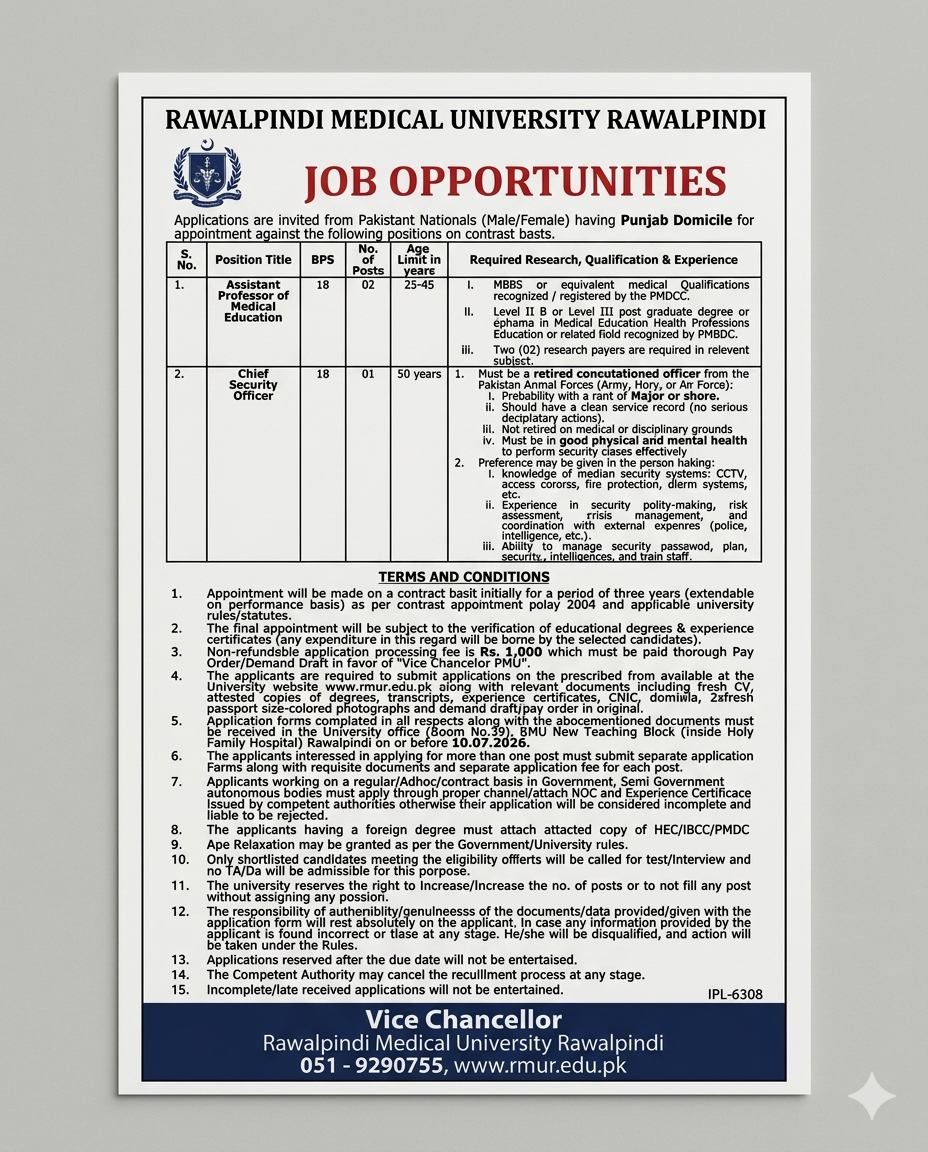
- Job Announced Assistant Professor Chief Security Officer
official public sector employment advertisement issued by Rawalpindi Medical University (RMU)
- Apply for this job
- Prepare for this job
- Share this job
- Have a question about this job? Ask in the discussion area.
-
15 Mar 26 Rawalpindi Medical University
-
Junior Computer Operator
-
5 Jobs
-
Last Date
28-Mar-26
-
-
21 Jan 26 Rawalpindi Medical University
-
Registrar
-
1 Jobs
-
Last Date
08-Feb-26
-
Rawalpindi Medical University: Career Opportunities for 2026
Rawalpindi Medical University (RMU), established in 2017, represents the evolved and expanded vision of the historic Rawalpindi Medical College. As a full-fledged university, it now oversees not only its constituent colleges but also a vast network of affiliated teaching hospitals, including the renowned Benazir Bhutto Hospital, Holy Family Hospital, and District Headquarters Hospital. This elevation has significantly broadened its mandate in medical education, cutting-edge research, and specialized healthcare delivery. For 2026, the university's strategic plan focuses on expanding its research output in fields like oncology, cardiology, and public health, which will directly translate into new, specialized career opportunities. The administration is actively working on projects that require integrating advanced digital health technologies and expanding community outreach programs, setting the stage for a diverse hiring cycle aimed at both clinical experts and innovative administrative talent.
The university's 2026 career development roadmap is intrinsically linked to the operational needs of its upgraded facilities and new academic programs. A key initiative is the planned enhancement of the RMU Simulation and Skills Center, which will necessitate hiring experienced simulation educators and biomedical engineers. Furthermore, with the anticipated launch of new postgraduate programs and research chairs, the university is preparing to recruit senior faculty and principal investigators who can lead multidisciplinary teams. These positions are not merely jobs but are considered pivotal roles in shaping the future of medical science in the region. Candidates looking for meaningful employment in 2026 should monitor the university's official channels closely, as these strategic expansions will be rolled out in phases, creating a steady stream of vacancies throughout the fiscal year.
Anticipated Job Openings in 2026
Based on the university's five-year development plan and current departmental reviews, several key areas are projected to have substantial hiring needs in the coming year. The Department of Medical Education is expected to advertise for instructional designers and medical education specialists to revamp the integrated curriculum. Concurrently, the expansion of telemedicine services across all affiliated hospitals will drive demand for IT professionals with expertise in healthcare systems, network security analysts, and remote patient monitoring coordinators. In the clinical realm, the newly established Center for Molecular Medicine is slated to recruit molecular biologists, genetic counselors, and lab managers to support its diagnostic and research functions. These roles represent a shift towards more specialized, technology-driven positions that reflect modern healthcare demands.
Beyond specialized fields, consistent annual vacancies are anticipated for Medical Officers across various hospital departments, particularly in emergency medicine, pediatrics, and internal medicine, due to routine rotations and service expansion. The nursing directorate has outlined a need for critical care nurses and nurse educators to maintain international patient care standards and train the next cohort. Administrative openings will likely focus on strengthening the university's grant management office, requiring finance officers and research proposal writers adept at handling national and international funding bodies. For all these roles, the application process will remain rigorous, emphasizing not only academic credentials but also a demonstrable commitment to RMU's mission of serving a large and diverse patient population while advancing medical knowledge.
Share your comments & questions here
No comments yet. Be the first to comment!