




 Jobs Home
 Cities
 Govt Depts
 Comapnies
 Industries
 Professions




New Jobs in Department of Archaeology Govt of Punjab
- Job posted on
23-Jul-2026
- Number of vacancies
1
-
Last date to apply
13-Aug-2026
- Job location
Lahore
- Job type
Temporary/Contract
- Job status
Full Time
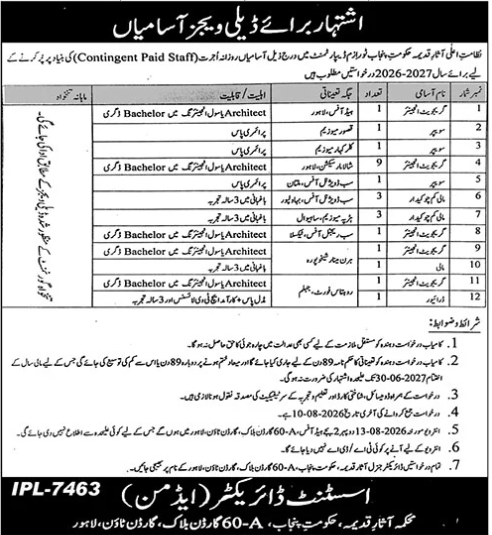
- Job Announced Gradaute Engineer Sweeper Chowkidar Driver
- Apply for this job
- Prepare for this job
- Share this job
- Have a question about this job? Ask in the discussion area.
-
02 Jul 26 Department of Archaeology Govt of Punjab
-
Director
-
1 Jobs
-
Last Date
16-Jul-26
-
-
12 May 26 Department of Archaeology Govt of Punjab
-
Chief Conservationist
-
1 Jobs
-
Last Date
22-May-26
-
-
06 May 26 Department of Archaeology Govt of Punjab
-
Procurement
-
2 Jobs
-
Last Date
18-May-26
-
-
23 Jan 26 Department of Archaeology Govt of Punjab
-
Meseum Management and Cersation Specailst
-
1 Jobs
-
Last Date
23-Feb-26
-
Department of Archaeology Govt of Punjab: Career Opportunities for 2026
The Department of Archaeology, Government of Punjab, is actively preparing for a significant expansion of its workforce in the 2026 fiscal year. This strategic hiring initiative is driven by the department's commitment to several new, large-scale projects, including the comprehensive conservation of the Lahore Fort's Shah Burj quadrant and the development of a digital heritage inventory for the entire province. These Department of Archaeology Govt of Punjab jobs are not merely positions; they represent a direct opportunity to contribute to safeguarding Pakistan's most iconic historical assets. The 2026 recruitment drive aims to bridge critical skill gaps in areas like advanced archaeological science, digital archiving, and monument engineering, ensuring the department is equipped to meet modern conservation challenges.
Prospective candidates should monitor the official Punjab government job portal and the department's own website regularly for the official announcement of vacancies. The hiring process for these government of Punjab archaeology careers is expected to follow a structured timeline, typically beginning with advertisement in major newspapers like Jang and Dawn, followed by online application submission, written testing for technical posts, and culminating in interviews conducted by the Punjab Public Service Commission or departmental selection boards. Early preparation of documents, including academic transcripts, domicile certificates, and any relevant field experience portfolios, is highly recommended for those seeking employment in this prestigious sector.
Archaeology Department Punjab Job Application Process
Securing a position within the Department of Archaeology requires navigating a formal and competitive government hiring procedure. All Department of Archaeology Govt of Punjab vacancies are advertised through authorized channels only, primarily the Punjab Public Service Commission (PPSC) for higher-grade posts (BS-16 and above) and the department's own notifications for contract or lower-scale positions. It is crucial for applicants to rely solely on these official announcements to avoid misinformation. The application is exclusively online via the PPSC website or the prescribed government portal mentioned in the advertisement. Each vacancy notice provides exhaustive details regarding eligibility criteria, including required qualifications, age limits, domicile requirements, and the specific experience needed for roles such as Assistant Director, Conservation Assistant, or Site Inspector.
The selection process is multi-tiered and designed to assess both theoretical knowledge and practical aptitude. For technical roles, a written examination often covers subjects like history of the subcontinent, archaeological methods, conservation principles, and general knowledge about Punjab's heritage sites. Successful candidates from the written test are then shortlisted for a rigorous interview. The interview panel typically includes senior archaeologists and government officials who evaluate a candidate's passion for heritage, problem-solving skills in hypothetical conservation scenarios, and understanding of the Antiquities Act. The entire process, from advertisement to final merit list, can span several months, requiring patience and thorough preparation from applicants.
Qualifications and Skills for Archaeology Careers in Punjab
The Department of Archaeology seeks a diverse range of professionals, and the required qualifications vary significantly by role. For core archaeological research and leadership positions, such as Deputy Director or Archaeologist, a Master's degree or PhD in Archaeology, Anthropology, History, or Museology from a recognized university is typically the minimum requirement, often coupled with published research or field excavation experience. For conservation and technical roles, degrees in Architecture, Civil Engineering, Chemical Sciences, or Materials Conservation are highly valued, with a focus on historical preservation techniques. Even for non-technical vacancies in administration, finance, or public relations, a bachelor's degree alongside a genuine interest in cultural heritage can be a strong asset.
Beyond formal degrees, certain practical skills are invaluable for a successful career in this field. Proficiency in digital tools is increasingly important; skills in GIS mapping, 3D modeling software for site documentation, and database management for artifact cataloging are major advantages. Physical stamina for fieldwork, a meticulous eye for detail during artifact analysis, and strong report-writing abilities are fundamental. Furthermore, excellent communication skills are essential for interacting with local communities near archaeological sites, guiding research teams, and developing public outreach materials.