




 Jobs Home
 Cities
 Govt Depts
 Comapnies
 Industries
 Professions




New Jobs in Office of The Deputy Commissioner
- Job posted on
01-Oct-2026
- Number of vacancies
1
-
Last date to apply
28-Oct-2026
- Job location
Dadu
- Job type
Temporary/Contract
- Job status
Full Time
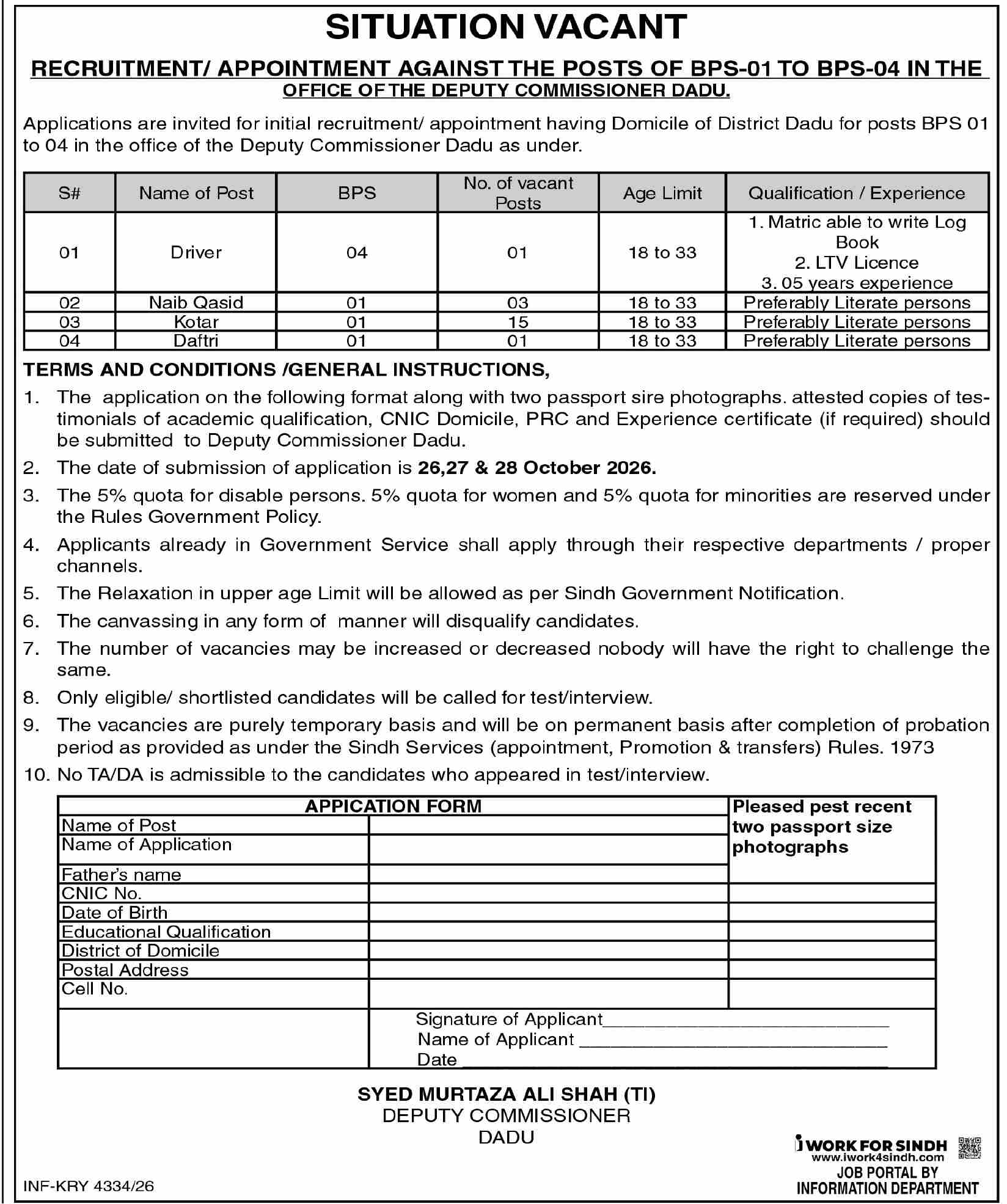
- Job Announced Driver Naib Qasid Kotar Daftri
The Office of the Deputy Commissioner Dadu invites applications from District Dadu domicile holders for recruitment against BPS-01 to BPS-04 posts (Driver, Naib Qasid, Kotar,
- Apply for this job
- Prepare for this job
- Share this job
- Have a question about this job? Ask in the discussion area.
-
22 Sep 26 Office of The Deputy Commissioner
-
Kotar
-
2 Jobs
-
Last Date
29-Sep-26
-
-
17 Sep 26 Office of The Deputy Commissioner
-
Kotar
-
2 Jobs
-
Last Date
24-Sep-26
-
-
05 Jul 26 Office of The Deputy Commissioner
-
Driver
-
3 Jobs
-
Last Date
20-Jul-26
-
-
23 Feb 26 Office of The Deputy Commissioner
-
Assistant
-
1 Jobs
-
Last Date
10-Mar-26
-
-
19 Feb 26 Office of The Deputy Commissioner
-
Driver
-
1 Jobs
-
Last Date
05-Mar-26
-
Office of the Deputy Commissioner: A Gateway to Public Service Careers
The Office of the Deputy Commissioner represents a cornerstone of district-level administration and governance. For individuals seeking a meaningful career in public service, positions within this office offer a unique opportunity to contribute directly to civic management, community development, and the implementation of government policies at the grassroots level. These roles are critical for ensuring the smooth operation of administrative functions, public welfare initiatives, and regulatory oversight within a district.
Core Functions and Departmental Structure
Operating under the broader framework of the district administration, the Office of the Deputy Commissioner is typically segmented into various wings, each handling specialized portfolios. Understanding this structure is key to identifying where your skills and interests might align.
- Revenue and Estate Management:This wing oversees land records, property taxation, revenue collection, and the settlement of land-related disputes. Careers here demand precision, a grasp of property laws, and integrity in handling public records.
- Magisterial and Judicial Functions:The Deputy Commissioner often holds magisterial powers. Supporting staff in this area work on maintaining law and order, executing court orders, and managing protocols related to executive magistracy.
- Disaster Management and Crisis Response:This crucial department plans for and coordinates responses to natural disasters, public emergencies, and crises. Roles require resilience, quick decision-making, and excellent logistical coordination skills.
- Development and Project Implementation:This wing focuses on monitoring and facilitating government-sponsored development projects, from infrastructure to social welfare schemes, ensuring they meet targets and benefit the intended communities.
- Public Grievance Redressal:A vital interface with the citizenry, this section addresses public complaints, facilitates access to services, and works to improve transparency and accountability in local governance.
Career Paths and Employment Opportunities
Employment within the Office of the Deputy Commissioner is not monolithic; it encompasses a spectrum of positions catering to diverse educational backgrounds and skill sets.
- Civil Service Officers (DM/DC):The Deputy Commissioner themselves is typically a senior officer from the prestigious civil service (e.g., the District Management Group). Entry is through highly competitive national-level examinations.
- Assistant Commissioners & Tehsildars:These are mid-level management officers who handle sub-divisional and tehsil-level administration. Recruitment is often through provincial public service commissions.
- Administrative and Clerical Staff:A large workforce of office assistants, data entry operators, clerks, and accountants ensures daily operations run smoothly. These positions are usually filled through district-level recruitment drives.
- Technical and Specialist Roles:Engineers, IT professionals, statisticians, and disaster management experts are hired to provide specialized knowledge for specific projects and departmental needs.
- Field Staff (Patwaris, Kanungos):At the village level, field staff like Patwaris are essential for maintaining land revenue records and acting as a liaison between the government and rural populations.
Essential Skills for Success
To thrive in this environment, certain competencies are indispensable:
Administrative Acumen:Proficiency in office management, record-keeping, and procedural adherence is fundamental.
Communication and Public Interaction:The ability to communicate clearly with diverse stakeholders—from senior officials to the general public—is critical.
Integrity and Ethical Fortitude:Handling sensitive information, public funds, and legal matters requires unwavering honesty and ethical conduct.
Problem-Solving Orientation:Daily challenges range from logistical hiccups to complex public disputes; a solution-focused mindset is key.
Adaptability and Resilience:The dynamic nature of public administration, especially during crises, demands flexibility and mental toughness.
Navigating the Recruitment Process
Staying informed about job openings is the first step. Vacancies are advertised through official gazettes, the websites of relevant public service commissions, and dedicated government job portals. The application process is formal and typically involves:
- Submission of a detailed application form.
- Scrutiny of academic and professional credentials.
- A written examination testing general knowledge, relevant subjects, and analytical abilities.
- An interview assessing personality, communication skills, and suitability for public service.
- For technical posts, skill-based tests or presentations may be required.
Pro Tip:Meticulously prepare all required documents—degrees, experience certificates, domicile, and CNIC—well in advance to avoid last-minute hurdles.
Why Pursue a Career Here?
Beyond job security, a career in the Office of the Deputy Commissioner offers intangible rewards. You become an integral part of the governance machinery, directly impacting community welfare, facilitating development, and upholding the rule of law. It is a career built on service, offering a profound sense of purpose and the chance to witness the tangible results of your work in the community you serve.
Last updated: 2026