




 Jobs Home
 Cities
 Govt Depts
 Comapnies
 Industries
 Professions




New Jobs in Elementary and Secondary Education Department
- Job posted on
06-Jul-2026
- Number of vacancies
1
-
Last date to apply
21-Jul-2026
- Job location
Thatta
- Job type
Temporary/Contract
- Job status
Full Time
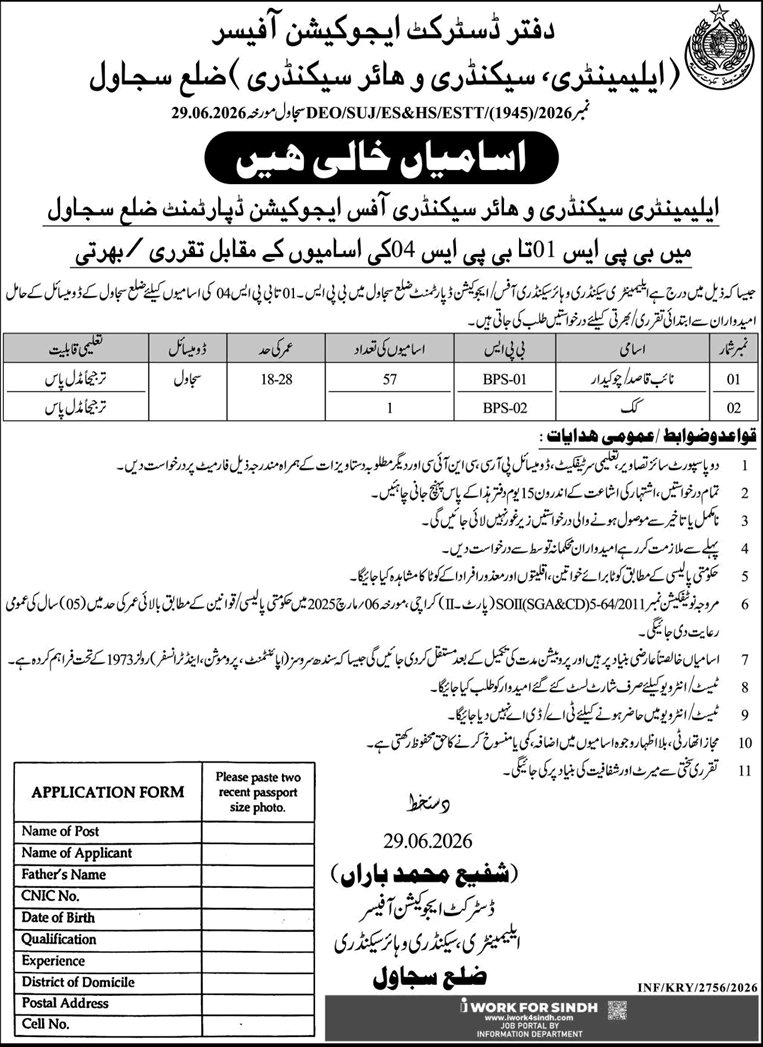
- Job Announced Naib Qasid Cook
The District Education Office, Sujawal invites domicile holders of Sujawal to apply within 15 days for two temporary BPS-01 and BPS-02 posts (Naib Qasid & Chowkidar) on merit
- Apply for this job
- Prepare for this job
- Share this job
- Have a question about this job? Ask in the discussion area.
-
-
Chowkidar
-
38 Jobs
-
Last Date
05-Mar-26
-
-
-
Account Clerk
-
1 Jobs
-
Last Date
28-Feb-26
-
Elementary and Secondary Education Department: Career Opportunities for 2026
The Elementary and Secondary Education Department is the cornerstone of our state's public education system, directly responsible for shaping academic standards, distributing critical funding, and ensuring equitable learning opportunities for over 750,000 students across more than 1,200 schools. Our mission extends beyond administration; we are a dynamic force for innovation in curriculum development, teacher support programs, and educational technology integration. As we look toward the 2025-2026 academic year and beyond, the department is embarking on a strategic hiring initiative to address evolving educational needs, from early literacy interventions to STEM pathway expansion and student mental health support. The employment opportunities we create are central to executing our five-year strategic plan, "Future Ready Learners," which mandates a significant investment in human capital.
Our 2026 career plans are specifically designed to build a resilient and forward-thinking workforce. We anticipate announcing over 200 new Elementary and Secondary Education Department jobs in the coming fiscal year, focusing on both instructional and operational excellence. These vacancies will span a diverse range of specializations, including but not limited to, curriculum specialists for the new state science standards, data analysts to monitor district performance metrics, federal program coordinators to manage Title I and IDEA funds, and school nutrition program auditors. This hiring surge is a direct response to legislative funding increases and a commitment to reducing administrative burdens on local school districts, allowing them to focus more resources on classroom instruction and student services.
Current Job Openings and Application Process
Prospective candidates can explore all current Elementary and Secondary Education Department careers through our dedicated online portal, the State Education Career Hub. The portal is updated bi-weekly with new postings for roles such as Education Program Consultant, School Finance Analyst, and Instructional Technology Coach. Each listing provides a comprehensive description of responsibilities, required qualifications (which often include state-specific certification or a master's degree in a relevant field), salary grade, and the specific bureau or office, such as the Office of Student Assessment or the Division of Educator Effectiveness, where the position is housed. We strongly encourage applicants to create a profile on the portal to receive automated alerts for Elementary and Secondary Education Department employment opportunities that match their saved search criteria, ensuring they never miss a relevant vacancy.
The application process for these government jobs is thorough and designed to ensure both fairness and a high-quality hire. After submitting an online application and required documents (e.g., resume, cover letter, transcripts), candidates may be invited to a preliminary screening interview conducted via video conference. Successful candidates then typically proceed to a panel interview with department directors and subject-matter experts, which may include a practical component such as analyzing a sample dataset or critiquing a curriculum framework. The entire process, from application closing date to final offer, aims to be completed within six to eight weeks. We prioritize transparent communication throughout, with status updates available via the applicant's portal dashboard.
Benefits of a Career with the Department
Choosing a career with the Elementary and Secondary Education Department means securing a position with a robust benefits package and long-term stability. Full-time employees are eligible for state health insurance plans with low premium costs, a defined-benefit pension plan through the state retirement system, and generous paid time off accruing to over 30 days per year including holidays, vacation, and sick leave. Furthermore, we are deeply committed to the professional growth of our staff. The department offers substantial tuition reimbursement for advanced degrees in education policy or public administration and hosts monthly professional development institutes on topics like grant writing and educational equity auditing. These benefits underscore our commitment to retaining top talent in the competitive field of public education.
Beyond the tangible benefits, the intrinsic reward of this work is profound. Employees in Elementary and Secondary Education Department jobs have a direct, statewide impact on educational quality and equity. The policy you help draft could improve reading outcomes for third graders in rural communities. The grant you manage could fund new robotics labs in underserved urban high schools.