




 Home
Home
 National
 International
 Merit list
 Date Sheet
 Result
 Admission
 Study Abroad
.gif)


HEC Cracks Down on Degree Scams: Unveils New Fee Structure and Blockchain e-Attestation
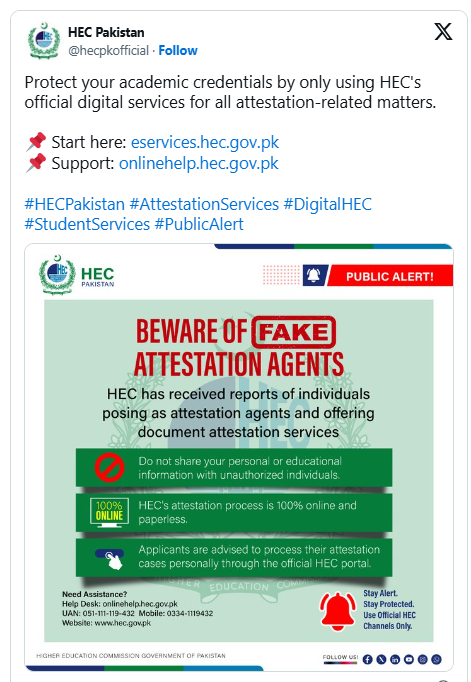
The Higher Education Commission (HEC) has officially issued an urgent public advisory warning students, graduates, and job seekers against highly organized, fraudulent attestation services operating across the country. Unauthorized individuals and deceptive digital groups have increasingly posed as official agents, promising expedited degree verification and validation services in exchange for hefty sums.
Concurrently, the Higher Education Commission (HEC) has made waves by announcing a massive increase in degree attestation fee structures, alongside a proactive incentive system designed to reward universities for implementing faster online degree checks.
As academic credentials become highly competitive assets in the global job market, the reliance on manual verification has historically exposed applicants to bureaucratic delays and criminal exploitation (Ayub Khan et al., 2021). This comprehensive news report breaks down the mechanics of the recent scam, structural changes to the fee landscape, and how applicants can safely use the HEC e-services portal to authenticate their education without third-party interference.
Understanding the Threat: How Fraudulent Attestation Agents Operate
According to explicit reports received by the commission’s IT security desk, third-party scammers are exploiting the anxieties of fresh graduates and overseas job applicants who require rapid document authentication. These unauthorized attestation agents routinely run deceptive social media pages, classified ads, and physical help-desks near educational hubs, falsely claiming official affiliation or inside tracks within the Higher Education Commission (HEC).
The operational flow of these scams usually targets the structural anxiety of students facing rigid deadlines from employment agencies or foreign embassies:
-
Identity & Data Theft: Fraudulent agents demand original degrees, transcripts, Computerized National Identity Cards (CNICs), and personal passwords under the guise of processing the application.
-
Document Forgery: Rather than submitting the paperwork to official channels, these agents utilize high-tech forging tools to stamp fake security features on original academic documents. This risks blacklisting the applicant for life under legal anti-forgery statutes.
-
Financial Extortion: Victims are charged thousands of rupees above standard commission rates, only to receive compromised documents or experience sudden ghosting by the fake service provider.
In its public advisory, the commission emphasized that the entire HEC framework has evolved to prevent these exact issues. The HEC degree attestation process is now completely automated, secure, and paperless on the front end, leaving no legitimate room or operational path for third-party intermediaries. Sharing sensitive credentials with unauthorized entities is a direct violation of safety protocols and strongly exposes citizens to identity misuse.
HEC Announces Massive Increase in Degree Attestation Fee
Compounding the urgency for student vigilance is a significant administrative shift: the HEC announces massive increase in degree attestation fee protocols. The updated fee architecture affects both local document processing and specialized urgent walk-in services.
While the administrative increase is intended to support infrastructural scaling, digital database maintenance, and faster processing systems, it means applicants can no longer afford to risk their funds on illegitimate agents.
The new pricing model requires all payments to be verified directly through integrated banking channels linked exclusively to an applicant's unique profile ID. No cash payments are processed by individual officers, and no external agent has the authorization to collect fees on behalf of the organization.
HEC to Reward Universities for Faster Online Degree Checks
To offset complaints regarding verification backlogs and to streamline the validation ecosystem, the commission has introduced a performance-based reward matrix. Under the initiative HEC to reward universities for faster online degree checks, higher education institutes (HEIs) across Pakistan are being systematically incentivized to digitize their historic student archives.
Historically, when a graduate applies for verification through the HEC e-services portal, the commission must initiate a backend cross-match with the respective degree-issuing university to guarantee systemic integrity (Ayub Khan et al., 2021). If a university lacks a real-time digital archive, this cross-verification becomes a bottleneck, forcing manual, paper-based authentication that slows down the pipeline.
By rewarding universities that clear verification queues within targeted hourly windows, the commission aims to slash average processing turnarounds from several weeks down to a matter of days. This shift directly neutralizes the primary selling point used by fraudulent attestation services—the false promise of bypassing system queues.
The Path Forward: Protecting Academic Integrity
As the commission tightens security protocols, the public must act as the primary line of defense. Academic credentials represent years of financial investment and hard work; exposing them to unauthorized attestation agents poses a severe threat to your professional future.
The commission urges all citizens to remain highly vigilant, report suspicious operators offering offline or backdoor validation routes, and strictly adhere to the paperless digital framework. By leveraging the automated power of the HEC e-services portal, applicants can seamlessly navigate the newly updated fee structures, benefit from accelerated institutional turnarounds, and confidently safeguard their educational legacies from malicious exploitation.










Share your comments & questions here
No comments yet. Be the first to comment!