









The admission process for a postgraduate degree in Microbiology begins after the completion of the bachelor’s degree of an individual. The admission process consists of various requirements that comprises the candidate’s information, the past educational records, and the information of a parent or guardian. The admission process can be accessed through online websites of various universities as well. The candidates are required to submit their previous academic documents along with the admission fee. After the admission process concludes the institutes display the lists of successful candidates.
Admissions in different Institutes for MS Microbiology
| Date Posted | Last Date | Institute Name | Program Name | Admission Image |
|---|---|---|---|---|
| 09-Oct-2026 | 20-Oct-2026 |
 Kohat University Of Science & Technology, Khyber
|
|
|
| 27-Sep-2026 | N/A |
 Superior University
|
|

|
| 20-Sep-2026 | 24-Sep-2026 |
 University of Central Punjab (UCP) Lahore
|
|

|
| 15-Sep-2026 | 21-Sep-2026 |
 Kohsar University Murree
|
|

|
| 01-Sep-2026 | 30-Sep-2026 |
 Jinnah University For Women Karachi
|
|

|
| 20-Aug-2026 | 21-Sep-2026 |
 Shaheed Benazir Bhutto Women University (Sbbwu) Peshawar
|
|

|
| 15-Jan-2026 | 26-Jan-2026 |
 Balochistan University Of Information Technology & Management Sciences (BUITEMS) Quetta
|
|
|
| 10-Oct-2025 | 24-Oct-2025 |
 National University of Medical Sciences NUMS Rawalpindi
|
|
|
| 04-Nov-2024 | 21-Jan-1800 |
 COMSATS Institute of Information Technology
|
|
|
| 01-Nov-2024 | 15-Nov-2024 |
 Federal Urdu University Of Arts, Science And Technology (Fuuast) Karachi
|
|
|
-
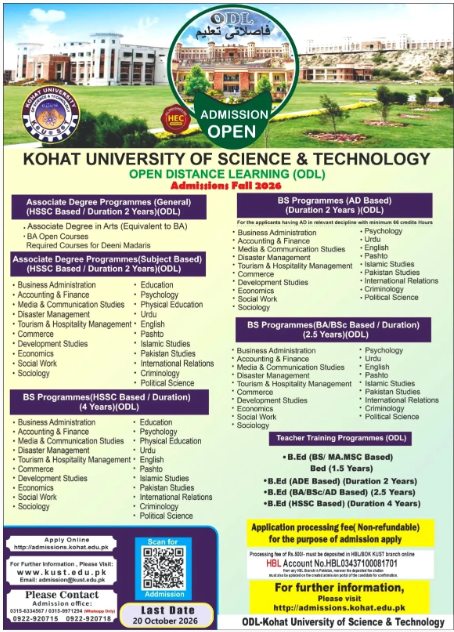
Kohat University Of Science & Technology, Khyber Date Posted: 09-Oct-2026 Last Date: 20-Oct-2026 Program: MS Microbiology
-
-
University of Central Punjab (UCP) Lahore Date Posted: 20-Sep-2026 Last Date: 24-Sep-2026 Program: Ms Microbiology
-
-
Jinnah University For Women Karachi Date Posted: 01-Sep-2026 Last Date: 30-Sep-2026 Program: MS Microbiology
-
Shaheed Benazir Bhutto Women University (Sbbwu) Peshawar Date Posted: 20-Aug-2026 Last Date: 21-Sep-2026 Program: MS Microbiology
-
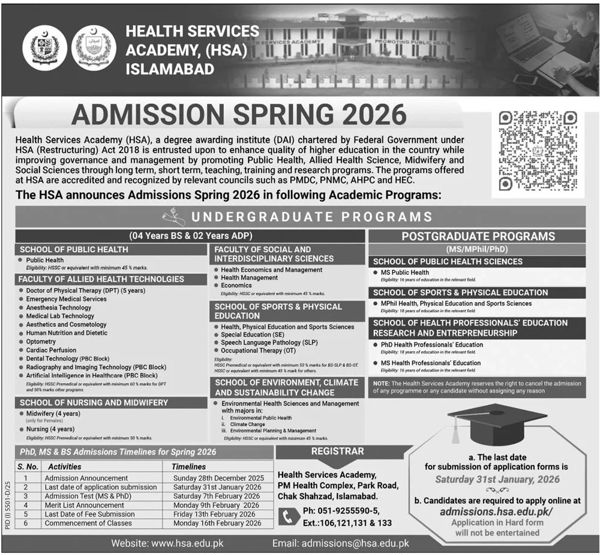
Balochistan University Of Information Technology & Management Sciences (BUITEMS) Quetta Date Posted: 15-Jan-2026 Last Date: 26-Jan-2026 Program: MS Microbiology
-
National University of Medical Sciences NUMS Rawalpindi Date Posted: 10-Oct-2025 Last Date: 24-Oct-2025 Program: MS Microbiology and Immunology
-
COMSATS Institute of Information Technology Date Posted: 04-Nov-2024 Last Date: 21-Jan-1800 Program: MS Microbiology and Immunology
-
Federal Urdu University Of Arts, Science And Technology (Fuuast) Karachi Date Posted: 01-Nov-2024 Last Date: 15-Nov-2024 Program: MS Microbiology
Cities with Admissions in MS Microbiology
Related Disciplines of MS Microbiology




Eligibility Criteria
The entry requirements include a bachelor’s degree in microbiology or an equivalent relevant field. The candidates are required to enroll for the entry test of the particular university or other assessment tests. The successful candidates are then called for an interview (subject to vary at different institutes).
Admission Intake
The two types of intakes include a spring semester and a fall semester. The fall semester begins in September while the spring semester commences from March or April depending on various universities.
Entry Test
Every university has a different requirement for its admission criteria. The different types of entry level tests include GRE, GAT, or the particular university test.
GRE- Graduate Record Examinations:
GRE is a renowned international graduate assessment test. The applicants applying for a master’s degree apply for this test. It is also considered for some universities abroad.
GAT- Graduate Assessment Test:
GAT is an exam held through NTS for the students who seek admissions for MS, M.Phil, and Ph.D. programs. The validity of a GAT test remains for 2 years after the test date. The test is divided into various sections according to the discipline. The questions of the test are divided into various portions. It includes a research-based portion, field related, and english vocabulary based.
University Test:
The candidates who have not attempted any other graduate assessment tests are required to appear for the university test at the time of admissions. The university test is held under the supervision of the particular department. The dates and center for the test is declared by the respective university on their official website.
Merit Lists
The merit lists are compiled through a specific percentage of every past academic record. This includes the score of matriculation or equivalent, intermediate or equivalent, the undergraduate degree, and the entry tests. The candidates who are successful to gain the required aggregate make it to the merit lists. The merit lists may include more than one list due to the increased seats of the department.
Fee Structure
The fee structure is different in every university. The private institutes have a relatively higher fee structure than the public institutes which is divided in a quarterly manner at most universities. The semester fee of the University of Punjab is approximately 19,925/- whereas 68,000/- for a private institute (NUMS) per semester.
Institutions:
The following institutes are offering an MS degree in Microbiology are:
- University of Central Punjab
- COMWAVE Institute Approved Education Center of SARHAD University
- University of the Punjab
- Jinnah University for Women
- University of Karachi
- National University of Medical Sciences
Public Sector:
Some Public Sector Universities that offer an MS in Microbiology are:
University of the Punjab
The Institute of Microbiology and Molecular Genetics at Punjab University offers an MS degree in Microbiology and Molecular Genetics. The 2-year postgraduate degree is designed to focus on research-based work in the field of microbiology. The eligibility criteria consist of a BS degree in Microbiology or a relevant field.
National University of Medical Sciences
To produce capable and high-quality researchers various postgraduate degrees are designed. The National University of Medical Sciences offers an MS in Microbiology and Immunology for students who have completed their bachelor’s degree with a minimum of 50% marks. The other requirements include a minimum score of 50% on a graduate assessment test and a mandatory NUMS interview. The admissions are solely granted on a merit basis. The merit is calculated according to the weightage of previous academic records (25%), graduate assessment test (50%), and interviews (25%).
University of Karachi
The University of Karachi is a public sector research institute offering a range of MS/MPhil programs. The MS Microbiology is a research-based study to understand various concepts and advanced studies in the field. The eligibility criteria are based on merit. Students are required to submit their documents during the admission process.
Private Sector:
Some Private sector Universities that offer an MS in Microbiology are:
COMWAVE Institute Approved Education Center of SARHAD University
The students who have completed their bachelor’s degree in Microbiology or relevant course with a minimum of 45% marks are eligible to apply for an MS degree in Microbiology. It is a research-based program that will enable students to have a deep insight into microbiology.
University of Central Punjab
The admission requirements for the postgraduate degree in Microbiology at UCP is at-least 2.0 CGPA or 50% marks in the bachelor’s degree. The graduates are required to complete 30 credit hours to earn an MS degree.
Jinnah University for Women
MS Microbiology has been introduced to gather the knowledge of research and development in the field of microbiology. The students learn advanced in the field and understand to practice them in their research projects. The eligibility criteria are a bachelor’s degree in microbiology or equivalent.
Frequently Asked Questions:
Q: When do MS Microbiology admissions open for 2026 in Pakistan?
A: Admissions typically open twice a year: Fall semester (July-September 2026) and Spring semester (December-February 2026).
Q: What is the eligibility criteria for MS Microbiology admission in 2026?
A: Candidates need a BS or BSc (Hons) in Microbiology, Molecular Biology, or related field with at least 2.5 CGPA (out of 4) or 60% marks.
Q: Is GAT General required for MS Microbiology admissions?
A: Yes, most HEC-recognized universities require GAT General with at least 50-60% score, though some universities conduct their own entry test.
Q: Which universities in Pakistan offer MS Microbiology?
A: Top universities include University of the Punjab (Lahore), University of Karachi, Quaid-i-Azam University (Islamabad), University of Agriculture Faisalabad, and COMSATS.
Q: What documents are required for MS Microbiology admission application?
A: Required documents include bachelor's degree transcript and certificate, CNIC/B-Form, domicile, passport-size photos, GAT score, and letters of recommendation.