




 Jobs Home
 Cities
 Govt Depts
 Comapnies
 Industries
 Professions




New Jobs in Rawalpindi Institute of Cardiology (RIC)
- Job posted on
12-Jun-2026
- Number of vacancies
1
-
Last date to apply
07-Sep-2026
- Job location
Rawalpindi
- Job type
Permanent
- Job status
Full Time
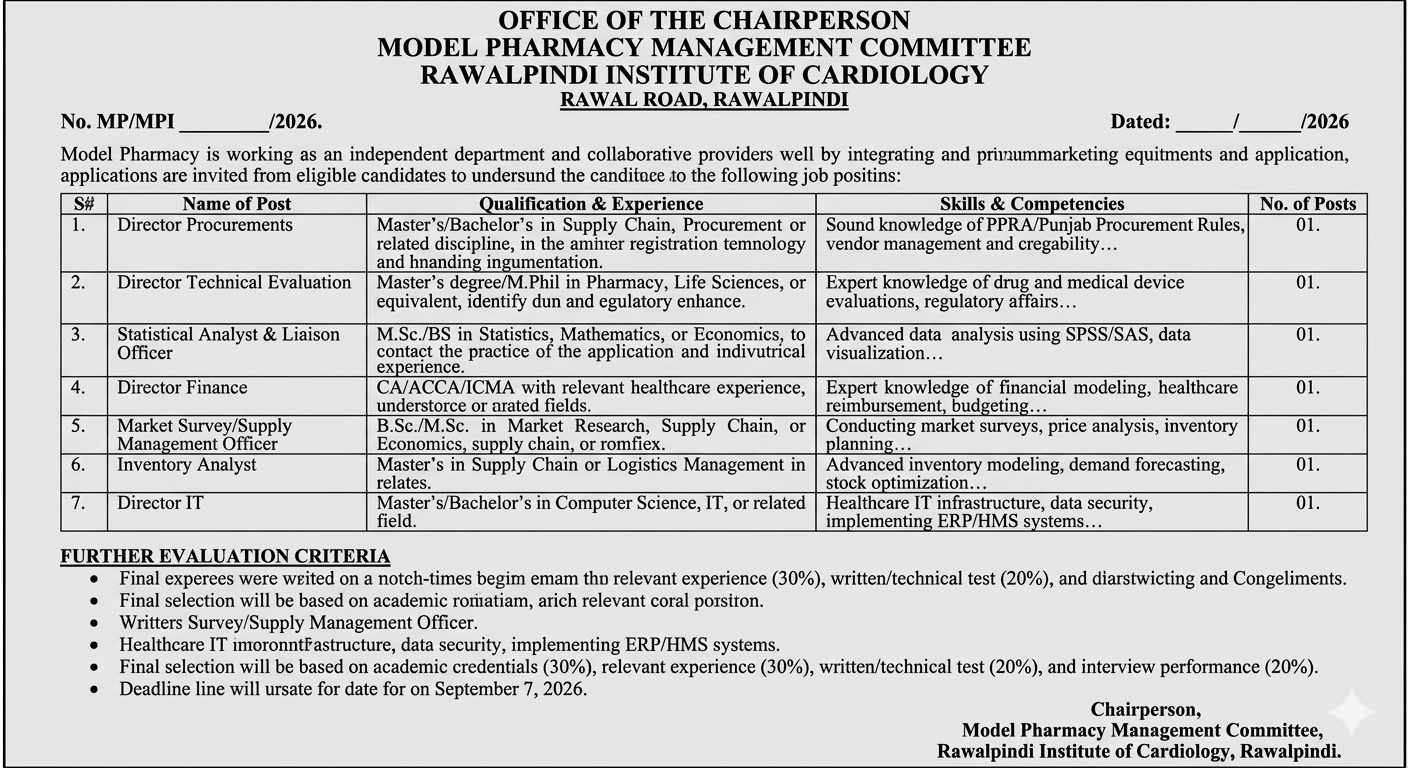
- Job Announced Director Statistical Analyst Market Survey Inventory analyst
official job advertisement issued by the Rawalpindi Institute of Cardiology (RIC). The Model Pharmacy Management Committee
- Apply for this job
- Prepare for this job
- Share this job
- Have a question about this job? Ask in the discussion area.
-
09 Apr 26 Rawalpindi Institute of Cardiology (RIC)
-
Data entry Operator
-
5 Jobs
-
Last Date
20-Apr-26
-
-
12 Feb 26 Rawalpindi Institute of Cardiology (RIC)
-
Senior Consultant Cardiac
-
1 Jobs
-
Last Date
28-Feb-26
-
-
01 Jan 26 Rawalpindi Institute of Cardiology (RIC)
-
Junior Technician
-
15 Jobs
-
Last Date
20-Jan-26
-
Rawalpindi Institute of Cardiology (RIC): Career Opportunities for 2026
The Rawalpindi Institute of Cardiology (RIC) stands as a premier cardiac care facility in Pakistan, renowned for its advanced medical interventions, comprehensive patient care, and commitment to cardiovascular research. As a tertiary care hospital under the Government of Punjab, RIC provides state-of-the-art treatments including complex angioplasties, open-heart surgeries, and dedicated pediatric cardiology services. The institute's reputation for clinical excellence is built upon a foundation of highly skilled professionals and cutting-edge technology, making it a sought-after workplace for healthcare talent across the region and the country.
Looking ahead to 2026, the Rawalpindi Institute of Cardiology has outlined ambitious expansion plans that will directly create new job opportunities. These plans include the activation of additional cardiac catheterization laboratories, the enhancement of its non-invasive diagnostic imaging department, and the potential development of specialized units for heart failure and electrophysiology. This strategic growth is designed to meet the increasing demand for cardiac services in Rawalpindi and its surrounding districts, necessitating a significant recruitment drive for qualified medical, paramedical, technical, and administrative staff in the coming year.
A Premier Employer in Pakistan's Healthcare Sector
Securing a position at the Rawalpindi Institute of Cardiology is widely regarded as a significant career achievement for healthcare professionals. The institute fosters a culture of continuous learning and professional development, offering its staff exposure to a high volume of complex cases and the opportunity to work alongside leading cardiologists and cardiac surgeons. Employees benefit from a structured environment that emphasizes evidence-based practice, patient safety, and multidisciplinary collaboration, which is essential for delivering superior cardiac care outcomes.
Beyond the professional environment, RIC offers a competitive and transparent employment structure for government jobs in Punjab. Salaries and benefits are typically in accordance with the provincial government's standardized pay scales, which include medical allowances, pension schemes, and other entitlements. The institute's status as a public sector hospital also provides a sense of job security and the profound satisfaction of serving the community through a vital public health mission, factors that contribute to high levels of employee dedication and institutional loyalty.
Current and Upcoming Job Vacancies at RIC
Job vacancies at the Rawalpindi Institute of Cardiology are announced periodically based on operational needs and expansion projects. These employment opportunities span a wide range of specializations. Clinical roles are most prominent, frequently calling for consultants in interventional cardiology, cardiac anesthesia, and cardiovascular surgery, alongside positions for medical officers, staff nurses, perfusionists, and echocardiography technicians. The institute also regularly hires for non-clinical departments, including vacancies in hospital administration, human resources, biomedical engineering, IT support, and finance.
Prospective applicants should monitor the official website of the Rawalpindi Institute of Cardiology and the Punjab government's job portal for the most accurate and timely announcements. Advertisement for RIC jobs are published in leading national newspapers such as Dawn, The News, and Jang, detailing the specific positions, required qualifications, experience, and the step-by-step application procedure. It is crucial for candidates to meticulously review the eligibility criteria and submit their applications before the stated deadline to be considered for the selection process.
How to Apply for Jobs at Rawalpindi Institute of Cardiology
The application process for government jobs at RIC is formal and structured. When vacancies are advertised, the notification will specify whether applications are to be submitted online through a designated web portal or via postal mail to a specified address. Required documents almost always include attested copies of academic degrees, professional certifications, a detailed curriculum vitae, a copy of the Computerized National Identity Card (CNIC), and recent photographs. Some senior-level positions may also require a portfolio of published research or letters of recommendation.
Following the submission deadline, the institute's Human Resources department, in conjunction with the relevant departmental heads, shortlists candidates. The selection process typically involves a written test to assess core knowledge, followed by a comprehensive interview before a panel of experts. For clinical roles, a practical skill assessment may also be part of the evaluation.