




 Jobs Home
 Cities
 Govt Depts
 Comapnies
 Industries
 Professions


.jpg)
New Jobs in Education Department Govt of Sindh
- Job posted on
06-Jul-2026
- Number of vacancies
1
-
Last date to apply
21-Jul-2026
- Job location
Thatta
- Job type
Temporary/Contract
- Job status
Full Time
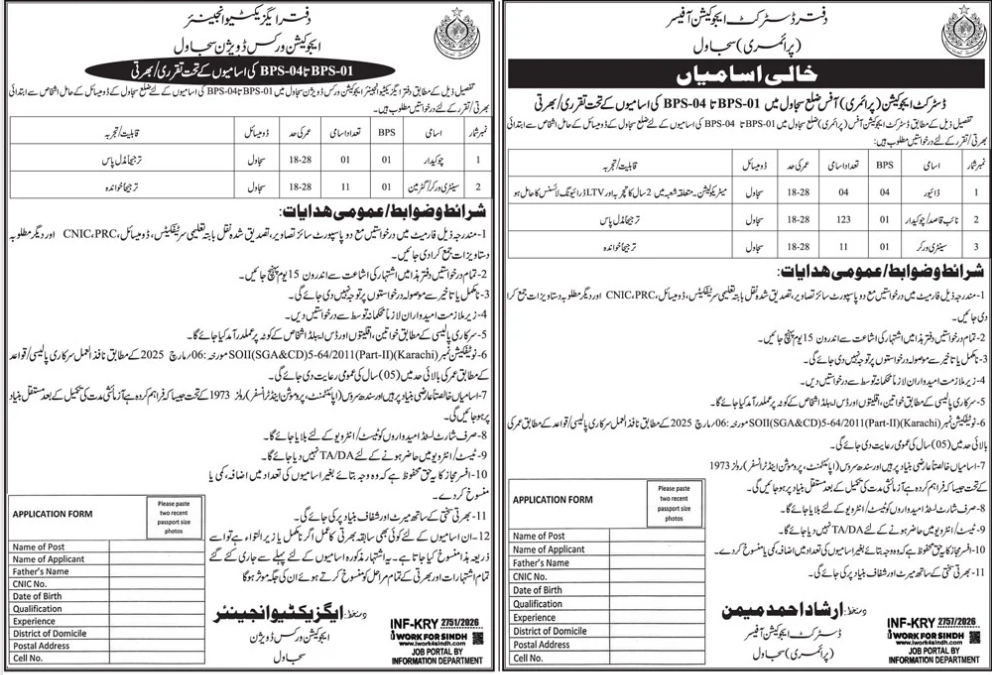
- Job Announced Driver Naib Qasid Sanitary Worker Chowkidar
The District Education Officer (Primary) Sujawal invites applications from domicile holders for 14 temporary BPS-01 to BPS-04 positions
- Apply for this job
- Prepare for this job
- Share this job
- Have a question about this job? Ask in the discussion area.
-
23 Jun 26 Education Department Govt of Sindh
-
Stenographer
-
1 Jobs
-
Last Date
08-Jul-26
-
-
26 Mar 26 Education Department Govt of Sindh
-
Cashir
-
1 Jobs
-
Last Date
17-Apr-26
-
Education Department Govt of Sindh: Career Opportunities for 2026
The Education Department Govt of Sindh stands as the primary architect of the province's educational future, managing a vast network of public schools, colleges, and literacy programs. With a renewed focus on the Sindh Education Sector Plan 2024-2028, the department is undergoing a significant transformation, emphasizing digital integration, improved learning outcomes, and equitable access. This strategic shift directly influences its 2026 hiring initiatives, which are designed to onboard professionals who can drive this ambitious reform agenda. Careers here are built on a foundation of public service, offering a unique chance to impact policy implementation at the grassroots level across all 29 districts of Sindh.
For 2026, the department's career plans are strategically aligned with filling critical gaps identified in recent performance audits. This includes a concentrated push to recruit subject-matter experts in STEM fields for secondary schools, data analysts for the newly established Monitoring & Evaluation wing, and seasoned project managers for donor-funded initiatives like the Sindh Basic Education Program. These roles are crucial for addressing systemic challenges and achieving tangible improvements in educational metrics, from student retention rates to teacher training effectiveness.
Anticipated Job Openings and Hiring Sectors in 2026
The hiring forecast for Education Department Govt of Sindh jobs in 2026 points towards a multi-sector recruitment drive. Beyond conventional teaching positions, a substantial number of vacancies are expected in technical and supervisory capacities. The department's ongoing digitization of student records, teacher transfers, and financial disbursements through the Sindh Education Management Information System (SEMIS) will create a consistent demand for IT support specialists, database administrators, and cybersecurity analysts. Furthermore, the expansion of non-formal and adult literacy centers in rural Talukas like Umerkot and Tharparkar will require dedicated coordinators and community mobilizers.
Another key sector for employment will be curriculum development and assessment. With the planned review and update of textbooks and pedagogical approaches, opportunities will arise for curriculum designers, assessment officers, and teacher trainers specializing in modern instructional methodologies. These positions often require collaboration with the Bureau of Curriculum and Extension Wing, offering a central role in shaping what and how students learn. Administrative roles in procurement, logistics, and infrastructure development will also be advertised to support the construction and rehabilitation of school facilities under the Annual Development Program.
Share your comments & questions here
Sunny
24 Oct 2018What is the last date to apply for this advertisement?
jawed
18 Oct 2018naib qasid job