




 Home
Home
 National
 International
 Merit list
 Date Sheet
 Result
 Admission
 Study Abroad
.gif)


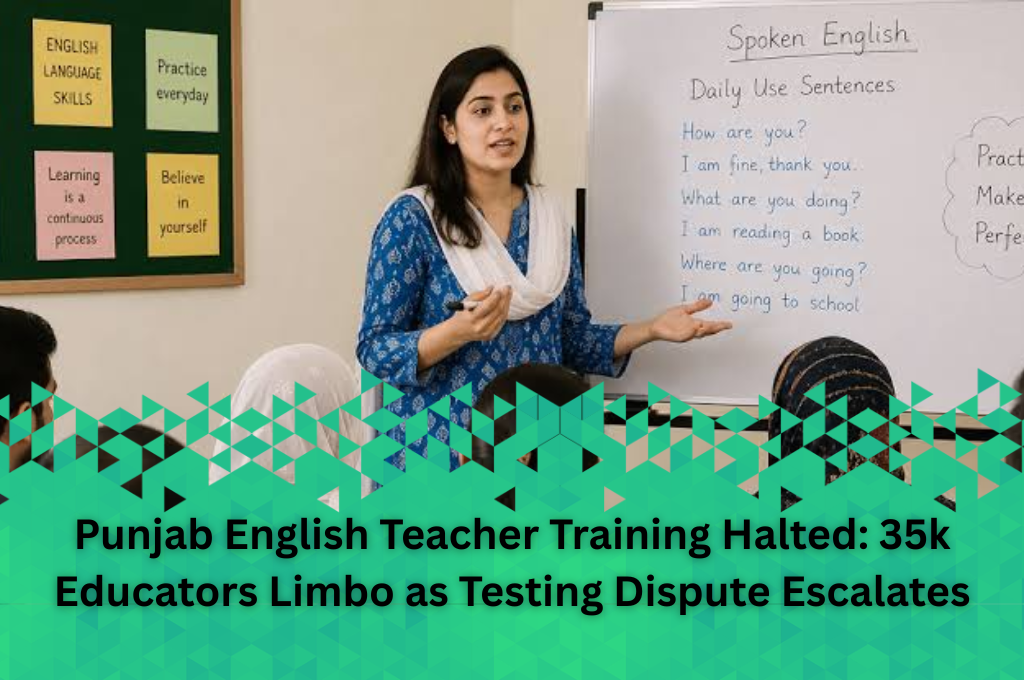
Punjab English Teacher Training Halted: 35k Educators Limbo as Testing Dispute Escalates
In a major development within the school education sector, the Government of Punjab has temporarily halted its massive capacity-building initiative. The highly anticipated Punjab teacher English training postponed after encountering stiff resistance from various educators' organizations and regulatory modifications. The program, which aimed to upscale the linguistic competencies of 35,000 teachers across the province, is now undergoing a complete structural overhaul.
According to departmental insiders, the postponement stems from structural disagreements regarding the evaluation metrics used to gauge teachers' current proficiencies. The Punjab Curriculum and Textbook Authority (PCTA) has now stepped in to recalibrate the strategy, shifting the execution model from a centralized district format to a highly localized tehsil-level framework.
Why Was the Punjab Teacher English Training Postponed?
The primary catalyst behind the sudden suspension of the training initiative was the controversial evaluation methodology originally devised by the department. To evaluate the foundational English skills of the 35,000 registered participants, authorities had introduced an online assessment system conducted via Google Forms.
However, this digital-only evaluation sparked widespread teachers' union reservations across all 36 districts of Punjab. The leadership of prominent teacher associations voiced severe apprehensions, arguing that an online questionnaire is a highly flawed indicator of an educator's pedagogical or linguistic capabilities.
The Grievances of the Teachers' Unions
Representatives from various teacher alliances collectively argued that a simple digital form could not accurately measure spoken fluency, classroom management, or the subtle nuances of teaching English as a second language. They highlighted several systemic challenges, including:
-
Digital Divide: Intermittent internet connectivity in rural tehsils could unfairly penalize competent teachers.
-
Superficial Assessment: Multiple-choice questions on Google Forms fail to assess real-time composition and communicative skills.
-
Lack of Consultation: The decision to enforce an online filter was made without taking senior academic stakeholders into confidence.
Fearing that poor results from an unverified digital test could negatively impact teachers' performance files and promotion tracks, the unions demanded an immediate halt to the program. Yielding to this sustained pressure, the provincial authorities agreed to review the evaluation blueprint.
Strategic Shift: PCTA Moves to Tehsil-Level Execution
Following the suspension, the Punjab Curriculum and Textbook Authority (PCTA) announced a major policy shift to address the educators' concerns. Instead of utilizing a broad, district-wide approach that relies heavily on digital pre-testing, the authorities have opted for a more personalized, localized methodology.
The English proficiency training will now be managed directly at the tehsil (sub-district) level. Academic experts believe that breaking down the massive cohort of 35,000 teachers into smaller, localized groups will dramatically improve the quality of the training.
Advantages of the New Tehsil-Based Framework
By decentralizing the infrastructure, the department aims to provide several distinct benefits:
-
Enhanced Accessibility: Teachers residing in remote villages will no longer need to travel long distances to district headquarters, saving time and commuting costs.
-
Better Trainer-to-Trainee Ratios: Smaller batches ensure that Master Trainers can focus on the specific phonetic and grammatical weaknesses of individual teachers.
-
Ditched Digital Filters: The controversial digital pre-test model is being replaced with structural, practical workshops that evaluate teachers through active classroom simulations rather than digital forms.
Financial Allocation: PKR 2 Billion Already Released
Despite the logistical delays and the news that the Punjab teacher English training postponed, government officials have clarified that funding is absolutely not an issue for this project. The provincial government remains heavily committed to reforming public school education quality.
According to official data released by financial compliance departments, the government has already dispatched a massive budget of PKR 2 Billion to the School Education Department. This substantial fund is safely secured and dedicated strictly to upgrading teacher capacity-building programs across the state.
Where Will the PKR 2 Billion Budget Be Spent?
The allocated funds will be systematically distributed across the decentralized tehsil networks to cover:
-
Honorariums and printing costs for specialized pedagogical training manuals.
-
Compensation packages for expert language instructors and Master Trainers.
-
Setting up localized training centers equipped with modern audio-visual teaching aids to enhance English listening and speaking skills.
-
Logistical arrangements and refreshment allowances for the thousands of participating government school teachers.
What Lies Ahead? The Upcoming PCTA Training Schedule
With the foundational strategy shifting to the grassroots level, the authorities are currently working around the clock to iron out a revised timeline. The Punjab Curriculum and Textbook Authority (PCTA) confirmed that its academic and logistical teams are designing a brand-new, comprehensive PCTA training schedule.
This upcoming roadmap will outline the specific phase-wise rollouts for all tehsils across Punjab. Officials have assured the public that the new schedule will be officially published immediately after receiving final approval from the Provincial Minister for School Education and senior bureaucracy.
Official Departmental Stance:“Our core objective is not to penalize or stress our educators through rigid digital filters, but to genuinely empower them. Shifting the training to the tehsil level guarantees that the PKR 2 billion budget translates into actual classroom quality improvements.”
Implications for Public School Students in Punjab
Ultimately, this structural delay is expected to yield positive results for the primary beneficiaries of the system—the students. Educators argue that rushing through a flawed digital training program would have done little to change classroom realities.
By taking the time to address teachers' union reservations and building a highly interactive, localized curriculum, the Punjab government is ensuring that its public school teachers are genuinely equipped to teach modern English. When the program eventually launches under the updated PCTA training schedule, it is set to radically transform English literacy rates across thousands of government schools in Punjab.






Share your comments & questions here
No comments yet. Be the first to comment!