



 Home
Home
 National
 International
 Merit list
 Date Sheet
 Result
 Admission
 Study Abroad
.gif)


First Time Ever: Punjab Greenlights Separate Religious Curriculum for Minorities
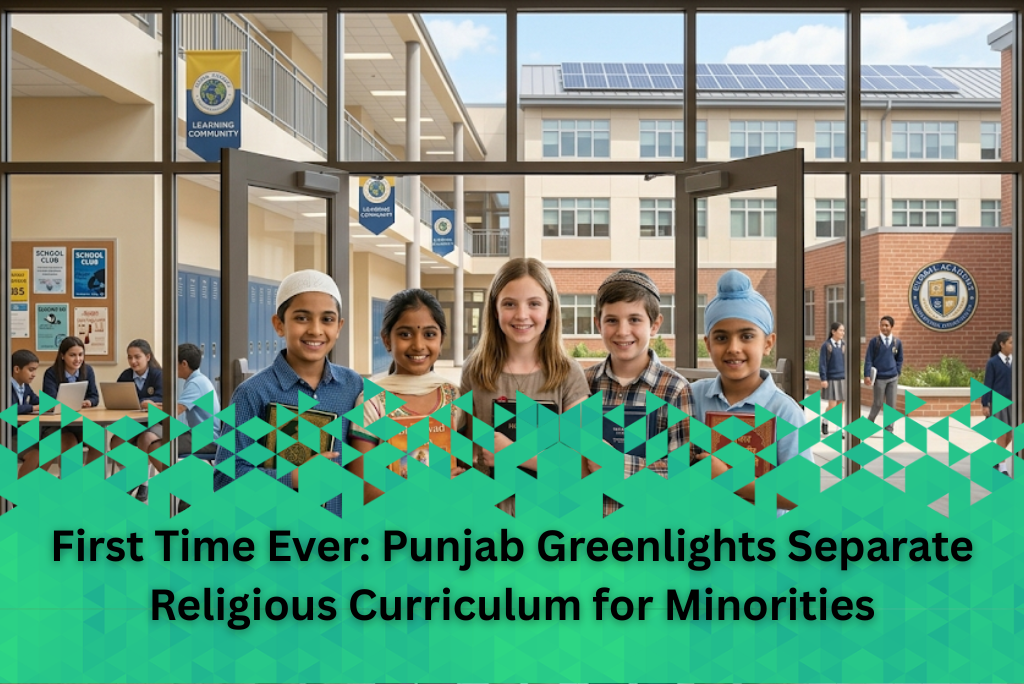
In an unprecedented and transformative legislative shift, the provincial administration of Punjab has officially authorized a separate religious curriculum for non-Muslim students across all public and private educational institutions. This historic milestone marks the first time since the creation of the province that students from minority communities will have the legal right to study their own respective faiths rather than a generic ethics course.
The Punjab Curriculum and Textbook Board (PCTB) formally issued the implementing notification on Monday, dictating that the newly customized religious textbooks will be introduced dynamically starting from the upcoming academic session 2026-27. Educational analysts, civil society organizations, and minority community leaders are hailing the initiative as a sweeping victory for religious freedom, long-term tolerance, and comprehensive social integration.
Strategic Shift Toward Inclusive Education in Punjab
For several generations, the framework of school-level religious studies across Pakistan required non-Muslim students to either sit through Islamic Studies (Islamiat) or opt for an alternative elective known as Ethics (Ikhlaqiyat). While the Ethics course was intended to provide a neutral platform covering universal human values, minority groups frequently noted that the content lacked a profound connection to their unique cultural, theological, and historical identities.
By introducing a dedicated, faith-specific separate religious curriculum for non-Muslim students, the Punjab Curriculum and Textbook Board (PCTB) aims to structurally rectify these institutional imbalances. According to board representatives, this proactive policy shift aligns systematically with constitutional guarantees concerning religious preservation and freedom of instruction.
Detailed Breakdown of the New Religious Curriculum Matrix
The structural changes approved under the new notification are extensive, covering six primary non-Muslim religious demographics residing within the province. Rather than applying a single uniform alternative book, the Punjab Curriculum and Textbook Board (PCTB) has systematically divided the courses across distinct grade brackets based on initial regional pilots and baseline academic data.
| Minority Faith Group | Core Textbook Subject Name | Target Grade Level Coverage |
| Christianity | Christian Education | Grade 1 to 9, and Grade 11 |
| Hinduism | Sanatan Dharma | Grade 1 to 3 |
| Sikhism | Sikh Dharma | Grade 1 to 3 |
| Kalasha Community | Kalasha Education | Grade 1 to 3 |
| Buddhism | Buddhism | Grade 1 to 3 |
| Zoroastrianism | Zoroastrianism | Grade 1 to 5 |
1. Deep Dive into the Christian Education Curriculum
Given that the Christian community comprises the largest religious minority within the province, the "Christian Education" track features the most comprehensive timeline. It extends continuously through primary and secondary education, up into intermediate level college tracks (Grade 11). The content focuses heavily on biblical history, the life of Jesus Christ, values of grace, and the historical contributions of Christian scholars to the development of modern Pakistan.
2. Integration of Sanatan Dharma and Sikh Dharma
The introduction of "Sanatan Dharma" for Hindu youth and "Sikh Dharma" for Sikh youth across early foundational years (Grades 1–3) marks a massive shift in cultural recognition. Textbook manuscripts emphasize core spiritual philosophies, sacred scriptures, and foundational ethical parables. For the Sikh community, this change ensures that the rich history of their faith—deeply tied geographically to the shrines and historical landmarks of Punjab—is taught formally from an early age.
3. Historical Inclusion of the Kalasha, Buddhist, and Parsi Communities
In an exceptionally rare move for state-level curricula, dedicated tracks for the endangered cultural heritage of the Kalasha community, alongside classical "Buddhism" and ancient "Zoroastrianism", have received full state recognition. Although the Kalasha community is predominantly concentrated in northern valleys, the presence of various minority networks across Punjab’s expansive urban centers prompted the board to provide inclusive options for all documented minority students.
Addressing Practical Implementation Challenges
While the approval of a separate religious curriculum for non-Muslim students is universally recognized as a human rights triumph, practical execution across thousands of public schools will require rigorous administrative efforts. Academic researchers have highlighted three critical areas that demand immediate fiscal and structural attention before the rollout in the academic session 2026-27:
-
Teacher Recruitment and Resource Allocation: Many rural public schools currently function under a constrained "one-teacher, one-classroom" setup. To properly facilitate multiple distinct religious tracks simultaneously, schools must recruit certified instructors from diverse faith backgrounds or provide specialized cross-training.
-
Infrastructure Adaptations: Providing distinct instruction blocks for varying groups requires auxiliary workspace. The provincial government has verified that it is conducting exhaustive student data aggregation mapping to allocate instructional spaces efficiently.
-
Mainstream Textbook Audits: Civil society groups note that true inclusivity requires checking standard language and social science textbooks to ensure they are free from implicit bias and fully reflect non-Muslim national heroes who helped build the country.
Danish George, a leading figure within the Christian Religious Studies wing of provincial educational authorities, assured the public that the government is compiling precise school-by-school data to streamline human resource deployments and ensure no child is left behind due to localized logistical shortages.
Looking Forward: Rolling Out the 2026-27 Academic Session
The Punjab Curriculum and Textbook Board (PCTB) has confirmed that the official directive has already been formally delivered to all divisional educational boards, private school regulatory bodies, and municipal district educational authorities across Punjab.
Publishing houses have been greenlit to begin textbook production instantly, preventing any potential inventory issues prior to the school semester start date. By moving away from a single baseline alternative and leaning into highly customized, faith-specific learning tools, Punjab's educational architecture sets a crucial precedent for other provinces across Pakistan to follow in the pursuit of complete religious equality and scholastic progression.




Share your comments & questions here
No comments yet. Be the first to comment!