




 Jobs Home
 Cities
 Govt Depts
 Comapnies
 Industries
 Professions




New Jobs in Provincial Disaster Management Authority
- Job posted on
24-Jul-2026
- Number of vacancies
1
-
Last date to apply
06-Aug-2026
- Job location
Karachi,Jamshoro,Sukkur
- Job type
Temporary/Contract
- Job status
Full Time
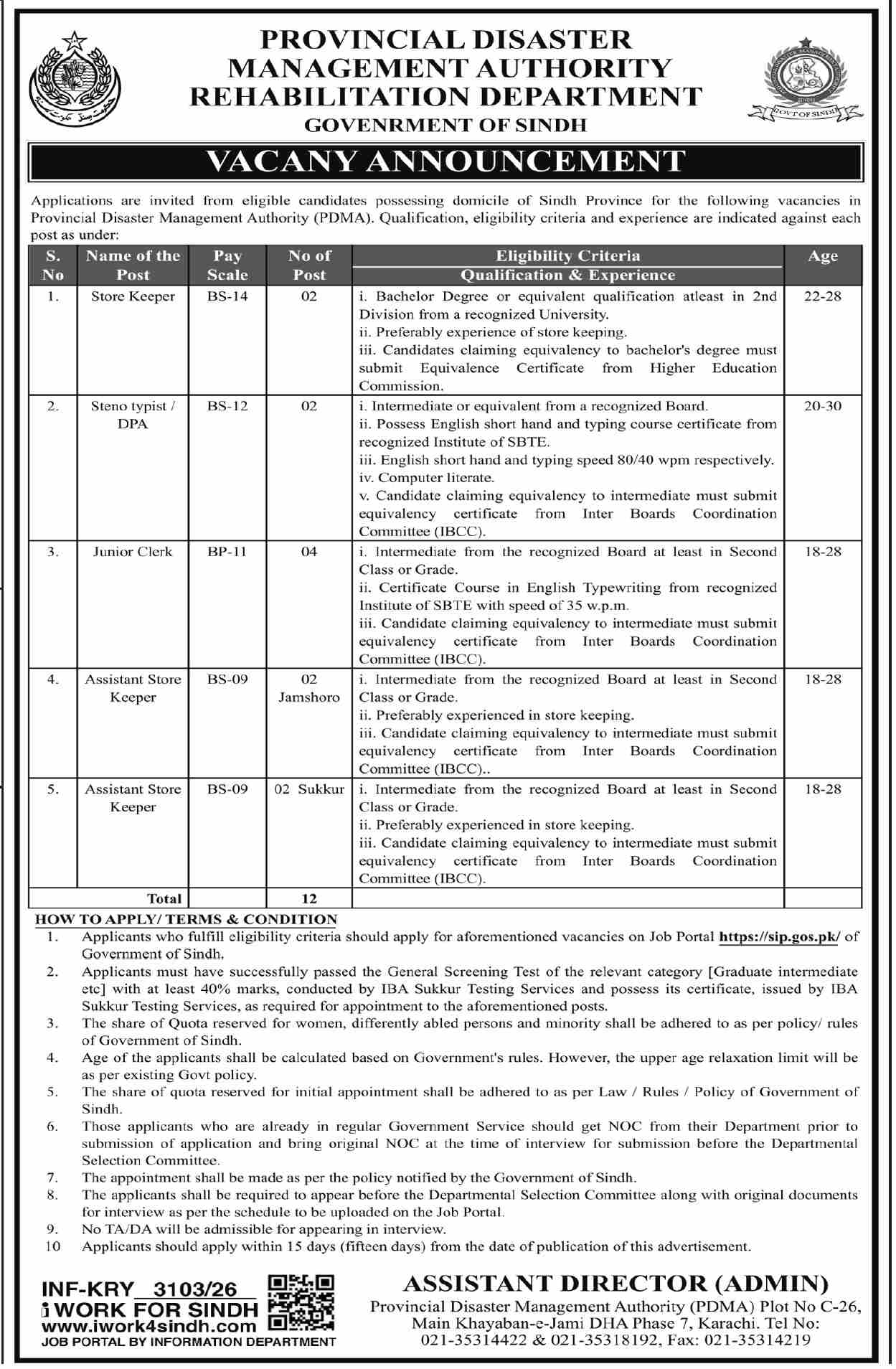
- Job Announced Store Keeper Steno Typist Junior Clerk Assistant Store Keeper
- Apply for this job
- Prepare for this job
- Share this job
- Have a question about this job? Ask in the discussion area.
Provincial Disaster Management Authority (PDMA) Jobs in Pakistan
The Provincial Disaster Management Authority (PDMA) stands as a cornerstone institution in Pakistan's national framework for disaster risk reduction and emergency response. Operating within each province, the PDMA is tasked with a critical mandate: to safeguard lives, livelihoods, and infrastructure from the devastating impacts of natural and man-made calamities. For professionals seeking a career imbued with profound purpose and public service,PDMA jobsoffer a unique and challenging pathway. These roles are not merely employment opportunities; they are calls to action for individuals dedicated to building community resilience, orchestrating complex relief operations, and contributing to sustainable development in the face of adversity.
This comprehensive guide delves into the ecosystem ofcareer opportunities within the PDMA, exploring the diverse roles, application procedures, and the significant impact these positions hold within Pakistan's socio-economic landscape.
Understanding the PDMA: Mandate and Organizational Structure
Established under the National Disaster Management Act, the PDMA functions as the provincial arm of the National Disaster Management Authority (NDMA). Its operational philosophy is built on a multi-phase approach:Preparedness, Mitigation, Response, and Recovery. This cyclical process ensures a proactive rather than purely reactive stance towards disasters.
The organizational hierarchy typically includes a governing body led by a Director General, with specialized wings or directorates focusing on key areas such as:
- Disaster Risk Reduction (DRR):Focused on hazard mapping, community-based training, early warning systems, and infrastructure resilience projects.
- Emergency Operations Center (EOC):The nerve center for coordinating real-time response during a disaster, managing resources, information, and inter-agency communication.
- Logistics and Procurement:Managing the supply chain for relief goods, including tents, food packs, medical supplies, and emergency shelters.
- Planning and Development:Formulating provincial disaster management plans, conducting vulnerability assessments, and integrating DRR into development planning.
- Finance and Administration:Handling budgetary allocations, grants, human resources, and the overall administrative machinery.
- Information Technology and GIS:Utilizing geospatial technology for risk analysis, damage assessment, and resource tracking.
Exploring Career Avenues: Types of PDMA Jobs
PDMA job vacanciescater to a wide spectrum of educational backgrounds and professional expertise. Recruitment is often project-based, tied to donor-funded initiatives, or conducted to fill permanent positions within the provincial government structure.
1. Technical and Specialist Roles
These positions require specific academic qualifications and hands-on experience.
- Disaster Management Experts:Professionals with advanced degrees in disaster management, environmental sciences, or urban planning.
- GIS Specialists & Remote Sensing Analysts:Experts in geographic information systems for spatial analysis and mapping.
- Civil/Structural Engineers:Involved in assessing building safety, designing flood protection works, and supervising resilient infrastructure projects.
- Hydrologists & Meteorologists:Specialists in water resource management and weather pattern analysis for flood and drought forecasting.
- Communication & Early Warning Specialists:Developing and disseminating public alerts through various media channels.
2. Field Operations and Community Outreach
These roles are frontline positions, directly engaging with at-risk communities.
- Field Coordinators & Mobilizers:Working in districts and tehsils to implement DRR activities, conduct drills, and liaise with local governments.
- Community Development Officers:Facilitating the formation of Community-Based Disaster Risk Management (CBDRM) committees and building local capacity.
- Relief & Logistics Officers:Managing warehouse stocks, distributing aid, and ensuring supply chains function during emergencies.
3. Administrative, Finance, and Support Services
Essential for the smooth functioning of the authority.
- Administrative Officers & HR Managers:Handling recruitment, personnel management, office administration, and protocol.
- Finance Officers & Accountants:Managing budgets, disbursing funds, auditing expenses, and preparing financial reports for donors.
- Procurement Officers:Ensuring transparent and efficient procurement of goods and services as per PPRA rules.
- IT Support Staff & Data Entry Operators:Maintaining hardware/software, managing databases, and ensuring digital systems are operational.
The Application Process: How to Secure a PDMA Job
Recruitment forPDMA jobs in Punjab, Sindh, Khyber Pakhtunkhwa, Balochistan, and Gilgit-Baltistanfollows a standardized, merit-based process typically advertised in leading national newspapers and on official government job portals.
Step-by-Step Guide:
- Vacancy Announcement:Keep a vigilant eye on newspapers like Dawn, Jang, The News, and official websites likewww.pdma.gop.pk(Punjab) or respective provincial PDMA sites. The advertisement details the post, pay scale, qualifications, experience, and application deadline.
- Eligibility Scrutiny:Meticulously review the required criteria—educational degree, age limit, domicile, and specific experience. Applications not meeting the exact requirements are often rejected at the initial stage.
- Application Submission:Prepare a complete application package as instructed. This usually includes:
- A handwritten or typed application on plain paper.
- Detailed Curriculum Vitae (CV) or bio-data.
- Attested copies of all educational certificates, CNIC, domicile, and experience letters.
- Recent passport-sized photographs.
- Any other documents specified (e.g., NOC from current employer).
- Testing & Interview:Shortlisted candidates are called for a written test (for some positions) followed by a comprehensive interview before a selection committee. The interview assesses technical knowledge, problem-solving skills, and understanding of disaster management challenges.
- Final Selection & Offer:The final merit list is prepared based on test/interview performance and academic credentials. Successful candidates receive a formal offer letter outlining terms of employment.
Why Pursue a Career with the PDMA?
Choosing a career with the PDMA extends beyond a conventional job. It offers:
- Meaningful Impact:Directly contribute to saving lives and protecting communities, offering immense professional satisfaction.
- Dynamic Work Environment:No two days are the same. Work oscillates between strategic planning and high-pressure emergency response.
- Skill Diversification:Gain expertise in project management, logistics, community mobilization, crisis communication, and inter-agency coordination.
- Competitive Remuneration:Salaries and benefits are generally aligned with provincial government scales, often including medical coverage, pensions, and other allowances.
- National & International Exposure:Collaborate with national agencies (NDMA, PDMAs), UN bodies (UNDP, UNICEF, WFP), and international NGOs, broadening professional networks.
Challenges and Future Outlook
PDMA professionals often work in resource-constrained settings, face bureaucratic hurdles, and operate in physically demanding and sometimes hazardous post-disaster environments. The emotional toll of responding to human suffering can be significant.
However, the future trajectory is geared towards greater institutional strengthening. With climate change intensifying the frequency and severity of hydro-meteorological disasters in Pakistan, the role of the PDMA is becoming increasingly pivotal. Investment in technology, community-based systems, and human capital is rising, creating a growing demand for skilled, passionate, and resilient professionals dedicated to the field of disaster risk management.
For the right individual, a PDMA job is more than a career—it's a vocation dedicated to building a safer, more resilient Pakistan.
Share your comments & questions here
No comments yet. Be the first to comment!