




 Jobs Home
 Cities
 Govt Depts
 Comapnies
 Industries
 Professions




New Jobs in National Heritage and culture Division
- Job posted on
13-Sep-2026
- Number of vacancies
1
-
Last date to apply
28-Sep-2026
- Job location
Islamabad
- Job type
Temporary/Contract
- Job status
Full Time
- Job Announced Chairman
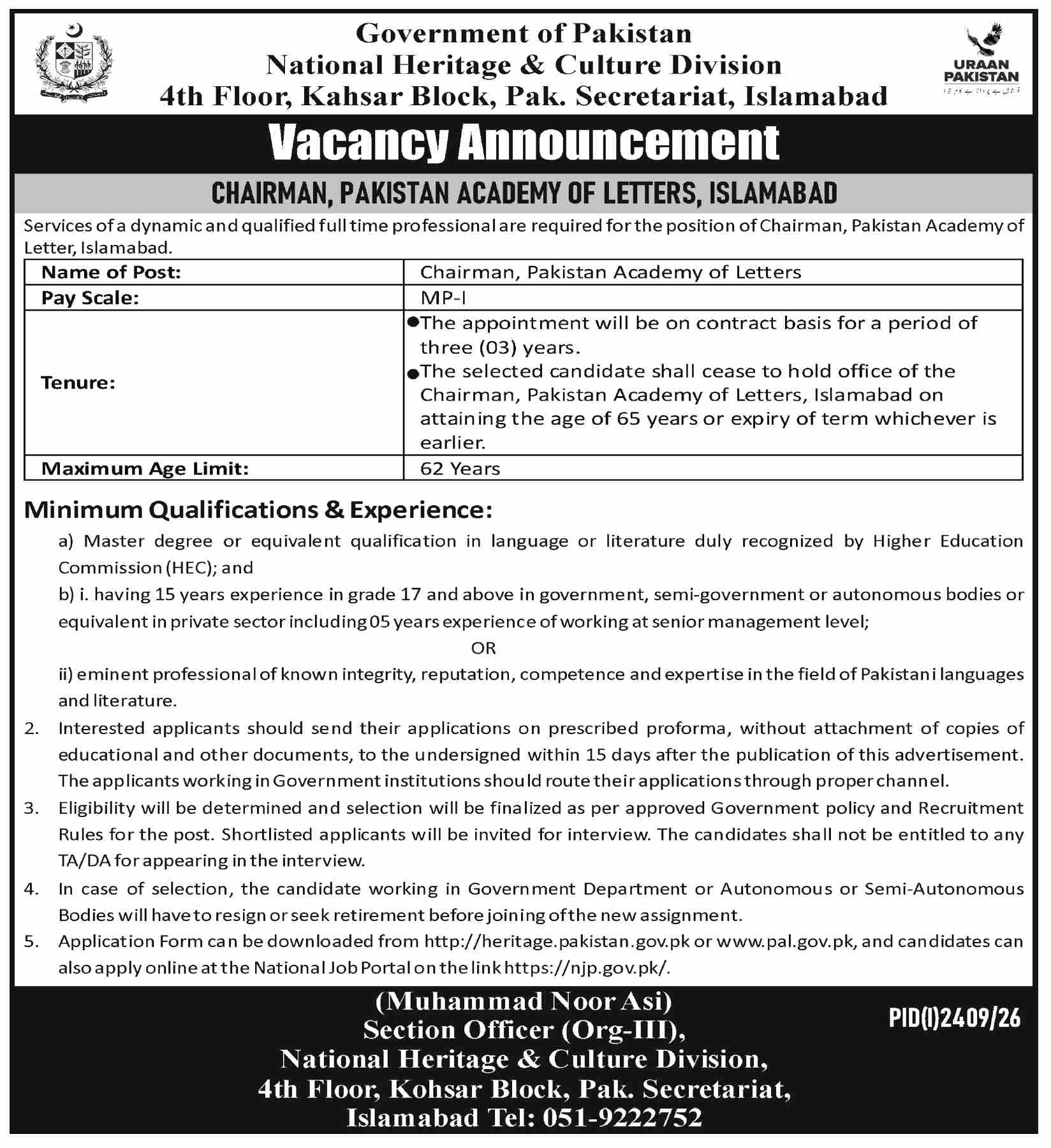
government vacancy for the Chairman of the Pakistan Academy of Letters, Islamabad, detailing qualifications, experience, tenure, age limit, and application instructions.
- Apply for this job
- Prepare for this job
- Share this job
- Have a question about this job? Ask in the discussion area.
-
02 Apr 26 National Heritage and culture Division
-
Director Quaid-i-Azam Academy
-
1 Jobs
-
Last Date
15-Apr-26
-
National Heritage and Culture Division: Career Opportunities for 2026
The National Heritage and Culture Division stands as the central government body dedicated to the preservation, promotion, and celebration of our nation's rich historical legacy and vibrant living traditions. Our mandate encompasses the stewardship of archaeological sites, the management of national museums and archives, the support of indigenous arts, and the formulation of cultural policy. As we look toward 2026, our strategic plan includes significant expansion of several flagship programs, including the National Digital Archives Initiative and the Community Heritage Grant scheme. This planned growth directly translates into a diverse array of new job opportunities and vacancies for professionals who are passionate about making a tangible impact on our national identity.
Our 2026 hiring outlook is robust and multifaceted. We anticipate openings across various specializations to support our expanding mission. Careers within the Division are not merely jobs; they are callings for individuals committed to safeguarding our past for future generations. We are actively seeking candidates for roles in archival science, historical research, monument conservation, cultural event management, and public policy analysis. These National Heritage and Culture Division employment opportunities are designed to attract talent that can contribute to both the preservation of physical heritage and the dynamic evolution of our contemporary cultural landscape. The application process for these positions will be formally announced through official government gazettes and our dedicated careers portal in the coming months.
Anticipated Job Roles and Required Expertise for 2026 Recruitment
The Division's operational needs for the upcoming fiscal year are projected to create vacancies in several critical domains. In the conservation and restoration sector, we will be recruiting architectural conservators and materials scientists to work on the ongoing preservation of UNESCO World Heritage-listed sites. For our digital transformation projects, openings for digital archivists and metadata specialists are expected, focusing on the digitization of fragile historical documents and the creation of accessible online collections. Furthermore, the expansion of our public engagement programs will necessitate hiring cultural outreach officers and museum educators to develop interactive programs for schools and international visitors.
Successful candidates for these National Heritage and Culture Division careers will typically possess a combination of formal education and practical experience. A postgraduate degree in heritage studies, museum studies, history, archaeology, or library science is often a prerequisite for specialist roles. However, we equally value hands-on experience in fields like collection management, archaeological fieldwork, or cultural project coordination. Proficiency in relevant digital tools, from GIS mapping software to collection management systems, is increasingly important. For policy-oriented roles, a strong background in public administration or law, with a focus on cultural heritage legislation, is highly desirable. We look for individuals who demonstrate not only technical skill but also a deep-seated respect for the cultural materials and communities they will serve.
Application Process and Career Development Pathways
Navigating the application process for National Heritage and Culture Division jobs requires attention to detail and an understanding of public sector recruitment standards. All vacancies are advertised publicly on the central government's official employment website, with each listing containing a comprehensive position description, specific eligibility criteria, and key competency requirements. The application itself usually involves submitting a detailed curriculum vitae, a formal cover letter addressing the selection criteria, and certified copies of academic transcripts. The selection process may then include a series of assessments, such as a written submission, a panel interview, and sometimes a practical skills test relevant to the role, such as artifact handling or policy analysis.
Once onboard, employees are welcomed into a supportive environment that prioritizes professional growth and continuous learning. Career development within the Division is structured yet flexible, offering multiple pathways for advancement. Specialists can progress to senior conservator or lead curator roles, while program officers can advance into management positions overseeing entire regional initiatives. We invest in our staff through regular training workshops, funding for conference attendance, and opportunities for collaborative research with academic institutions.