



 Jobs Home
 Cities
 Govt Depts
 Comapnies
 Industries
 Professions




New Jobs in Ministry of Foreign Affairs
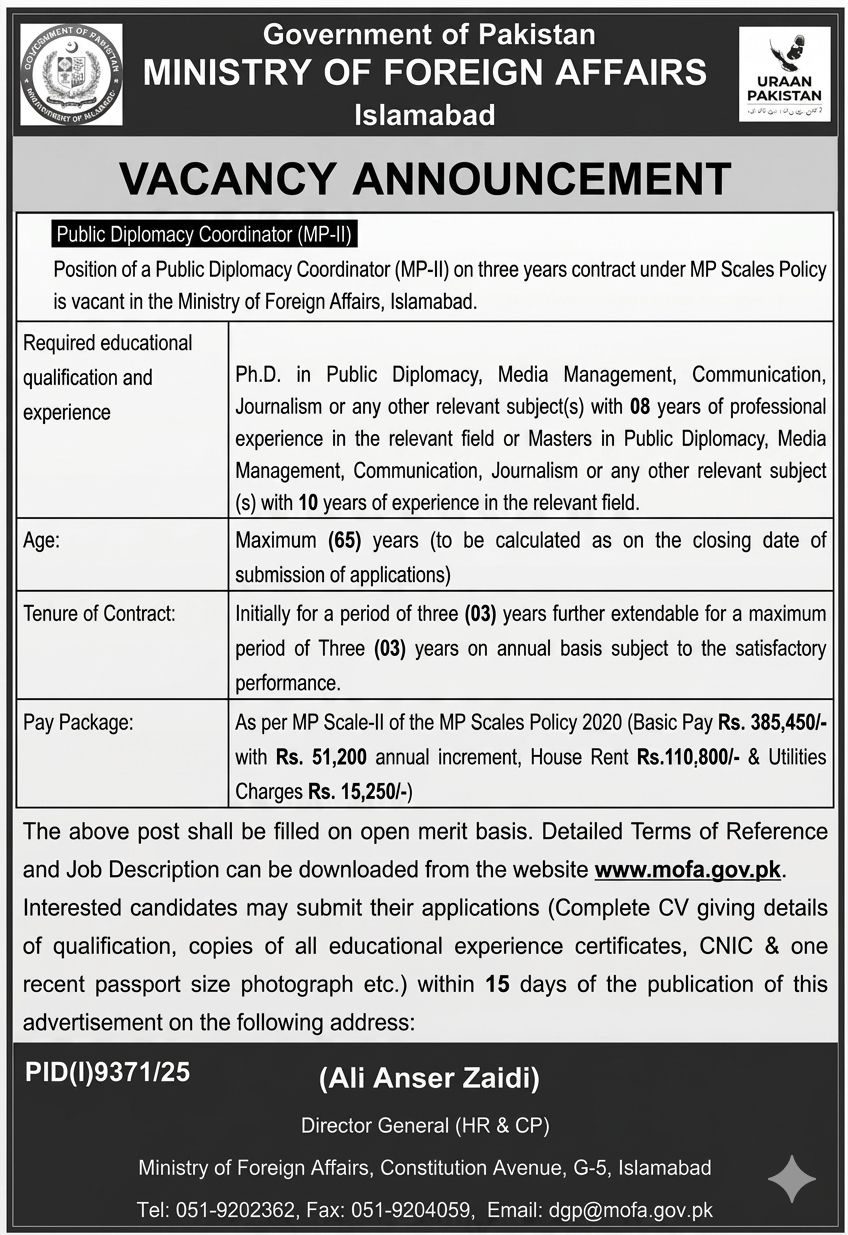
- Job posted on
22-May-2026
- Number of vacancies
1
-
Last date to apply
06-Jun-2026
- Job location
Islamabad
- Job type
Temporary/Contract
- Job status
Full Time
- Job Announced Coordinator
job recruitment announcement by the Ministry of Foreign Affairs (MoFA), Pakistan
- Apply for this job
- Prepare for this job
- Share this job
- Have a question about this job? Ask in the discussion area.
-
05 May 26 Ministry of Foreign Affairs
-
content Developer
-
1 Jobs
-
Last Date
20-May-26
-
-
02 Jan 26 Ministry of Foreign Affairs
-
Director General
-
1 Jobs
-
Last Date
12-Jan-26
-
Navigating a Career with the Ministry of Foreign Affairs
Embarking on a professional journey with the Ministry of Foreign Affairs represents a unique and prestigious career path, dedicated to serving national interests on the global stage. This institution is the cornerstone of a nation's international relations, responsible for diplomacy, consular services, and fostering bilateral and multilateral partnerships. A career here is not merely a job; it is a commitment to representing your country's values, protecting its citizens abroad, and contributing to global peace and development.
Professionals within the Ministry operate at the intersection of politics, economics, and culture, requiring a blend of sharp analytical skills, cultural sensitivity, and unwavering integrity. From diplomatic envoys and political analysts to consular officers and protocol experts, the roles are diverse, challenging, and profoundly impactful. This career demands individuals who are adept at negotiation, resilient under pressure, and passionate about international affairs.
Core Divisions and Career Tracks
The Ministry's structure is designed to manage the multifaceted nature of international relations. Key divisions typically include:
- Political Affairs:Officers in this division analyze global political developments, manage bilateral relations with specific countries or regions, and contribute to foreign policy formulation.
- Economic Diplomacy:This track focuses on promoting trade, attracting foreign investment, and engaging in international economic forums to advance the nation's economic interests.
- Consular Services:A critical public-facing division dedicated to assisting citizens overseas with passport services, emergency aid, legal support, and visa facilitation for foreign nationals.
- Protocol:Experts ensure the smooth execution of state visits, diplomatic ceremonies, and accreditation of foreign diplomats, adhering to international etiquette and conventions.
- Strategic Communications:This wing manages public diplomacy, media relations, and digital outreach to shape the nation's international image and communicate policy positions.
Essential Qualifications and Skills
Securing a position requires meeting stringent criteria that reflect the role's high responsibility. While specific requirements vary by country, common prerequisites include:
- An advanced university degree (Master’s or equivalent) in International Relations, Political Science, Law, Economics, or a related field.
- Proficiency in multiple languages, with English and other official UN languages (French, Spanish, Arabic, Chinese, Russian) being highly advantageous.
- Demonstrated excellence in written and oral communication, critical thinking, and research abilities.
- A clean record and the ability to obtain high-level security clearance.
- Soft skills such as cultural adaptability, discretion, leadership potential, and problem-solving under ambiguity are indispensable.
The Recruitment and Selection Process
The entry process is notoriously competitive and thorough, designed to identify the most capable candidates. It generally follows these stages:
- Rigorous Written Examination:Candidates face comprehensive tests covering general knowledge, current international affairs, essay writing, and sometimes subject-specific papers related to their chosen track.
- In-Depth Psychological Assessment:Evaluations to gauge temperament, stress tolerance, ethical grounding, and suitability for a diplomatic lifestyle involving frequent relocation.
- Panel Interview:A before a senior board assessing intellectual depth, motivation, personality, and alignment with the Ministry's core values.
- Final Selection and Training:Successful candidates undergo an extensive, residential training program at a foreign service academy. This training covers international law, diplomatic history, negotiation simulations, language immersion, and protocol before posting.
Career Progression and Lifestyle
A diplomatic career offers a structured but dynamic progression ladder, typically from Third Secretary to the pinnacle of Ambassador or Foreign Secretary. Postings rotate between the Ministry's headquarters and diplomatic missions abroad (embassies, high commissions, consulates, and permanent missions to international organizations like the UN).
This lifestyle involves constant learning and adaptation, offering unparalleled exposure to different cultures and global leaders. However, it also requires personal sacrifices, including time away from family and the need to quickly integrate into new societies every few years. The rewards include the privilege of shaping history, providing crucial assistance to compatriots, and being at the forefront of international dialogue.
Why Pursue This Path?
Choosing a career in foreign affairs is a calling for those who wish to serve their country in a profound and international context. It provides a platform to:
- Directly influence and implement foreign policy.
- Engage in high-stakes international negotiation and conflict resolution.
- Build bridges between cultures and foster mutual understanding.
- Gain a unique, ground-level perspective on global events.
- Enjoy a career of lifelong learning, prestige, and diverse experiences.
For aspiring candidates, thorough preparation through academic excellence, staying abreast of global currents, and developing a well-rounded personality is key. The journey is demanding, but for those with the requisite passion and skill, a career with the Ministry of Foreign Affairs offers an unmatched opportunity to make a significant difference on the world stage.