




 Jobs Home
 Cities
 Govt Depts
 Comapnies
 Industries
 Professions



New Jobs in Environment Protection Department
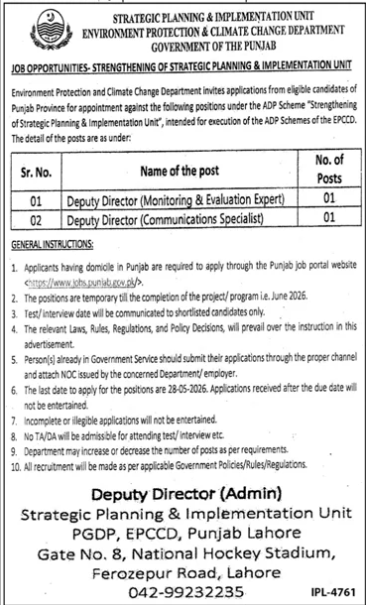
- Job posted on
14-May-2026
- Number of vacancies
1
-
Last date to apply
28-May-2026
- Job location
Lahore
- Job type
Temporary/Contract
- Job status
Full Time
- Job Announced Deputy Director
temporary leadership vacancies within the Punjab Environment Protection and Climate Change Department
- Apply for this job
- Prepare for this job
- Share this job
- Have a question about this job? Ask in the discussion area.
-
26 Apr 26 Environment Protection Department
-
Communication Lead
-
1 Jobs
-
Last Date
11-May-26
-
-
22 Feb 26 Environment Protection Department
-
Operation and procurement Manager
-
1 Jobs
-
Last Date
08-Mar-26
-
Career Paths at the Environment Protection Department (EPD)
The Environment Protection Department (EPD) stands as a pivotal institution dedicated to safeguarding our natural heritage and ensuring a sustainable future. For individuals passionate about ecological balance, climate action, and public health, a career within the EPD offers a profound opportunity to translate that passion into meaningful, impactful work. This department operates at the critical intersection of science, policy, and community engagement, tackling challenges from pollution control and waste management to biodiversity conservation and environmental impact assessment. Professionals here don't just have jobs; they embark on missions to protect air, water, and land resources for current and future generations.
Core Divisions and Specialized Roles
The EPD's multifaceted mandate is executed through various specialized wings, each offering distinct career trajectories. Understanding these divisions helps identify where your skills and interests align best.
- Environmental Monitoring and Compliance:This division is the department's eyes on the ground. Roles here involve conducting field inspections, sampling air and water quality, analyzing data in laboratories, and ensuring industries adhere to environmental regulations. It's ideal for scientists, chemists, and field officers with a keen eye for detail.
- Policy, Planning, and Development:Focused on the bigger picture, this wing formulates long-term environmental strategies, drafts legislation, and develops action plans for climate change mitigation and adaptation. Careers here suit environmental economists, policy analysts, and strategic planners.
- Environmental Impact Assessment (EIA):Specialists in this unit critically evaluate proposed development projects—from new factories to infrastructure—to predict and mitigate their ecological consequences. It requires expertise in ecology, environmental engineering, and regulatory frameworks.
- Conservation and Biodiversity:Dedicated to protecting ecosystems, wildlife, and natural habitats, this division manages protected areas, runs species recovery programs, and promotes sustainable land use. It is a perfect fit for biologists, ecologists, and conservation officers.
- Public Awareness and Community Outreach:Effective environmental protection requires public partnership. This team designs educational campaigns, engages with communities, and fosters corporate environmental responsibility through workshops and media initiatives, ideal for communications experts and community liaisons.
Essential Qualifications and Desired Competencies
Building a career with the EPD demands a blend of formal education and core personal attributes. The department seeks individuals who are not only qualified but also deeply committed to its ethos.
- Academic Background:A bachelor’s or master’s degree in Environmental Sciences, Environmental Engineering, Chemistry, Biology, Forestry, Urban Planning, or Law is typically essential. Specialized roles may require advanced degrees or certifications in fields like hydrology or environmental auditing.
- Technical Proficiency:Familiarity with Geographic Information Systems (GIS), data analysis software, environmental modeling tools, and laboratory instrumentation is highly valued. A strong grasp of national and international environmental laws is crucial for compliance and policy roles.
- Analytical and Problem-Solving Mindset:The ability to assess complex environmental data, identify root causes of pollution, and devise practical, sustainable solutions is fundamental to all EPD functions.
- Communication and Advocacy Skills:Whether writing detailed technical reports, presenting findings to stakeholders, or explaining regulations to the public, clear and persuasive communication is indispensable.
- Integrity and Resilience:Upholding environmental regulations often involves navigating challenging situations. Unwavering ethical standards and the perseverance to see long-term projects through are key character traits for success.
The Recruitment and Application Journey
Joining the EPD is a competitive and structured process. Positions are generally advertised through official government gazettes and dedicated public service commission portals. The application process is meticulous, often involving the following stages:
- Vacancy Announcement:Detailed job advertisements specifying the role, required qualifications, experience, and application deadline are published.
- Application Submission:Candidates must submit a comprehensive application package, including attested academic transcripts, a detailed CV, a cover letter, and any other requested documentation, strictly adhering to the prescribed format.
- Screening and Written Examination:Shortlisted candidates are typically invited for a written test assessing subject knowledge, analytical abilities, and general aptitude.
- Interview Process:Successful written exam candidates face a panel interview to evaluate their technical expertise, problem-solving approach, motivation, and alignment with the department's goals.
- Final Selection and Induction:Selected candidates undergo final vetting before receiving an offer, followed by a formal induction program to integrate them into the EPD's culture and operations.
Growth, Impact, and Future Prospects
A career at the EPD is not static; it is a journey of continuous learning and growth. The department often provides opportunities for advanced training, workshops, and international conferences. Professionals can advance into supervisory, managerial, and directorial positions, shaping national environmental policy. In an era defined by climate urgency and ecological awareness, the work of the EPD has never been more critical. Choosing this path means committing to a profession that directly contributes to planetary health, community well-being, and building a legacy of sustainability—a truly rewarding endeavor for any dedicated individual.
Share your comments & questions here
No comments yet. Be the first to comment!