




 Jobs Home
 Cities
 Govt Depts
 Comapnies
 Industries
 Professions




New Jobs in Cattle Market Management Company
- Job posted on
09-Aug-2026
- Number of vacancies
1
-
Last date to apply
20-Aug-2026
- Job location
Lahore,Sargodha,Sahiwal
- Job type
Temporary/Contract
- Job status
Full Time
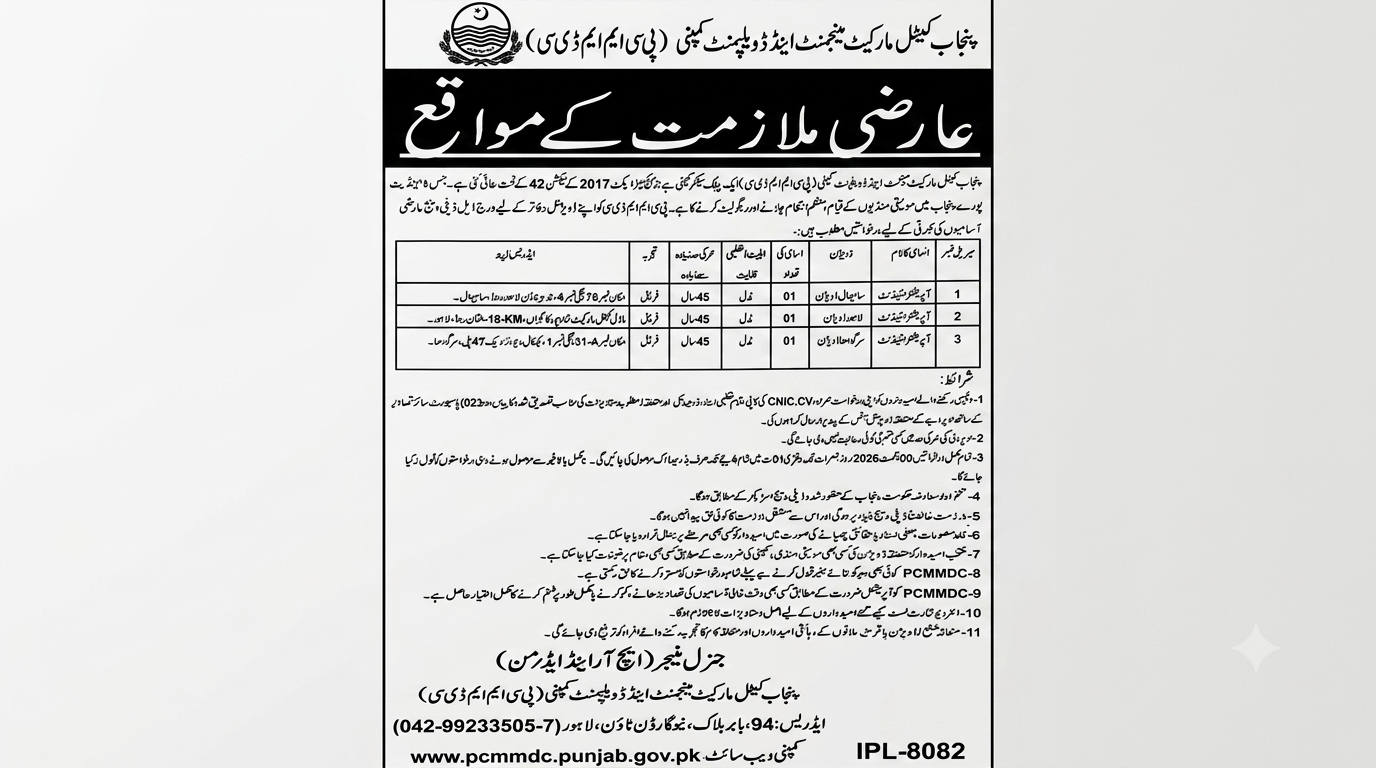
- Job Announced Operations Attendent
PCMMDC invites applications for temporary positions (Office Assistant, Driver, Sweeper) in Sargodha for candidates aged 18–45 with relevant qualifications and experience
- Apply for this job
- Prepare for this job
- Share this job
- Have a question about this job? Ask in the discussion area.
-
26 Apr 26 Cattle Market Management Company
-
Office Assistant
-
1 Jobs
-
Last Date
12-May-26
-
-
16 Jan 26 Cattle Market Management Company
-
Law Officer
-
1 Jobs
-
Last Date
01-Feb-26
-
Navigating a Career in Cattle Market Management
For individuals passionate about agriculture, commerce, and logistics, a career within aCattle Market Management Companyoffers a dynamic and impactful professional path. These specialized firms are the operational engines behind modern livestock markets, ensuring the efficient, ethical, and profitable trade of cattle. This sector is not just about traditional animal husbandry; it's a sophisticated intersection of supply chain management, veterinary science, financial services, and digital technology, all focused on a vital agricultural commodity.
At its core, a Cattle Market Management Company orchestrates the entire marketplace ecosystem. This involves far more than simply providing a physical space for buyers and sellers to meet. These companies implement structured systems for animal health verification, transparent auction processes, secure payment gateways, and post-sale logistics. They build trust in the marketplace, which is the fundamental currency of the livestock trade. For job seekers, this translates into a diverse array of roles that require both specialized knowledge and versatile skill sets.
Core Operational Areas and Associated Career Roles
Understanding the key functions of these companies reveals the spectrum of employment opportunities available. Each department relies on skilled professionals to maintain seamless operations.
Market Operations & Auction Management
This is the heartbeat of the company, where the physical trade occurs. Careers here are fast-paced and require excellent organizational and people skills.
- Auctioneers:The charismatic facilitators of the sale, requiring rapid numeracy, clear communication, and an intuitive understanding of animal valuation and bidder psychology.
- Yard Supervisors:Responsible for the welfare and movement of livestock within the market premises. They manage penning, feeding, watering, and ensure adherence to strict animal welfare protocols.
- Logistics Coordinators:These professionals plan and execute the transportation of cattle to and from the market, coordinating with hauliers, managing documentation, and ensuring compliance with transport regulations.
Veterinary & Animal Welfare Services
Ensuring animal health is a non-negotiable priority, both ethically and commercially. This department safeguards the integrity of the market.
- Market Veterinarians:Conduct pre-sale health inspections, issue certificates, provide emergency care, and enforce biosecurity measures to prevent disease spread.
- Animal Welfare Officers:Monitor handling practices, inspect facilities, and ensure all activities comply with national and international animal welfare standards.
Commercial & Financial Services
This backbone supports the financial transactions and commercial relationships that make trade possible.
- Sales Account Managers:Build and maintain relationships with farmers, breeders, and large-scale buyers, understanding their needs and promoting market services.
- Finance Officers:Handle invoicing, manage secure payment settlements between parties, oversee market commissions, and ensure robust financial reporting.
- Data Analysts:Interpret sales data, track price trends for different cattle categories, and generate market intelligence reports for stakeholders.
Technology & Digital Innovation
The modern cattle market is increasingly digital. This area is growing rapidly and offers tech-focused career paths.
- Platform Developers:Create and maintain online auction platforms, mobile apps for remote bidding, and herd management software for clients.
- Digital Marketing Specialists:Promote market events online, manage social media presence, and run targeted campaigns to attract national and international buyers.
- IT Support Technicians:Ensure all digital systems—from weighing scales to payment terminals—are operational and secure.
Essential Skills for Success in Cattle Market Management
While academic qualifications in agriculture, veterinary science, business, or IT are highly beneficial, certain core competencies are universal across roles in this field.
- Industry Knowledge:A solid understanding of cattle breeds, grading systems, meat production cycles, and common livestock diseases.
- Integrity & Trustworthiness:The entire market operates on trust. Professionals must demonstrate unwavering honesty in all transactions and animal dealings.
- Communication & Negotiation:The ability to communicate clearly with a diverse range of people, from seasoned farmers to financial institutions, is crucial.
- Problem-Solving Under Pressure:Markets are dynamic environments where issues like transport delays or animal health concerns must be resolved swiftly and effectively.
- Adaptability to Technology:Embracing new digital tools for tracking, trading, and data analysis is no longer optional but a requirement for career advancement.
The Future Outlook and Career Advancement
The global demand for protein and increasing focus on traceability and sustainability are driving innovation in cattle market management. Careers are evolving with trends like blockchain for supply chain transparency, satellite imagery for pasture assessment, and genetic data integration into sales listings. Entry-level positions in yard operations or admin can lead to supervisory roles, department management, and even executive positions such asOperations DirectororChief Executive Officerof a market group. Specializing in a niche like export compliance, sustainable livestock certification, or digital platform management can also create unique and high-demand career trajectories.
Choosing a career with a Cattle Market Management Company means stepping into a profession that is deeply connected to food security and rural economies. It is a career for pragmatic, energetic individuals who are not afraid of hard work and who derive satisfaction from facilitating one of humanity's oldest and most essential forms of commerce. The path offers stability, variety, and the opportunity to grow alongside an industry that is modernizing its traditions for the 21st century.