




 Home
Home
 National
 International
 Merit list
 Date Sheet
 Result
 Admission
 Study Abroad




School Reopening Adds Financial Pressure on Parents in Islamabad and Rawalpindi
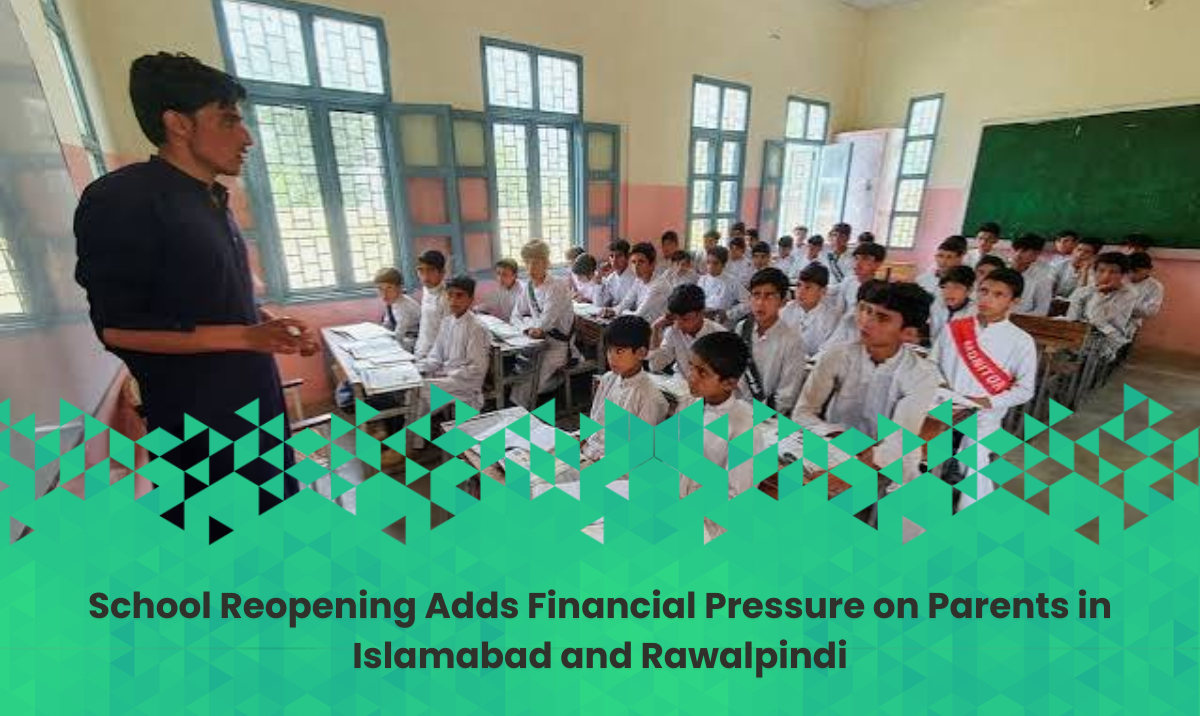
The start of a new academic year is traditionally a time of fresh beginnings, new classrooms, and renewed academic goals for students. However, for households across the twin cities of Islamabad and Rawalpindi, the current school reopening season has brought acute anxiety rather than excitement. Families are grappling with severe financial strain as private educational institutions allegedly enforce strict policies requiring parents to purchase branded books, notebooks, uniforms, and stationery from designated outlets rather than open-market retailers.
This growing commercialization of education has ignited widespread public debate. Parents across the region are raising concerns over exorbitant profit margins, mandatory purchases, and a distinct lack of regulatory oversight that leaves middle- and lower-middle-class households heavily squeezed.
The Burden of the Back-to-School Season
With Islamabad schools already functioning after summer recess and Rawalpindi schools preparing to resume classes on August 24, local markets and designated bookstores have turned into chaotic hubs of activity. Yet, behind the scenes of this seasonal rush lies a distressing narrative of mounting household debt and compromised household budgets.
According to numerous consumer complaints, private schools frequently mandate that parents buy complete, packaged book sets alongside customized school-branded stationery. This practice effectively strips families of their purchasing freedom. For instance, parents who possess usable textbooks passed down from older siblings find themselves unable to reuse them.
Nazia, a resident whose child studies in Class 8 at a private institution in Iqbal Town, voiced deep frustration over this systemic rigidity. She pointed out that even though her household already owned several textbooks in pristine condition from her older children, the school administration explicitly demanded the purchase of an entirely new, sealed book set.
Unmasking the Price Gap: Open Market vs. Designated Outlets
To understand the scale of the economic pressure, a practical market analysis reveals stark pricing discrepancies between independent local vendors and school-endorsed monopolies.
Local marketplace surveys—including data gathered from established merchants like Satti Book Depot—highlight substantial markups on basic educational essentials:
-
Notebooks: Standard notebooks that comfortably retail between Rs. 100 and Rs. 180 in the open market are routinely priced at Rs. 220 to Rs. 250 at designated outlets.
-
Files and Folders: A standard school file available for Rs. 50 to Rs. 80 in open markets spikes dramatically to over Rs. 200 simply because it bears a school monogram.
-
Homework Diaries: Everyday student diaries priced at approximately Rs. 50 open-market value are marked up to roughly Rs. 170 when stamped with a private institutional logo.
Israrul Haq, a prominent book depot owner, confirmed that these specialized retail loops isolate parents, forcing them to buy items marked up by as much as 150% to 300% compared to standard open-market alternatives. When multiplied across dozens of notebooks, specialized sketchpads, geometry boxes, and branded clothing components, the extra cash outflow adds an unmanageable burden to yearly household expenditures.
Multi-Child Households Bear the Brunt
For families managing two, three, or even four school-going children, the financial arithmetic becomes deeply punishing. Parents point out that private school fees, annual registration charges, laboratory costs, and building funds already consume a major chunk of monthly earnings. Adding inflated, monopolized material costs at the start of every academic term triggers a severe cash-flow crisis for salaried individuals.
Maryam, another concerned parent navigating the private education system in Rawalpindi, expressed her dismay over these compounding costs.
Critics argue that these tied-selling arrangements point to unholy commercial alliances between selective private school administrations and preferred vendors, running counter to fair trade practices and consumer rights protection frameworks.
Calls for Regulatory Intervention and Transparency
As financial strains deepen across the twin cities, civic groups and affected families are scaling up calls for urgent intervention from the Federal Directorate of Education (FDE) and Punjab’s regulatory bodies. Parents are demanding:
-
Strict enforcement of policies prohibiting schools from forcing purchases through specific vendors.
-
Mandatory allowance of reusable books to minimize paper waste and family expenditures.
-
Caps on branding markups, ensuring that school logos do not artificially inflate item prices by multiple folds.
Without prompt, decisive action from regulatory authorities to enforce transparency and protect consumers, the start of every academic calendar will continue to act as an unmitigated financial crisis for ordinary households striving to provide quality education for their children.









Share your comments & questions here
No comments yet. Be the first to comment!