




 Home
Home
 National
 International
 Merit list
 Date Sheet
 Result
 Admission
 Study Abroad


.jpg)
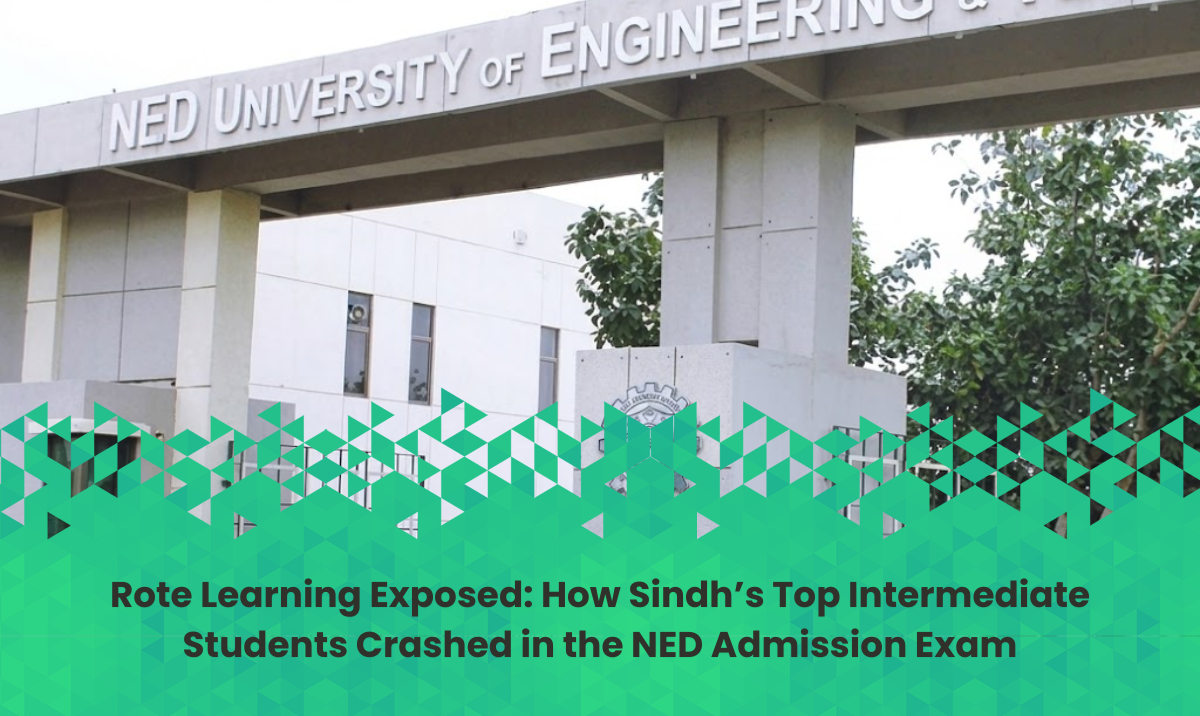
Sindh Board Education Crisis: 70% to 80% Matric & Intermediate Scorers Fail NED University Admission Test
The stark contrast between theoretical academic performance and practical capability has been laid bare once again. In a development that has sent shockwaves through Pakistan's academic community, the entry test results for the prestigious NED University of Engineering and Technology have exposed deep-seated systemic flaws within the public sector Sindh educational boards .
The findings are alarming: thousands of students who secured stellar 70% to 80% marks in intermediate exams failed to achieve even the bare minimum passing criteria in the university’s rigorous entrance assessment. Meanwhile, candidates hailing from independent, federal, and international examination systems achieved overwhelmingly high pass rates, highlighting a growing educational divide.
The Shocking Findings: Grading Inflation vs. Practical Aptitude
Speaking on the outcome, the Vice Chancellor of NED University, Dr. Muhammad Tufail, expressed deep concern over the credibility of the grading mechanisms employed by several public boards across Sindh. According to university data, while a high percentage of applicants entered the application pool boastfully holding 'A' and 'A-1' grades from their respective intermediate boards, their performance collapsed when faced with conceptual testing.
To qualify for open merit admissions at NED University, a candidate must secure a minimum of 50% marks in the admission test . Out of the 13,056 candidates who sat for the high-stakes test, 9,252 managed to qualify , translating into an overall institutional pass rate of 70.86% . However, a granular breakdown of the results reveals a devastating disparity based on the students’ primary boards of education.
Private vs. Public Boards: A Tale of Two Educational Worlds
The data shows a massive performance gap between students from private or standardized federal systems and those from provincial public boards in Sindh.
The Top Performers (Private & Federal Systems)
Students coming from international and independent examination systems proved to have a robust conceptual foundation:
-
Foreign Examination Systems: Recorded the highest success with an incredible 95.65% pass rate.
-
Cambridge Assessment International Education (CAIE): Followed closely behind with an impressive 94.32% pass rate.
-
Aga Khan University Examination Board (AKU-EB): Continued its track record of excellence with an 88.84% pass rate.
-
Federal Board of Intermediate and Secondary Education (FBISE): Logged a highly respectable 83.71% pass rate.
The Urban-Rural Divide in Sindh Boards
Within Sindh, only the urban hub of Karachi maintained a salvageable academic standing. The Board of Intermediate Education Karachi (BIEK) posted a pass rate of 79.91% .
However, the educational infrastructure outside of Karachi collapsed under scrutiny:
-
Hyderabad Board: 46.83% pass rate.
-
Nawabshah Board: 42.03% pass rate.
-
Mirpurkhas Board: 40.43% pass rate.
-
Larkana Board: 36.71% pass rate.
-
Sukkur Board: 35.06% pass rate.
-
Sindh Board of Technical Education (SBTE): Bottomed out with a dismal 13.95% pass rate.
Analyzing the Performance Gap
|
Examination Board / System |
Pass Rate (%) in NED Entry Test |
Performance Status |
|
Foreign Systems |
95.65% |
Exceptional |
|
Cambridge (O/A-Levels) |
94.32% |
Exceptional |
|
Aga Khan Board (AKU-EB) |
88.84% |
Very High |
|
Federal Board (FBISE) |
83.71% |
High |
|
Karachi Board (BIEK) |
79.91% |
Satisfactory |
|
Hyderabad Board |
46.83% |
Critical / Poor |
|
Nawabshah Board |
42.03% |
Critical / Poor |
|
Mirpurkhas Board |
40.43% |
Critical / Poor |
|
Larkana Board |
36.71% |
Failing |
|
Sukkur Board |
35.06% |
Failing |
|
Technical Board (SBTE) |
13.95% |
Disastrous |
Why Are High-Scoring Sindh Board Students Failing?
Education experts and university administrators point to several critical issues that explain why students with high intermediate percentages are unable to clear a basic engineering aptitude test:
1. Rote Learning vs. Conceptual Clarity
The curriculum and testing methodology in many of Sindh’s public boards favor rote memorization ( ratta culture ) over critical thinking and conceptual understanding. When students encounter the application-based questions of the NED admission test—which demand logical reasoning in Physics, Chemistry, and Mathematics—memorized definitions fail to carry them through.
2. Grade Inflation and Unfair Means
There are deep concerns regarding "grade inflation" and the lenient checking practices within certain regional boards. In many rural centers, the persistence of cheating, paper leaks, and unstandardized assessment metrics allows students to secure 80%+ marks without possessing fundamental subject knowledge.
3. Institutional and Governance Collapse
Perhaps the most damaging factor is the structural decay of the examination boards themselves. Over the last several years, key public boards across Sindh have functioned without permanent leadership. Crucial administrative posts, including Chairpersons, Controllers of Examinations, Secretaries, and Audit Officers , are either left vacant or filled by ad-hoc, temporary appointments. For instance, both the Hyderabad Board and the Karachi Matriculation Board have operated without permanent chairpersons for months, leading to a total loss of oversight, quality control, and accountability.
A Call for Immediate Education Reforms in Sindh
The performance of the Sindh Board of Technical Education (SBTE)—where nearly 86% of students failed the admission test—is a clear warning sign. Technical education is supposed to prepare students for practical, hands-on engineering fields, yet its candidates proved to be the least prepared.
Educationists assert that the provincial government must treat this as an education emergency . If intermediate certificates issued by public boards do not align with the entry requirements of national universities, the future of thousands of rural youth remains in jeopardy.
Recommended structural reforms include:
-
Digitization and Centralization: Upgrading the grading and examination methods to eliminate human bias, paper leaks, and manual tampering.
-
Appointing Permanent Leadership: Clearing administrative bottlenecks by immediately appointing qualified, permanent officers to oversee board operations.
-
Teacher Training: Retraining college lecturers across interior Sindh to shift their teaching methodologies from textbook memorization to analytical problem-solving.
What Lies Ahead for NED Candidates?
For now, the compiled entry test statistics do not include A-Level students because their final exams are still ongoing. Dr. Tufail confirmed that NED University will hold a dedicated admission test phase for CAIE A-Level candidates as soon as their academic sessions conclude.
As the university prepares its final merit list, the conversation among educators, parents, and policy experts must shift toward bridging this gap. Without an immediate overhaul of Sindh's public examination system, the academic credentials of its students risk losing all worth in the competitive national and global market.








Share your comments & questions here
No comments yet. Be the first to comment!