




 Home
Home
 National
 International
 Merit list
 Date Sheet
 Result
 Admission
 Study Abroad


.jpg)
Pakistan TTS Salary Revision: Ministry of Finance Notification Triggers Backlash Over Major Pay Disparities
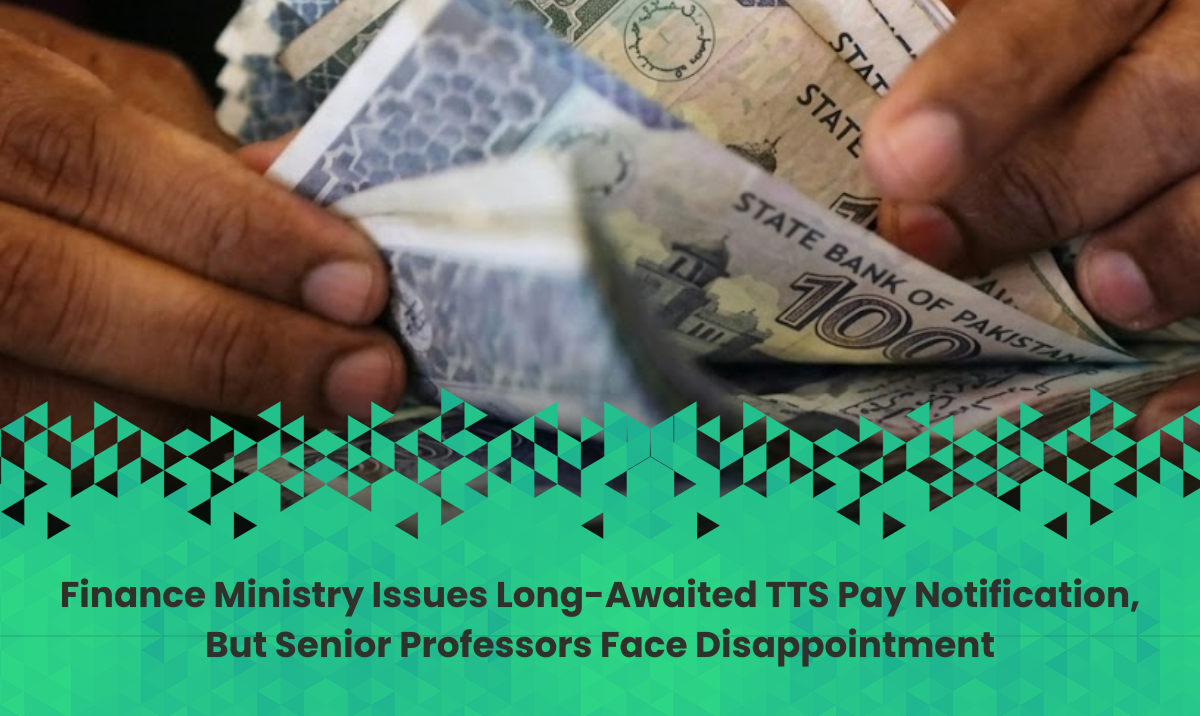
For the first time in five years, the Federal Government of Pakistan has officially announced a pay revision for foreign-qualified and highly specialized university faculty members employed under the Tenure Track System (TTS) . While the decision was meant to offer financial relief amidst soaring inflation, it has instead sparked severe backlash and an immediate rejection from the TTS Faculty Association .
The Ministry of Finance issued the formal notification following years of academic unrest, marking July 1 as the implementation date. However, rather than resolving long-standing issues, the newly revised salary scales have exposed a massive, deep-seated structural crisis. University professors and senior academic circles claim that the revision falls severely short of the 35% TTS salary increase promise made by the Prime Minister's office back in 2021. Instead of a uniform correction, the new framework has introduced major pay disparities across academic ranks, threatening to stifle career progression and accelerate brain drain within Pakistan's higher education sector.
Breaking Down the Pay Disparities: A Look at the Revised TTS Salary Scales
The primary catalyst for the widespread outrage is the highly uneven distribution of increments across different teaching ranks. Rather than applying a flat percentage adjustment to all tiers, the Higher Education Commission (HEC) and the Ministry of Finance designed a skewed, asymmetrical scale:
-
University Professors (Minimum Increase): Senior professors, who spearhead major research publications and manage PhD cohorts, received a negligible maximum salary increase of only 4% .
-
Associate Professors (Moderate Increase): Faculty members in this mid-tier rank received salary increments ranging strictly between 31% and 40.8% .
-
Assistant Professors (Maximum Increase): Entry-level TTS faculty members saw the most substantial adjustments, with pay raises jumping by up to 55% .
According to the official notification issued by the Finance Division:
-
The minimum salary of a TTS Professor has nudged upward from Rs. 394,875 to Rs. 407,230 , while the maximum cap is fixed at Rs. 712,030 .
-
The minimum monthly pay of a TTS Assistant Professor has risen from Rs. 175,500 to Rs. 288,020 , with the maximum limit set at Rs. 553,820 .
TTS vs. BPS: The Widening Disparity
To put these figures into perspective, the table below highlights how the newly announced ranges stack up across the three academic cadres, highlighting the pay anomalies.
|
Academic Rank |
Previous Minimum Salary (PKR) |
New Minimum Salary (PKR) |
New Maximum Salary (PKR) |
Maximum Percentage Increase |
|
Assistant Professor |
Rs. 175,500 |
Rs. 288,020 |
Rs. 553,820 |
55.0% |
|
Associate Professor |
Varies by tier |
Slightly revised |
Slightly revised |
40.8% |
|
Professor |
Rs. 394,875 |
Rs. 407,230 |
Rs. 712,030 |
4.0% |
Why the TTS Faculty Association Rejects the Pay Structure
The TTS Faculty Association and the Federation of All Pakistan Universities Academic Staff Associations (FAPUASA) have completely rejected the notification, labeling it "legally and administratively flawed" .
The core grievance is that the new system fundamentally breaks the logical pay hierarchy of academia. Under the new pay structure, senior assistant professors and associate professors will, in many instances, earn more than newly promoted colleagues in higher ranks.
Furthermore, the association points out that the revision directly violates:
-
The Prime Minister’s Task Force recommendations (headed by Planning Minister Ahsan Iqbal), which advised aligning TTS salaries with a consistent 35% premium over the Basic Pay Scale (BPS) system.
-
Multiple directives issued by the High Court regarding fair compensation.
-
Constitutional principles of fairness, equity, and equal pay for equal work.
The Financial Burden Shifted to Public Universities
In a surprising administrative move, the federal government clarified that it will not provide additional funding to cover these salary increases. Instead, individual public universities must bear the entire financial impact of this salary revision utilizing their own local resources .
This clause has sent shockwaves through university administrations nationwide. Public sector higher education institutions in Pakistan are already facing an unprecedented financial crunch. With the recurring grants from HEC remaining largely frozen, many universities are already struggling to pay basic monthly pensions and utilities. Forcing universities to self-fund a massive wage adjustment for assistant and associate professors will likely lead to:
-
A freeze on new research grants and laboratory upgrades.
-
Cuts in student services, library resources, and digital access.
-
A complete halt on hiring new foreign-qualified PhDs.
Erosion of the Tenure Track System & Threat of Brain Drain
The Tenure Track System (TTS) was conceptualized and launched in 2002 to modernize Pakistan’s higher education landscape. The core vision was to attract exceptional, foreign-qualified PhD researchers by promising them a contract-based, highly competitive, double-salary structure compared to the secure but lower-paying Basic Pay Scale (BPS) .
However, since 2021, TTS salaries had remained absolutely frozen. During this same five-year window, Pakistan witnessed record-high inflation levels reaching up to 38%, accompanied by an 81% surge in the tax burden on salaried professionals. Conversely, BPS faculty members received regular ad-hoc relief allowances, utility allowances, and annual pay adjustments. This has resulted in a bizarre system inversion where regular BPS professors frequently out-earn their high-output TTS counterparts.
The failure to preserve the mandated 35% TTS-BPS salary gap is accelerating a severe brain drain. Highly qualified scientists, engineers, and researchers are leaving public universities to take up positions in the private sector or fleeing the country entirely for academic roles in the Middle East, Europe, and North America.
Way Forward: Urgent Reforms Needed
Academic stakeholders and the TTS Faculty Association are calling upon the Prime Minister, the Ministry of Finance, and the HEC to instantly withdraw the controversial notification. They demand a restructured, non-discriminatory salary revision that preserves the 35% premium across all cadres. Without immediate rectification, Pakistan's higher education sector risks losing its competitive research edge and its most valuable human resource assets.







Share your comments & questions here
No comments yet. Be the first to comment!