




 Home
Home
 National
 International
 Merit list
 Date Sheet
 Result
 Admission
 Study Abroad



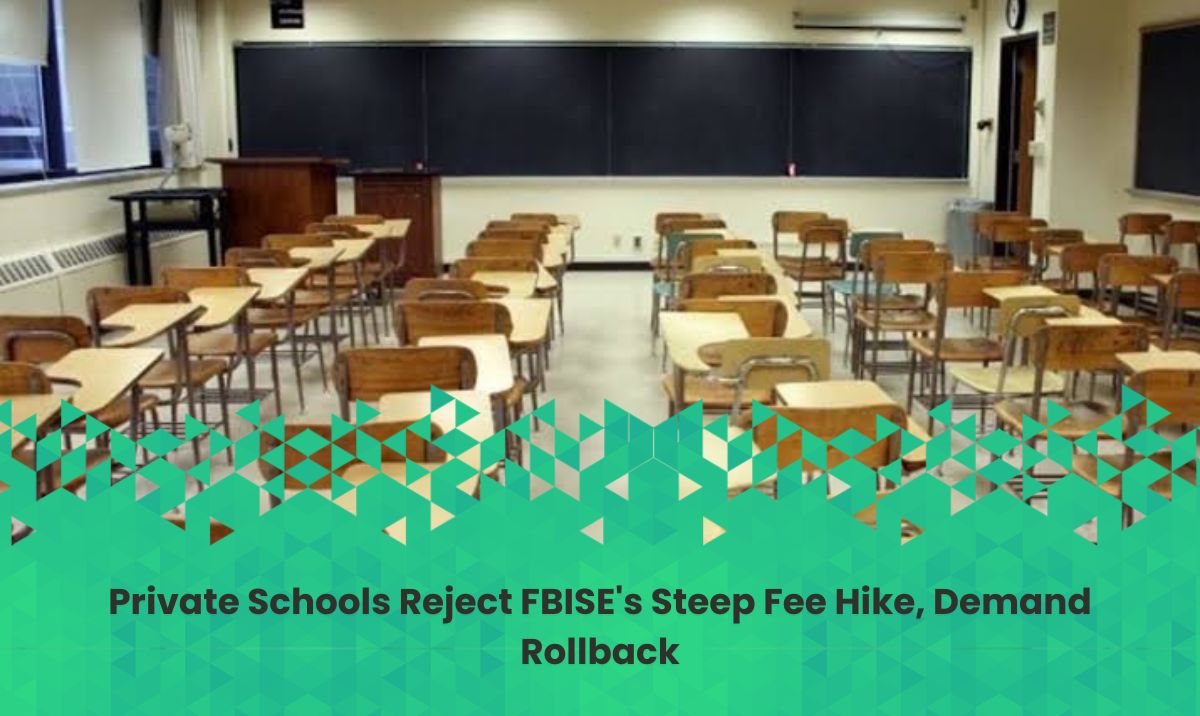
Private school associations across Pakistan have formally rejected a sharp increase in fees charged by the Federal Board of Intermediate and Secondary Education (FBISE), including affiliation, inspection, renewal and security charges. A joint delegation met Federal Education Minister Khalid Maqbool Siddiqui and submitted a charter of demands, warning that the hike could push low- and medium-fee schools into financial distress. The minister assured that the government would review the concerns raised.
FBISE Fee Increase Sparks Backlash From Private School Bodies
Private educational institutions across Pakistan have pushed back against a several-fold increase in fees imposed by the Federal Board of Intermediate and Secondary Education (FBISE), calling the hike unaffordable for schools operating on low and medium fee structures.
The protest was formalized when a delegation representing the Joint Action Committee of All Private Schools Associations held a meeting with Federal Education Minister Khalid Maqbool Siddiqui to present a detailed charter of demands, seeking an immediate review of the revised fee structure.
What Triggered the Protest
According to the delegation, FBISE has substantially raised charges across several categories, including:
- School affiliation fees
- Inspection fees
- Renewal fees
- Security-related charges
- Other administrative fees
School representatives argued that these increases go well beyond what smaller institutions can sustainably absorb, particularly those already operating on tight budgets while charging modest tuition fees to middle- and lower-income families.
The associations stressed that private schools are not simply commercial entities but active partners of the state in expanding access to education, currently educating millions of children across the country. They argued that policies increasing operational costs risk undermining this partnership and could eventually be passed on to parents through higher tuition — defeating the purpose of affordable private education.
Who Was in the Delegation
The delegation that met the federal minister included a mix of current and former board representatives along with leaders of major private school networks:
- Nasir Mahmood — former member, FBISE Board of Governors
- Hafiz Mohammad Basharat — member, FBISE Board of Governors
- Abrar Ahmed Khan — President, APSMA North Punjab
- Chaudhry Mohammad Obaidullah
- Maqbool Hussain Dar — President, Private Schools Network
- Malik Naseem Ahmed — President, All Pakistan Private Schools Association
- Sakina Taj — former member, FBISE Board of Governors
- Raja Khalid Mahmood — leader, Educational Society
The presence of both current and former Board of Governors members in the delegation signals that concerns over the fee hike extend beyond ordinary school owners and into the board's own governance circles.
Government's Response
Federal Education Minister Khalid Maqbool Siddiqui, responding to the delegation, acknowledged the concerns raised over the fee increase and assured that the recommendations, proposals and difficulties presented would be addressed by the government.
He further stated that private educational institutions play a supportive role in the government's broader push to promote education nationwide, and reaffirmed that the government recognizes and values this contribution.
While the minister's remarks signal openness to reviewing the matter, no formal announcement rolling back or revising the FBISE fee structure has been made yet. Private school associations are expected to continue engaging with the ministry until a concrete decision is issued.
Why This Matters for Parents and School Owners
For parents, any additional financial burden on schools — especially those in the low-fee category — carries the risk of being passed down through tuition adjustments. For school owners and administrators, the fee hike raises broader questions about the cost of maintaining FBISE affiliation, particularly for smaller institutions in cities and towns outside major urban centers.
The outcome of these discussions could set a precedent for how regulatory fee structures are handled for private education boards going forward.





Share your comments & questions here
No comments yet. Be the first to comment!