








BS Islamic Studies Jobs in Pakistan 2026 – Career Opportunities
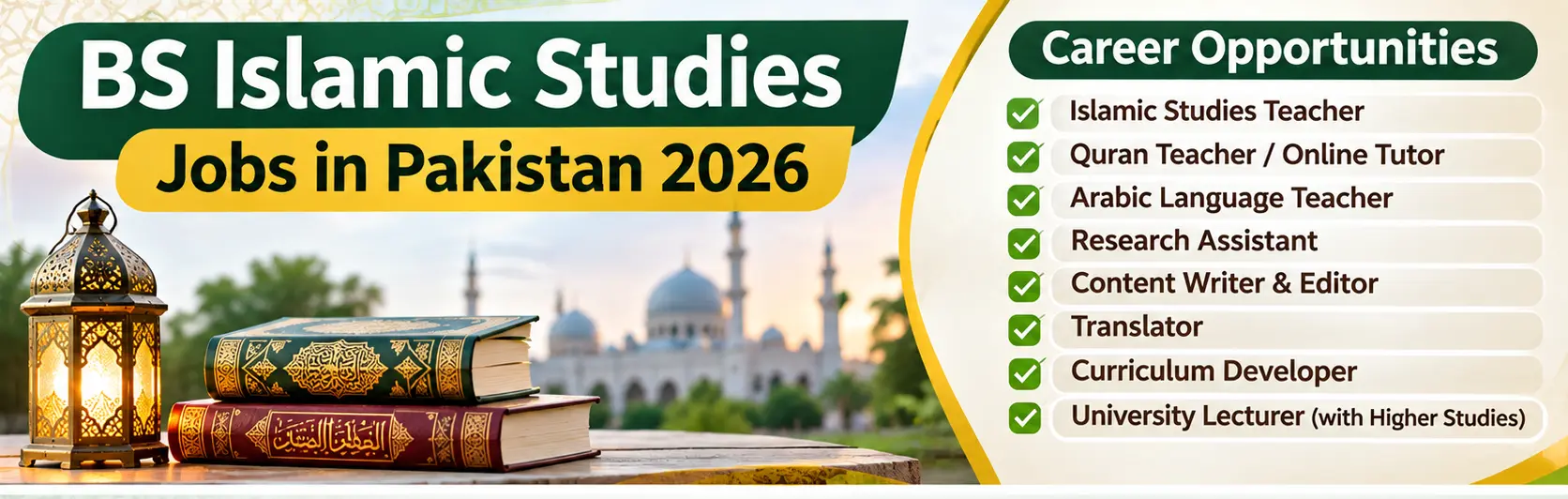
BS Islamic Studies jobs in Pakistan include opportunities in education, Quran teaching, religious research, translation, publishing, educational content development and selected government departments. Graduates can pursue careers in schools, Islamic educational institutions, research organizations and digital learning platforms, depending on their qualifications and professional skills.
Students searching for BS Islamic Studies jobs in 2026 should understand that a four-year bachelor's degree can qualify them for certain entry-level positions, while university teaching, advanced research and specialized professional roles may require postgraduate education or additional training.
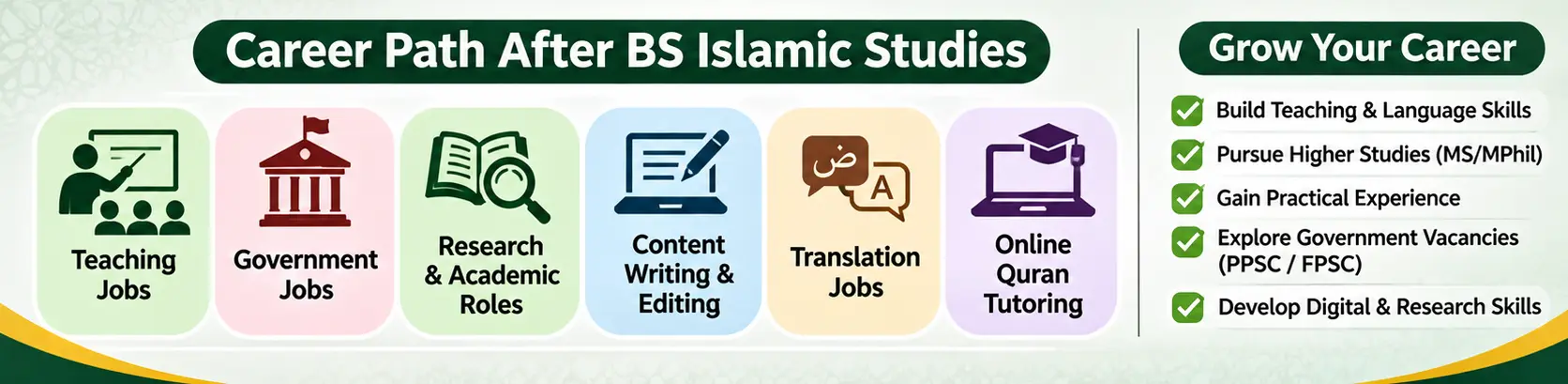
The career options available after BS Islamic Studies are not limited to religious teaching. Graduates with strong communication, Arabic language, research and digital skills may also explore content writing, translation, academic publishing and online education.
BS Islamic Studies Career Opportunities in Pakistan
The scope of BS Islamic Studies depends on a graduate's academic background, specialization, teaching abilities and professional experience. Some graduates begin working after completing their bachelor's degree, while others pursue MS or MPhil studies to qualify for more specialized academic positions.
The following table explains common career options after BS Islamic Studies.
|
Career Option |
Employment Sector |
Additional Requirements |
|---|---|---|
|
Islamic Studies Teacher |
Schools and academies |
Teaching skills; B.Ed. may be required |
|
Quran Teacher |
Schools, academies and online platforms |
Tajweed and Quran teaching proficiency |
|
Arabic Language Teacher |
Language institutes and schools |
Strong Arabic proficiency |
|
Government Teacher |
Public education departments |
Recruitment eligibility and selection tests |
|
University Lecturer |
Universities |
Normally MS/MPhil or equivalent |
|
Research Assistant |
Universities and research centers |
Research and academic writing skills |
|
Islamic Content Writer |
Publishers and digital platforms |
Writing and subject knowledge |
|
Islamic Translator |
Translation and publishing organizations |
Arabic and translation proficiency |
|
Curriculum Developer |
Educational publishers and institutions |
Curriculum design experience |
|
Academic Editor |
Publishing and research organizations |
Editing, referencing and language skills |
Students planning their careers should first understand the academic foundation of the degree. The BS Islamic Studies syllabus provides information about the subjects studied during the program, including Quranic Studies, Hadith, Islamic Jurisprudence, Arabic and Research Methodology.
Jobs After BS Islamic Studies in Pakistan
Graduates can explore employment in both the public and private sectors. However, the availability of positions varies by institution, location, recruitment cycle and required qualifications.
1. Islamic Studies Teacher
Teaching is one of the most direct career options for BS Islamic Studies graduates. Private schools, Islamic schools and educational academies may recruit candidates to teach Islamiyat, Islamic history, Quranic studies and related subjects.
Teachers prepare lessons, conduct classroom activities, assess students and help learners understand Islamic teachings. Strong communication skills and knowledge of the relevant curriculum are particularly useful.
A BS Islamic Studies degree may meet the academic requirements of certain school teaching positions. However, some employers require a B.Ed., teaching experience or additional professional qualifications.
2. Quran Teacher and Online Quran Tutor
Quran teaching offers opportunities in Islamic schools, academies, religious education centers and online tutoring platforms.
Graduates with strong Tajweed, Quran recitation and teaching skills can provide instruction to children and adult learners. Online teaching may also allow qualified tutors to work with students outside their local area.
Candidates can explore Quran teacher jobs in Pakistan to learn about relevant teaching roles and application opportunities.
A university degree alone does not establish expertise in Quran recitation or memorization. Employers may require a Tajweed certificate, Hifz qualification, teaching demonstration or evidence of practical proficiency.
3. Arabic Language Teacher
Graduates who develop strong Arabic language skills may pursue teaching opportunities in schools, academies and language learning institutions.
Arabic teachers help students understand grammar, vocabulary, reading comprehension and translation. Some institutions also require familiarity with classical Arabic texts.
Candidates should assess their Arabic proficiency before applying because completing introductory Arabic courses during a BS degree does not automatically qualify someone to teach advanced Arabic.
4. Islamic Studies Lecturer
University teaching is a possible long-term career for graduates who continue their education after BS Islamic Studies.
A four-year BS degree alone is generally insufficient for appointment as a university lecturer under the applicable HEC faculty qualification framework. Candidates ordinarily need an MS/MPhil or equivalent qualification in a relevant discipline, subject to current institutional and regulatory requirements.
Students interested in academic careers can pursue postgraduate specialization in Quranic Studies, Hadith, Islamic Law, Islamic History or related fields.
Recruitment may involve academic screening, interviews, teaching demonstrations and other assessments specified by the university.
5. Islamic Research Assistant
Research assistants support academic projects involving Islamic history, Quranic interpretation, Hadith studies, comparative religion and Islamic intellectual traditions.
Their responsibilities may include collecting references, reviewing academic literature, organizing research material and preparing written summaries.
Graduates who have studied Research Methodology and completed academic projects may find this career particularly relevant. Advanced research positions usually require further qualifications and experience.
6. Islamic Content Writer and Editor
Islamic content writing is another potential career path for graduates with strong research and writing skills.
Educational publishers, websites, digital learning platforms and media organizations may require writers to prepare articles, textbooks, study guides and educational scripts.
An Islamic content writer must verify religious references carefully and distinguish established scholarship from personal interpretation. Knowledge of English, Urdu or Arabic can improve opportunities in multilingual publishing.
Editors may also review manuscripts, check references and improve the clarity of educational material.
7. Islamic Translator
Translation opportunities may be available to graduates who are proficient in Arabic, Urdu and English.
Translators work with educational texts, historical documents, research material and other written content. Accurate translation requires more than basic language knowledge, particularly when working with specialized religious terminology.
Professional translation training and a portfolio of completed work can help candidates demonstrate their abilities.
8. Curriculum Developer and Educational Content Specialist
Graduates with teaching experience and curriculum design skills may contribute to the development of Islamic Studies textbooks, worksheets, assessments and digital learning resources.
These positions can involve aligning educational material with prescribed curricula, preparing lesson objectives and reviewing academic accuracy.
Additional experience in instructional design, educational technology or classroom teaching can be valuable.
Government Jobs After BS Islamic Studies in Pakistan
Government employment is an important career consideration for many BS Islamic Studies graduates. Relevant opportunities may arise in public schools, colleges, educational departments and other government organizations.
However, eligibility depends on the specific vacancy advertisement. A BS Islamic Studies degree does not automatically qualify a candidate for every teaching or administrative position.
Government Islamic Studies Teacher Jobs
Public education departments may advertise Islamiyat or Islamic Studies teaching positions according to their staffing requirements.
Recruitment conditions can include:
-
A recognized academic qualification in the relevant subject.
-
A professional teaching qualification where required.
-
Age, domicile and other eligibility conditions.
-
Written examinations, interviews or merit-based selection.
-
Document verification and any additional recruitment requirements.
Candidates should read each advertisement carefully because the eligibility requirements may differ between provinces and recruitment authorities.
PPSC and FPSC Islamic Studies Jobs
The Punjab Public Service Commission (PPSC), Federal Public Service Commission (FPSC) and other relevant recruitment bodies may advertise positions for which Islamic Studies graduates are eligible.
Some posts are subject-specific, while others accept graduates from several disciplines.
Applicants should check the required qualification, experience, age limits, domicile conditions, syllabus and selection procedure for each vacancy.
Government College Lecturer Jobs
Government college lecturer recruitment should not be confused with school teaching recruitment or university faculty appointments.
The required qualification depends on the relevant service rules and the advertised post. Candidates should not assume that every college lecturer position accepts a four-year BS degree.
Students interested in academic teaching can also review BS Islamic Studies admissions when comparing universities and planning further education.
BS Islamic Studies Salary in Pakistan 2026
The salary of a BS Islamic Studies graduate depends on the employer, job role, city, qualifications, experience and working arrangements.
There is no single verified salary scale that applies to all Islamic Studies graduates in Pakistan. Private schools, online tutoring platforms, publishers and government institutions use different compensation structures.
|
Job Role |
Main Salary Factors |
|---|---|
|
Private School Teacher |
Institution, city, experience and teaching workload |
|
Government Teacher |
Applicable pay scale, allowances and service rules |
|
Quran Tutor |
Number of students, teaching hours and fee arrangements |
|
Arabic Teacher |
Language proficiency, institution and experience |
|
University Lecturer |
Academic rank, qualification and employer |
|
Research Assistant |
Project funding, contract duration and experience |
|
Content Writer |
Employment type, workload and writing expertise |
|
Translator |
Language combination, specialization and project complexity |
A previous 2026 school recruitment advertisement listed an Islamiyat teaching position at approximately Rs. 50,000 per month including an allowance, while a Nazra teaching position was advertised at Rs. 40,000. These figures are examples from specific advertised positions, not average salaries or guaranteed earnings.
Students should compare current job advertisements rather than relying on outdated salary estimates.
Private Sector Jobs for BS Islamic Studies Graduates
Private educational institutions provide another possible employment route for Islamic Studies graduates.
Schools and academies may offer teaching positions, while publishing houses and digital education organizations may recruit content developers, editors and translators.
Graduates can also explore opportunities with educational charities, community learning initiatives and research organizations. The availability of such roles depends on organizational needs and the candidate's relevant skills.
Those considering the degree can compare BS Islamic Studies universities to evaluate their academic options and available specializations.
Online Jobs After BS Islamic Studies
Online work may be suitable for graduates who want to combine subject knowledge with digital communication skills.
Potential online career paths include Quran tutoring, educational content writing, academic editing, translation and the development of Islamic learning resources.
Online teaching requires reliable internet access, clear communication and the ability to explain lessons effectively. Freelance writing and translation also require strong research skills and a portfolio of relevant work.
Students should evaluate online opportunities carefully, confirm payment terms and avoid employers requesting suspicious advance fees.
Higher Studies After BS Islamic Studies
Further education can improve eligibility for advanced teaching and research positions.
Graduates may consider postgraduate studies in Islamic Studies or a related specialization, depending on the university's admission requirements.
Possible academic pathways include:
|
Higher Education Path |
Potential Career Relevance |
|---|---|
|
MS/MPhil Islamic Studies |
University teaching and research |
|
MS/MPhil Quranic Studies |
Specialized Quranic research |
|
MS/MPhil Hadith Studies |
Hadith research and scholarship |
|
MS/MPhil Islamic Law |
Academic study of Islamic jurisprudence |
|
MS/MPhil Comparative Religion |
Research and comparative religious studies |
|
PhD in a Relevant Discipline |
Advanced academic and research careers |
Admission requirements and program availability differ by university. Completing a postgraduate degree can strengthen a candidate's eligibility, but it does not guarantee employment.
Students can also compare the BS Islamic Studies fee structure when planning the financial requirements of their undergraduate education.
Skills Required for BS Islamic Studies Jobs
Academic qualifications provide the foundation for employment, but professional skills are also important.
Communication and teaching: Graduates should be able to explain complex concepts clearly, organize lessons and communicate with different audiences.
Arabic language proficiency: Strong Arabic skills can support translation, textual research and specialized teaching opportunities.
Research and referencing: Employers involved in academic publishing and research may expect candidates to evaluate sources and prepare accurate references.
Digital literacy: Word processing, online teaching software, presentation tools and basic content management skills can support several career paths.
English and Urdu writing: Clear writing skills are useful for education, translation, editing and content development.
Students who are still planning their academic journey can review BS Islamic Studies merit lists to understand university admission selection information.
How to Apply for BS Islamic Studies Jobs in 2026
Applying for relevant jobs requires a clear understanding of the advertised eligibility conditions.
-
Identify suitable positions. Search for Islamic Studies teacher, Islamiyat teacher, Quran tutor, research assistant, Arabic teacher and related vacancies.
-
Check eligibility. Confirm the required degree, experience, professional certifications, age limits and other conditions.
-
Prepare a professional CV. Include academic qualifications, relevant subjects, language proficiency, teaching experience and research projects.
-
Gather supporting documents. Prepare degree certificates, transcripts, identification documents and other records required by the employer.
-
Apply through the stated procedure. Follow the application instructions and submit documents before the closing date.
-
Prepare for assessments. Review relevant subject knowledge, teaching methods and interview questions.
Graduates should also consider internships, supervised teaching experience and short professional courses to strengthen their applications.
Is BS Islamic Studies a Good Career Choice in Pakistan?
BS Islamic Studies can be a suitable degree for students interested in Islamic education, research, religious scholarship, translation and academic writing.
Its career value depends on the graduate's goals and the qualifications required by prospective employers. Students primarily interested in school teaching may benefit from professional teacher training, while those aiming for university careers should plan for postgraduate education.
Graduates who combine Islamic Studies with strong language, research and digital skills may also explore opportunities outside conventional classroom teaching.
The degree offers several possible professional directions, but students should assess actual vacancies, eligibility requirements and career progression before choosing a specialization.
Related Disciplines of BS Islamic Studies



More on BS Islamic Studies
Free Admission Advice for bs islamic studies
Frequently Asked Questions
What jobs can I get after BS Islamic Studies in Pakistan?
Graduates may pursue school teaching, Quran tutoring, Arabic teaching, educational content writing, translation, research assistance and related positions. Eligibility depends on the employer and any additional qualifications required.
Are BS Islamic Studies government jobs available in 2026?
Government departments may advertise relevant teaching and other positions during 2026. However, the availability of vacancies changes, and candidates must check current advertisements for eligibility requirements and application deadlines.
Can I become a lecturer after BS Islamic Studies?
A four-year BS degree alone is generally not sufficient for a university lecturer position. Candidates ordinarily need an MS/MPhil or equivalent qualification under the applicable higher education faculty requirements. College recruitment rules may differ.
What is the salary after BS Islamic Studies in Pakistan?
Salaries vary according to the job, institution, city, experience and qualifications. Government positions follow applicable pay structures, while private employers and online platforms determine their own compensation arrangements.
Can I become an Islamic Studies teacher after completing BS Islamic Studies?
Yes, graduates may qualify for certain school teaching positions. Some employers also require a B.Ed., teaching experience or other professional qualifications. Applicants should verify the requirements of each vacancy.
Can BS Islamic Studies graduates apply for PPSC jobs?
Yes, they can apply for PPSC positions when their degree meets the advertised eligibility criteria. Some posts require specific subject qualifications, professional training or additional experience.
Are online jobs available after BS Islamic Studies?
Potential online opportunities include Quran tutoring, educational content writing, translation and academic editing. Candidates need appropriate subject knowledge, communication skills and digital proficiency.
Which higher degree is useful after BS Islamic Studies?
An MS/MPhil in Islamic Studies or a relevant specialization can support further academic development and eligibility for certain teaching or research positions. A PhD may be appropriate for graduates pursuing advanced academic careers.