




 Home
Home
 Studyabroad
 Guides
 Consultants
 Top Scholarship




Harris Social Impact Fellowship 2027 in the USA
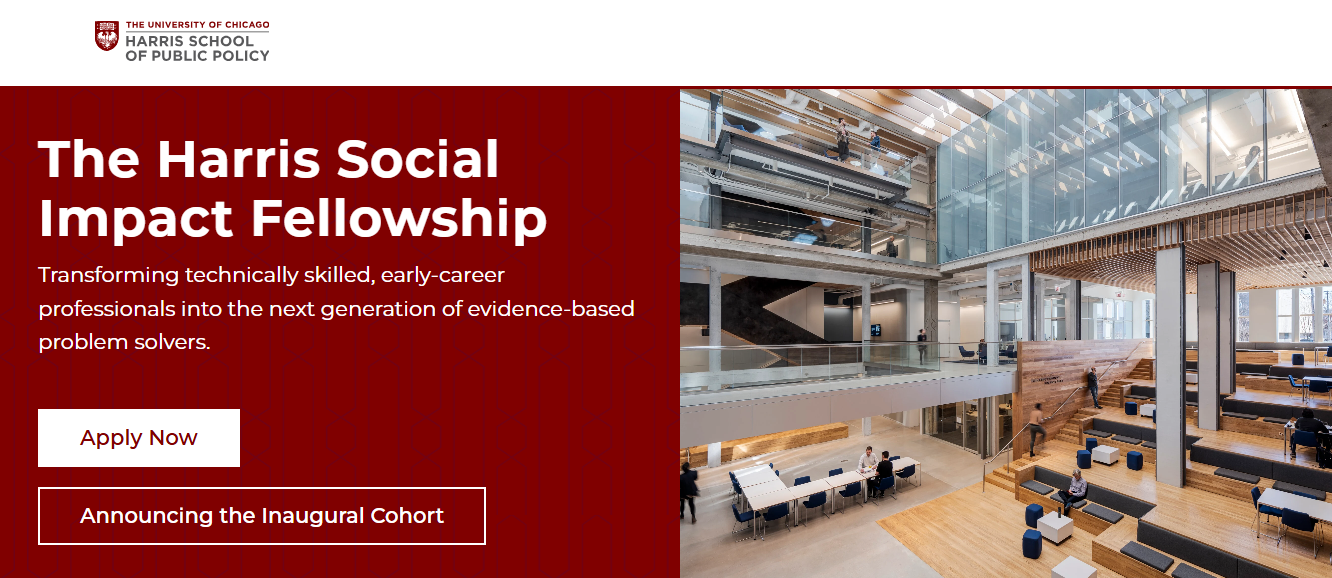
The Harris Social Impact Fellowship 2027 at the University of Chicago is an 11-month, full-time fellowship designed for recent college graduates and early-career professionals with strong STEM, quantitative, technical, or analytical backgrounds. The programme is offered by the University of Chicago Harris School of Public Policy and combines academic training with practical experience addressing real-world social and policy challenges.
The fellowship is designed for individuals who want to use technical and analytical skills beyond traditional careers in areas such as technology, finance, or consulting. Fellows receive training in policy analysis, critical reasoning and data analytics, followed by practical placement with a research centre or policy organisation.
For the 2027 cohort, the fellowship provides substantial financial support, including funding for living and healthcare expenses and academic costs. The current application deadline is October 19, 2026.
What Is the Harris Social Impact Fellowship 2027?
The Harris Social Impact Fellowship is a selective professional development programme at the University of Chicago's Harris School of Public Policy. It is intended for recent graduates and early-career professionals who have demonstrated the ability to perform serious technical, quantitative, or analytical work.
The 11-month programme combines classroom-based learning with practical policy work. Fellows first develop their knowledge of policy analysis, quantitative reasoning, and data analytics before applying those skills to important social challenges through a hands-on placement.
The inaugural cohort began in 2026–27, and the University of Chicago selected 16 fellows for that cohort.
Harris Social Impact Fellowship 2027 Benefits
The 2027 fellowship provides comprehensive financial support for selected participants. Current programme information reports the following benefits:
-
$75,000 stipend for living and healthcare expenses
-
$21,000 to cover the fellowship's academic credentials
-
Faculty-led coursework in policy analysis and data analytics
-
Training in quantitative reasoning and critical thinking
-
Practical placement at a research centre or policy institute
-
Mentoring and professional development
-
Leadership coaching and career support
-
Networking with policy and social-impact professionals
-
Access to an alumni network and fellowship activities
The fellowship is therefore more than a conventional scholarship. It combines financial support, academic training, and professional experience in public policy and social impact.
Who Can Apply?
The Harris Social Impact Fellowship is aimed at recent college graduates and early-career professionals.
According to the University of Chicago's official fellowship information, applicants must have a bachelor's degree conferred before the start of the fellowship. They must also demonstrate the ability to undertake serious technical, quantitative, or analytical work through their academic studies, research, or professional experience.
Applicants should also be prepared to participate in the fellowship on a full-time basis and live in person in Chicago for the duration of the programme.
One important eligibility consideration for international applicants is immigration status. The University of Chicago states that it cannot sponsor visas for this fellowship, and the fellowship does not qualify for the STEM OPT extension. Applicants who already hold a U.S. visa must determine whether their existing status permits participation.
Therefore, international students should carefully review the visa and work-authorization requirements before applying.
Academic and Professional Background
The fellowship is particularly relevant to applicants with strong STEM or analytical backgrounds. Potentially relevant areas can include:
-
Computer Science
-
Data Science
-
Statistics
-
Mathematics
-
Economics
-
Engineering
-
Environmental Science
-
Computational Biology
-
Quantitative Social Science
-
Other technical and analytical disciplines
The programme is not simply looking for a specific undergraduate major. Applicants need to demonstrate that they can use quantitative or analytical methods to understand and address complex social and policy problems.
Programme Structure
The Harris Social Impact Fellowship combines academic learning and practical experience.
During the programme, fellows receive intensive training in areas such as policy analysis, critical reasoning, quantitative methods and data analytics. They then apply these skills through practical work with research centres or policy organisations.
The fellowship allows participants to explore how technical knowledge can be applied to areas such as public policy, environmental challenges, social equity, government effectiveness and other issues affecting communities.
The 2026–27 fellows, for example, have worked on areas including environmental policy, pollution, climate issues, public health and policy applications of computational methods.
Required Documents
Applicants should prepare the required materials before starting the online application. Current programme information indicates that applicants need to provide:
-
Resume or CV
-
Motivation statement
-
Technical experience statement
-
One letter of recommendation
-
Academic transcripts
-
Additional information requested through the online application
-
Technical assessment if shortlisted
Applicants should use their statements to explain their academic or professional background, analytical experience and interest in applying technical skills to social-impact challenges.
How to Apply for the Harris Social Impact Fellowship 2027?
The application is submitted online through the University of Chicago's application system.
Applicants should create an account and select the relevant 2027 Non-Degree Programs option. They can then complete the application form and upload the required supporting materials.
The general process includes:
-
Review the eligibility requirements.
-
Prepare your CV, statements, transcript and recommendation letter.
-
Create an online application account.
-
Select the Harris Social Impact Fellowship under the appropriate 2027 non-degree programme.
-
Complete the application form.
-
Upload all required documents.
-
Submit the application before the deadline.
-
Complete the technical assessment if invited to the next stage.
Applicants should make sure their application clearly demonstrates their quantitative or technical abilities as well as their interest in evidence-based social impact.
Harris Social Impact Fellowship 2027 Deadline
The application deadline for the Harris Social Impact Fellowship 2027 is October 19, 2026, at 11:59 PM Central Time (CT), according to current programme information.
| Fellowship Detail | Information |
|---|---|
| Fellowship Name | Harris Social Impact Fellowship 2027 |
| Host Institution | University of Chicago |
| School | Harris School of Public Policy |
| Country | USA |
| Location | Chicago, Illinois |
| Duration | 11 months |
| Study/Work Format | Full-time, in person |
| Target Applicants | Recent graduates and early-career professionals |
| Background | STEM, quantitative or analytical |
| Living & Healthcare Support | $75,000 |
| Academic Support | $21,000 |
| Application Deadline | October 19, 2026 |
| Visa Sponsorship | Not available |
Important Note for International Applicants
The fellowship can be relevant to international applicants, but candidates should pay particular attention to the visa requirement. The University of Chicago explicitly states that it cannot sponsor visas for this programme. It also states that the fellowship does not qualify for the STEM OPT extension.
This means that simply meeting the academic eligibility criteria does not guarantee that an international applicant can participate. Applicants should independently confirm that they have appropriate U.S. work or participation authorisation.
Final Thoughts
The Harris Social Impact Fellowship 2027 provides a structured pathway for technically trained graduates and early-career professionals who want to apply data, quantitative reasoning and analytical skills to public-policy and social-impact challenges.
The 11-month programme combines academic instruction, practical experience, mentorship and substantial financial support. With reported support of $75,000 for living and healthcare expenses plus $21,000 toward the academic component, the fellowship offers significant financial assistance while providing participants with professional experience in evidence-based policy work.
Applicants should prepare their CV, statements, transcripts and recommendation letter well in advance of the October 19, 2026 deadline. International candidates should also carefully review the programme's visa restrictions before submitting an application. Apply Now




Related ScholarShips
-
01-Oct-2026

KAUST Global Fellowship Program 2027 in Saudi Arabia
-
30-Nov-2026

ATRIUM Summer School 2027 Artificial Intelligence for Humanities
-
30-Sep-2026

British Academy Postdoctoral Fellowship 2027 in UK
-
12-Oct-2026

Society of Fellows in the Humanities Postdoctoral Fellowship 2027
-

AIXI Labs Research Fellowship 2027 in UK
-
01-Mar-2027

Imperial President’s PhD Scholarship 2027-28 in UK
-
01-Jan-2027

Global Korea Scholarship 2027 for International Students
-
19-Oct-2026

Nuffield Medical Fellowship 2028 at University of Oxford