Home
Home
 Studyabroad
 Guides
 Consultants
 Top Scholarship




CRUK Manchester Centre Scholarship 2027–28 in the UK (Fully Funded PhD)
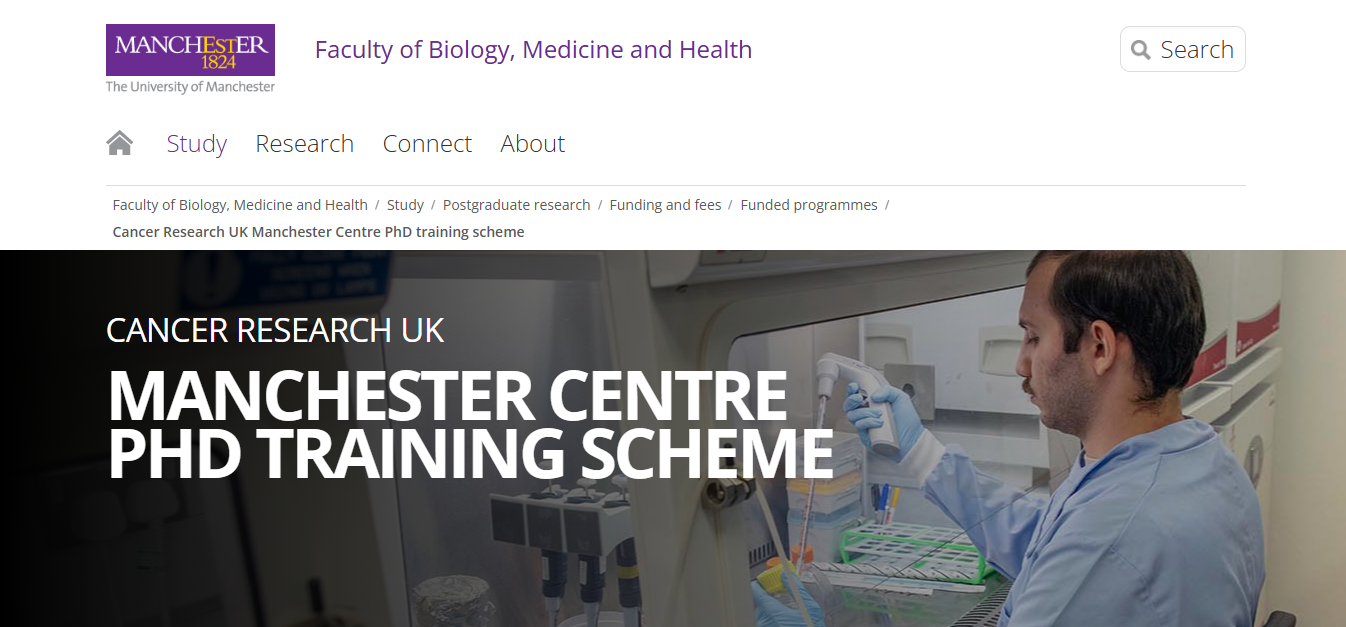
The CRUK Manchester Centre Scholarship 2027–28 offers an exciting opportunity for aspiring researchers and eligible clinical professionals to pursue doctoral research in cancer-related fields in the United Kingdom. Managed by the Cancer Research UK (CRUK) Manchester Centre in collaboration with the Manchester Cancer Research Centre, the program aims to develop talented researchers who can contribute to advances in cancer prevention, diagnosis, treatment, and patient care.
The scholarship scheme provides research training in a multidisciplinary environment, bringing together scientific investigation and clinical expertise. For students interested in building a career in cancer research, this opportunity offers access to specialist research facilities, academic supervision, and professional development.
Applications for the 2027–28 intake open on October 12, 2026, and the deadline is November 23, 2026. Eligible applicants should begin preparing their documents and identifying a suitable research project in advance.
CRUK Manchester Centre Scholarship 2027–28 Overview
| Scholarship Detail | Information |
|---|---|
| Scholarship Name | CRUK Manchester Centre Scholarship |
| Host Institution | University of Manchester |
| Research Centre | Manchester Cancer Research Centre |
| Host Country | United Kingdom |
| Study Level | PhD |
| Research Area | Cancer research and related disciplines |
| Scholarship Period | 2027–28 entry |
| Application Opening Date | October 12, 2026 |
| Application Deadline | November 23, 2026 |
| Expected Start Date | September 2027 |
| Funding Type | Research studentship or clinical fellowship, depending on pathway |
What Is the CRUK Manchester Centre Scholarship?
The CRUK Manchester Centre PhD Training Scheme supports postgraduate research focused on cancer and related scientific and clinical challenges. It operates within a collaborative research environment involving the University of Manchester, Cancer Research UK, and The Christie NHS Foundation Trust.
The program has different pathways for applicants with clinical and non-clinical backgrounds. Clinical research training fellowships are designed for eligible healthcare professionals seeking to develop their research careers, while non-clinical studentships are intended for graduates interested in scientific research.
Applicants should select a project that matches their academic qualifications, research interests, and professional objectives.
CRUK Manchester Centre Scholarship Benefits
The funding package depends on the applicant's pathway and the specific award. The program offers financial and academic support to help successful candidates undertake doctoral research.
Potential benefits include:
-
Tuition fee support: Eligible students receive funding for university tuition fees according to the applicable award conditions.
-
Stipend or salary: Financial support is provided according to the student's research pathway and the terms of the award.
-
Research expenses: Eligible funding can cover project-related running costs.
-
Research facilities: Students gain access to specialist facilities and a collaborative cancer research environment.
-
Professional development: The program offers training in transferable skills and research-related activities.
-
Academic supervision: Candidates work with experienced researchers in their chosen research area.
International applicants should pay particular attention to the funding conditions. The standard international funding arrangements cover UK tuition fees and a stipend, but a limited number of full studentships or fellowships are available to exceptional international candidates. Applicants should confirm the exact funding package offered for their selected project.
Eligibility Criteria for CRUK Manchester Centre Scholarship 2027
Eligibility depends on whether an applicant applies through the clinical or non-clinical pathway.
Clinical Research Applicants
Clinical research training fellowships are intended for qualified healthcare professionals who want to combine clinical practice with cancer research.
Applicants generally need to:
-
Be post-registration clinicians.
-
Ideally hold a specialist training post or have an appropriate clinical background.
-
Meet the academic and professional requirements for their proposed research project.
-
Be eligible for the relevant clinical research training arrangements.
Clinical fellowships are usually three years long, although four-year arrangements may be possible in exceptional circumstances.
Non-Clinical PhD Applicants
The non-clinical pathway is suitable for recent graduates and final-year undergraduate students interested in scientific research.
Applicants generally need to:
-
Hold or be about to obtain at least an upper second-class undergraduate degree, or an equivalent qualification.
-
Demonstrate an appropriate academic background for the selected research project.
-
Show a strong interest in cancer research.
-
Meet the university's doctoral admission requirements.
-
Provide the required supporting documents.
A relevant master's degree can strengthen an application but is not necessarily compulsory for every candidate.
International applicants must select full-time study to meet the stated visa requirements. Part-time awards, where available, cannot be less than 50% of full-time study.
Required Documents for the CRUK Manchester Centre Scholarship
Applicants should prepare the following documents before submitting their applications:
-
Updated curriculum vitae (CV)
-
Supporting statement of no more than 1,000 words
-
Details of two referees
-
Academic certificates and transcripts
-
Official English language proficiency certificate, where applicable
-
Information about the preferred research project
-
Any additional documents requested by the university
The supporting statement should explain the applicant's academic background, motivation for pursuing a PhD, research interests, and suitability for the selected project.
Candidates should ensure that all documents are accurate and complete before submission.
How to Apply for the CRUK Manchester Centre Scholarship 2027–28
Applicants can follow these steps to prepare their applications.
Step 1: Explore available research projects. Review the advertised PhD projects and identify the one that best matches your academic background and research interests.
Step 2: Contact the project supervisor. Applicants are strongly encouraged to contact the relevant supervisor before or during the application process to discuss their interests and suitability.
Step 3: Prepare your documents. Organize your CV, supporting statement, academic transcripts, certificates, and referee details.
Step 4: Complete the online application. Apply through the University of Manchester's postgraduate research application system and select the appropriate MCRC PhD Programme option.
Step 5: Complete the funding section. Follow the university's instructions for identifying the relevant funding scheme and award details.
Step 6: Submit your application. Review all information and submit the completed application before the November 23, 2026 deadline.
Applicants can apply for only one project under the scheme, so selecting the most suitable opportunity is important.
Important Dates and Selection Process
The key dates for the CRUK Manchester Centre Scholarship 2027–28 are:
| Application Stage | Date |
|---|---|
| Applications Open | October 12, 2026 |
| Application Deadline | November 23, 2026 |
| Expected Interview Period | Week commencing January 11, 2027 |
| Expected PhD Start | September 2027 |
Shortlisted candidates are expected to be contacted before Christmas and invited to interviews in January. The assessment may include a paper critique, panel discussion, and question-and-answer session.
Submitting an application does not guarantee admission or funding. Selection depends on the candidate's qualifications, suitability for the research project, and the competitiveness of the applicant pool.
Why Consider Cancer Research at Manchester?
The Manchester cancer research community brings together scientific researchers, clinicians, and other specialists working on cancer-related challenges. This collaborative approach gives doctoral researchers opportunities to develop research skills and understand how scientific findings may contribute to clinical practice.
For candidates planning careers in biomedical research, oncology, clinical research, or academic science, the program can provide valuable doctoral training and professional experience.
Pakistani applicants with relevant academic or clinical backgrounds should carefully review the eligibility requirements and funding arrangements before applying, particularly because fully funded awards for international candidates are limited and competitive.
Final Thoughts
The CRUK Manchester Centre Scholarship 2027–28 in the UK is a valuable opportunity for eligible graduates and clinical professionals seeking PhD training in cancer research. The program combines research training, academic supervision, and potential financial support for successful applicants.
With applications opening on October 12, 2026, and closing on November 23, 2026, prospective candidates should start preparing their documents and selecting a suitable research project as early as possible.
Before applying, confirm the specific eligibility criteria, tuition fee coverage, stipend or salary arrangements, and additional requirements for international applicants. A carefully prepared application can help demonstrate your research interests and readiness for doctoral study. Apply Now




Related ScholarShips
-
31-Oct-2026

Sabancı University PhD Scholarship 2027 in Turkey – Fully Funded
-
31-Oct-2026
Japan Culture Camp Scholarship 2027 for Pakistani Students
-

Qatar University Pakistani Students Scholarship 2026 in Qatar
-
30-Nov-2026
Yenching Academy Scholarship 2027 in China for Pakistani Students
-
15-Dec-2026

Erasmus Mundus NOHA Scholarship 2027 in Multiple Countries
-
DAAD EPOS Scholarship 2027 in Germany for Pakistani Students
-
15-Nov-2026
EURECOM Scholarship 2027 in France for International Students
-
01-Nov-2026
AITHYRA PhD Scholarship 2027 in Austria