



 Jobs Home
 Cities
 Govt Depts
 Comapnies
 Industries
 Professions




New Jobs in USAID
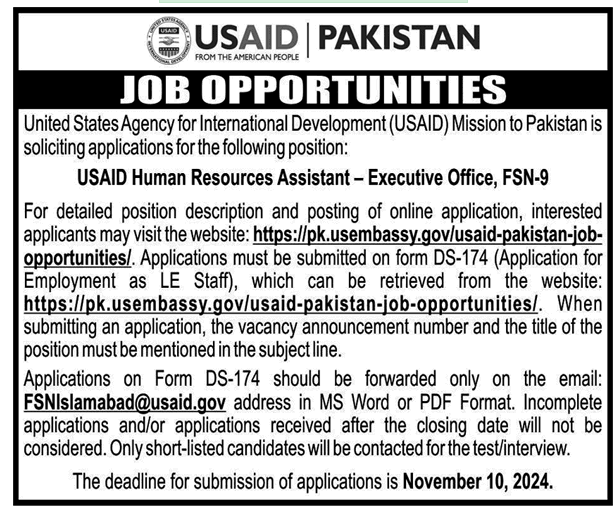
- Job posted on
28-Oct-2024
- Number of vacancies
1
-
Last date to apply
10-Nov-2024
- Job location
Islamabad
- Job type
Permanent
- Job status
Full Time
- Job Announced
- Apply for this job
- Prepare for this job
- Share this job
- Have a question about this job? Ask in the discussion area.
Securing a position with the United States Agency for International Development represents a unique and impactful career path for professionals dedicated to global development and humanitarian assistance. As we look toward 2026, the landscape for USAID jobs is expected to evolve, reflecting shifting global priorities and new strategic initiatives. The agency consistently seeks talented individuals across a wide spectrum of specializations, from public health experts and agricultural scientists to governance advisors and crisis stabilization specialists. These career opportunities are not merely jobs; they are missions that contribute directly to the agency's goal of ending extreme poverty and promoting resilient, democratic societies. The hiring process is competitive and thorough, designed to identify candidates who possess not only the requisite technical skills but also a deep commitment to the agency's core values and development principles.
For those aspiring to join this mission-driven organization, understanding the application ecosystem is crucial. USAID employment opportunities are primarily advertised on the official USAID Careers website and through the U.S. Government's centralized employment site, USAJOBS.gov. Prospective applicants must meticulously tailor their federal resumes and responses to specialized experience statements to meet the specific requirements listed in each vacancy announcement. Networking with current and former agency personnel, attending development sector career fairs, and gaining relevant field experience through fellowships or contracts with implementing partners are all proven strategies to strengthen a candidacy. The anticipation for USAID jobs in 2026 is building, with projections indicating increased hiring in sectors like digital technology for development, climate change adaptation, and locally-led development initiatives, making now an ideal time to begin strategic career preparation.
The United States Agency for International Development is the world's premier international development agency and a catalytic actor driving global progress. Since its establishment by President John F. Kennedy in 1961, USAID has been at the forefront of America's foreign policy, embodying the nation's humanitarian spirit and strategic interests. The agency operates in over 100 countries, working in close partnership with host governments, local organizations, the private sector, and other donors to design and implement programs that address complex challenges. Its work spans emergency response in the wake of disasters to long-term investments in economic growth, health systems, education, and democratic institutions. The organizational structure includes Washington D.C.-based bureaus that set policy and provide technical support, and mission teams deployed in countries around the world who manage programs on the ground, offering diverse environments for professional growth.
USAID's mission is to advance U.S. national security and economic prosperity by promoting a path to recipient self-reliance and resilience. This is achieved by leading international development and humanitarian efforts through partnerships and investments that save lives, reduce poverty, strengthen democratic governance, and help nations progress beyond the need for assistance. The agency's vision is rooted in a belief in the dignity and potential of every individual, driving efforts to create a world where communities are thriving, peaceful, and capable of shaping their own futures. Every USAID career is built upon this foundational purpose, ensuring that daily work contributes to larger, transformative goals. Employees are empowered to bring innovation, evidence-based approaches, and a collaborative spirit to some of the world's most pressing issues, from food security and global health to conflict prevention and women's empowerment.
The spectrum of USAID vacancies is remarkably broad, catering to a diverse array of professional backgrounds and expertise. The agency hires both direct-hire employees, who are U.S. citizens and form the core civil service, and foreign service officers, who serve rotational assignments overseas. Furthermore, numerous opportunities exist through personal services contracts (PSCs) and institutional support contracts. Key hiring areas consistently include global health, where professionals work on initiatives like the President's Malaria Initiative and HIV/AIDS programs; economic growth and trade, focusing on agriculture, entrepreneurship, and market systems; democracy and governance, supporting rule of law, civil society, and electoral processes; and humanitarian assistance, providing life-saving aid during conflicts and natural disasters. Technical fields such as engineering, monitoring and evaluation, and environmental science are also perpetually in demand to ensure program effectiveness and sustainability.
To be a competitive candidate for USAID employment, individuals must typically demonstrate a combination of advanced education, relevant professional experience, and specific competencies. A master's degree in international relations, public health, economics, or a related field is common for many professional roles. Crucially, hands-on experience working in development contexts, often gained with non-governmental organizations, consulting firms, or other international agencies, is highly valued. Language proficiency, particularly in languages like French, Spanish, Arabic, or Portuguese, can significantly enhance an application. The agency also places a strong emphasis on soft skills such as cross-cultural communication, adaptability, problem-solving in resource-constrained environments, and the ability to work effectively in complex team settings. Demonstrating a clear understanding of USAID's operational models, such as co-creation and collaborating, learning, and adapting (CLA), can further distinguish an applicant.
The benefits and career growth associated with USAID hiring are substantial and designed to support a long-term, meaningful career. Federal employees receive a comprehensive benefits package that includes competitive salaries under the General Schedule (GS) or Foreign Service pay scales, health and life insurance, retirement plans, and generous leave allowances. For foreign service officers, benefits often include housing, post allowances, and education travel for dependents. Beyond compensation, the professional development opportunities are unparalleled. Employees have access to continuous learning through the USAID University, opportunities for detail assignments to different bureaus or agencies, and the chance to work on pioneering development projects. The career trajectory can lead from technical or program roles into leadership and management positions, such as Contracting/Agreement Officer's Representative (COR/AOR), Office Director, or even Mission Director, shaping the agency's direction and impact on a global scale.