



 Home
Home
 National
 International
 Merit list
 Date Sheet
 Result
 Admission
 Study Abroad




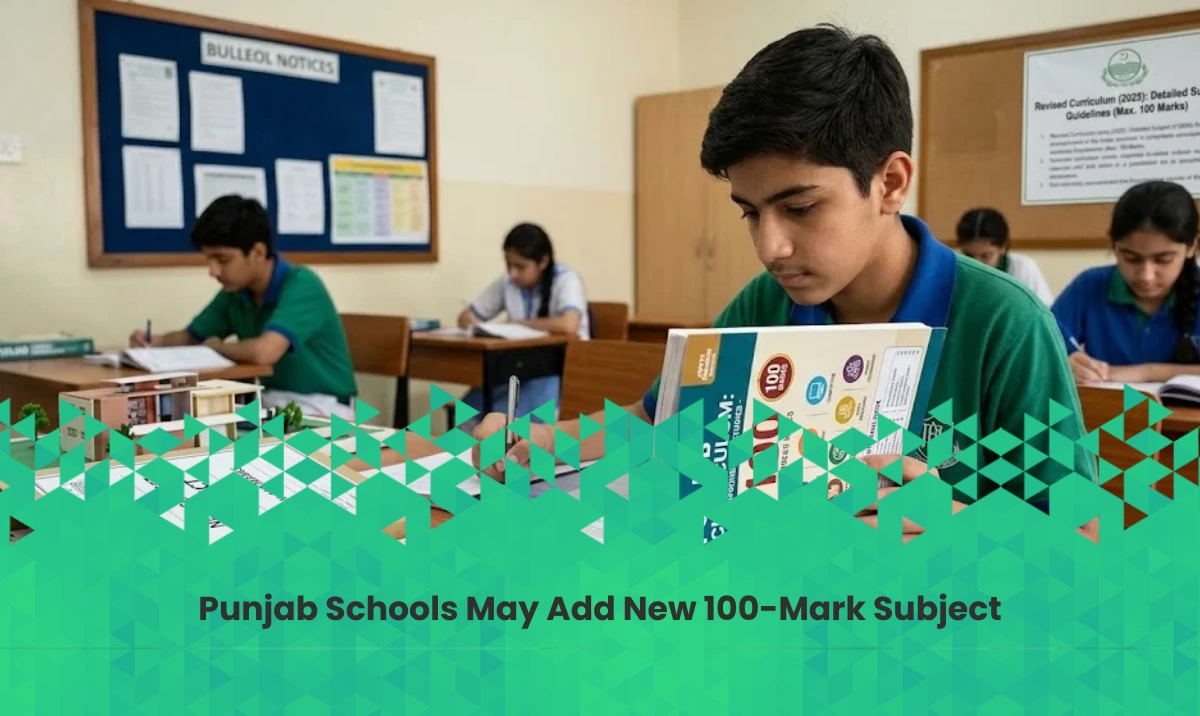
Punjab Schools May Add New 100-Mark Subject: Global Citizenship Curriculum Planned for Grades 4 to 8
In a landmark move to reshape primary and middle-tier education, educational authorities in Pakistan's largest province are taking major steps toward modernizing learning frameworks. Punjab schools are actively considering the introduction of Global Citizenship as a dedicated, standalone 100-mark subject starting from the upcoming academic year. Aimed at elementary and middle school tiers, this curriculum reform seeks to instill critical 21st-century values, international awareness, and civic responsibility among young learners.
According to insider reports, the initiative is being planned in close collaboration with the United Nations Children’s Fund (UNICEF), which is expected to extend extensive technical and financial backing to ensure a smooth nationwide rollout model within the province.
Transforming the Curriculum: What the New Subject Entails
The proposed Global Citizenship curriculum is slated to target students ranging from Grade 4 to Grade 8. Education sector experts note that targeting this specific developmental window—bridging late primary and middle school—is crucial for shaping empathetic, socially conscious, and globally aware individuals.
Unlike traditional elective courses, the subject is planned as a rigorous 100-mark evaluation component. This means students will be formally tested on their comprehension of international frameworks, cross-cultural empathy, and universal human rights.
The core syllabus is expected to focus heavily on:
-
International Rights and Responsibilities: Educating children on global charters, human rights, and the reciprocal duties individuals hold toward society.
-
Sustainable Development: Aligning local student competencies with global standards such as sustainable practices, environmental conservation, and resource management.
-
Interconnectedness and Diversity: Fostering respect for multiculturalism, peacebuilding, and non-violence in an increasingly digital and globalized world.
-
Civic Engagement: Equipping students with problem-solving tools to tackle local issues that carry global implications, such as climate change and economic inequality.
UNICEF Partnership and Institutional Consultations
The implementation roadmap is already underway. Sources indicate that the Punjab Examination Commission (PEC) alongside relevant curriculum authorities have initiated detailed consultations with UNICEF representatives.
The partnership extends beyond mere policy consultation. UNICEF is anticipated to shoulder a significant portion of the financial burden, particularly regarding the mass printing of textbooks, teacher training modules, and supplementary digital educational materials. Officials from the School Education Department have emphasized that external funding will ensure that public sector schools receive high-quality, standardized resources without overburdening provincial administrative budgets.
The collaborative framework builds upon prior discourse concerning modernizing regional educational paradigms. Educational stakeholders have long argued that conventional syllabi must evolve to address rapid technological shifts, globalization, and cross-border socio-economic challenges.
Broadening Horizons for Punjab Students
For decades, the standard public school curriculum in Punjab has heavily prioritized traditional subjects like Mathematics, Science, Urdu, and English. While foundational, educationists argue that these subjects often leave a gap when it comes to practical emotional intelligence, global awareness, and interpersonal civic duty.
By introducing Global Citizenship as a prominent 100-mark subject, the Punjab government aims to bridge this gap. The initiative is projected to:
-
Enhance Analytical Thinking: Push students beyond rote memorization into critical reflections regarding global events, justice, and equality.
-
Prepare for International Standards: Cultivate skills that match international benchmarks, ensuring local students can comfortably compete and collaborate on global platforms.
-
Institutionalize Peace and Tolerance: Foster a culture of inclusivity, mutual respect, and peaceful coexistence from a formative age.
Next Steps and Future Outlook
As consultations wrap up over the coming months, the final framework, textbook drafts, and assessment structures are expected to be formally approved. Teacher training workshops will subsequently roll out across districts to prepare educators for the unique pedagogical strategies required for teaching global citizenship.
If implemented successfully according to schedule, the next academic year will mark a historic turning point for Punjab schools, setting a precedent for other provinces to follow in modernizing Pakistan's educational landscape for the future.



Share your comments & questions here
No comments yet. Be the first to comment!