




 Home
Home
 National
 International
 Merit list
 Date Sheet
 Result
 Admission
 Study Abroad




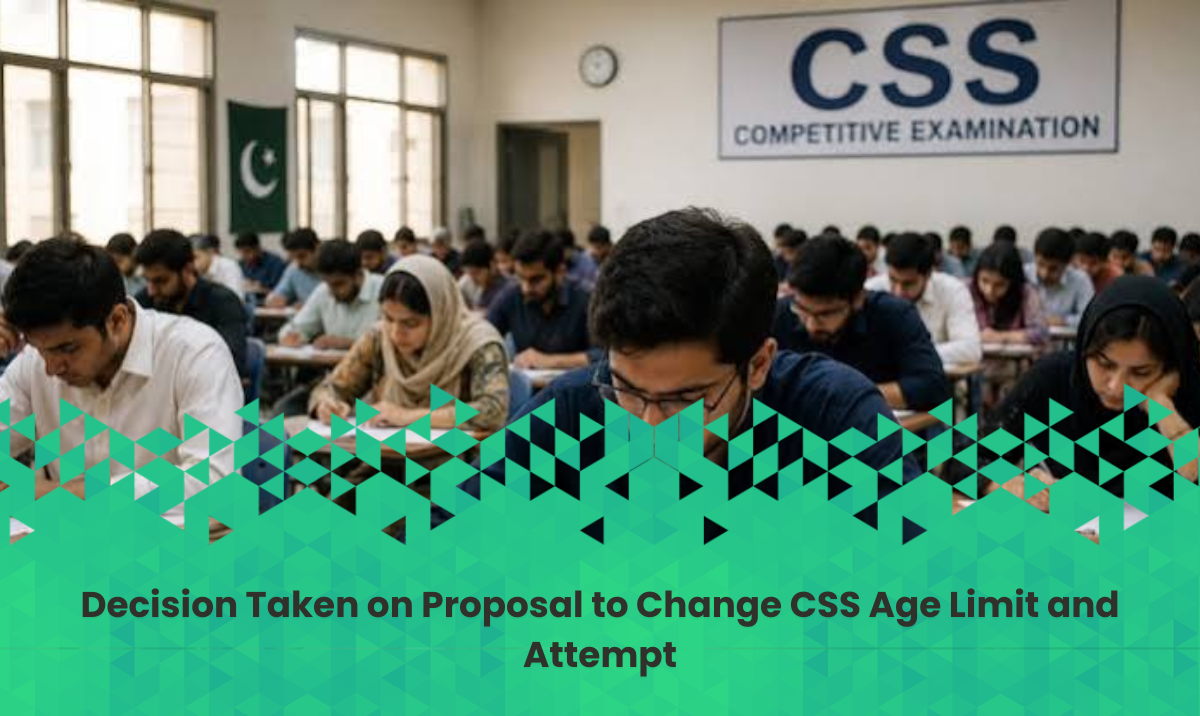
Establishment Division Rejects Proposals to Raise CSS Age Limit and Increase Examination Attempts
The federal government has formally turned down parliamentary recommendations to overhaul the eligibility criteria for the Central Superior Services (CSS) examination. In a definitive policy stance communicated to the parliament, the Establishment Division rejected proposals to raise the CSS upper age limit from 30 to 35 years and to increase the number of allowable CSS attempts from three to five. Consequently, the recruitment framework administered by the Federal Public Service Commission (FPSC) remains unchanged, keeping the general age ceiling strictly between 21 and 30 years with a maximum of three attempts.
Background of the Proposed CSS Reforms
The debate surrounding Pakistan's civil service recruitment framework gained momentum following recommendations put forward by a sub-committee of the Senate Standing Committee on Cabinet Secretariat. Lawmakers and parliamentary panels had argued that modernizing the bureaucratic entry barriers was essential to accommodate candidates facing socioeconomic, academic, or professional delays.
The sub-committee's primary recommendations included:
-
Raising the maximum CSS age limit for general candidates from 30 years to 35 years.
-
Expanding the permitted number of CSS examination attempts from three to five.
-
Introducing greater flexibility into the national civil service recruitment policy to align with regional standards.
Proponents of the reform argued that a higher age limit would give candidates who missed early opportunities due to financial constraints or extended university education a fair chance to enter public service. However, despite parliamentary deliberations and earlier legislative resolutions, executive oversight bodies evaluated the changes and ultimately deemed them unworkable.
Why the Establishment Division Rejected the Proposals
The Establishment Division detailed its objections in a formal written response submitted to the parliamentary committee. Declaring the recommendations impractical, the division outlined several administrative, financial, and structural reasons for maintaining the status quo:
1. Exponential Administrative Burden on the FPSC
Opening the eligibility bracket to candidates up to age 35 and allowing five attempts would trigger a massive surge in the volume of applicants. The Establishment Division noted that a drastically expanded candidate pool would severely strain the FPSC’s logistical capacity, multiplying the workload required to conduct screening tests (such as the CSS MPT), supervise nationwide examination centers, and scrutinize thousands of detailed subjective answer scripts.
2. Loss of Productive Years for Aspirants
Government evaluators raised concerns that increasing the maximum attempts to five would encourage candidates to spend critical, productive years of their youth repeatedly preparing for a single competitive examination. Rather than entering the broader national workforce or private sectors, candidates might remain trapped in cycles of exam preparation, risking long-term professional stagnation if they ultimately fail to qualify.
3. Reduced Effective Service Tenure for Civil Servants
A critical long-term concern highlighted by the administration involves the retirement timeline and career progression of successful candidates. Raising the upper age limit to 35 means that successful officers would enter the civil service at a significantly older age. Consequently, their overall service tenure would be shortened, reducing the timeframe available for the state to benefit from their experience before retirement. Furthermore, officers entering later would take up critical field assignments and mid-career policy roles around the ages of 37 to 38, potentially destabilizing the long-term availability of seasoned leadership for senior bureaucratic slots.
4. Disproportionate Advantage for Affluent Aspirants
Critics within the administration pointed out that extended preparation windows inherently favor candidates from financially privileged backgrounds who can afford to remain out of the active workforce for extended periods. Conversely, applicants from middle-class or lower-income families often lack the financial cushion to sustain years of unemployed test preparation.
Current CSS Eligibility Criteria to Remain Enforced
With the rejection of the proposed reforms, the existing guidelines enforced by the FPSC will govern upcoming competitive examinations. Aspirants must continue to meet the following parameters:
-
Age Limits: General candidates must be between 21 and 30 years of age as of January 1 of the examination year.
-
Relaxation Clauses: A two-year age relaxation (extending the limit to 32 years) remains applicable only to specific demographic groups, including government servants with at least two years of continuous service, recognized residents of Azad Jammu & Kashmir (AJK), Gilgit-Baltistan (GB), erstwhile FATA regions, and registered persons with disabilities.
-
Number of Attempts: Candidates are strictly restricted to a maximum of three attempts across their lifetime.
The FPSC continues to streamline its schedule independently of the age policy debate, recently adjusting timelines such as the CSS MPT (MCQ Preliminary Test) to optimize administrative execution.
For thousands of civil service aspirants across Pakistan, the government's decision brings absolute clarity. While the debate on civil service modernization may resurface in future parliamentary sessions, candidates preparing for upcoming recruitment cycles must structure their timelines according to the enduring rulebook: a maximum age ceiling of 30 and a strict cap of three attempts.









Share your comments & questions here
No comments yet. Be the first to comment!