Home
 National
 International
 Merit list
 Date Sheet
 Result
 Admission
 Study Abroad




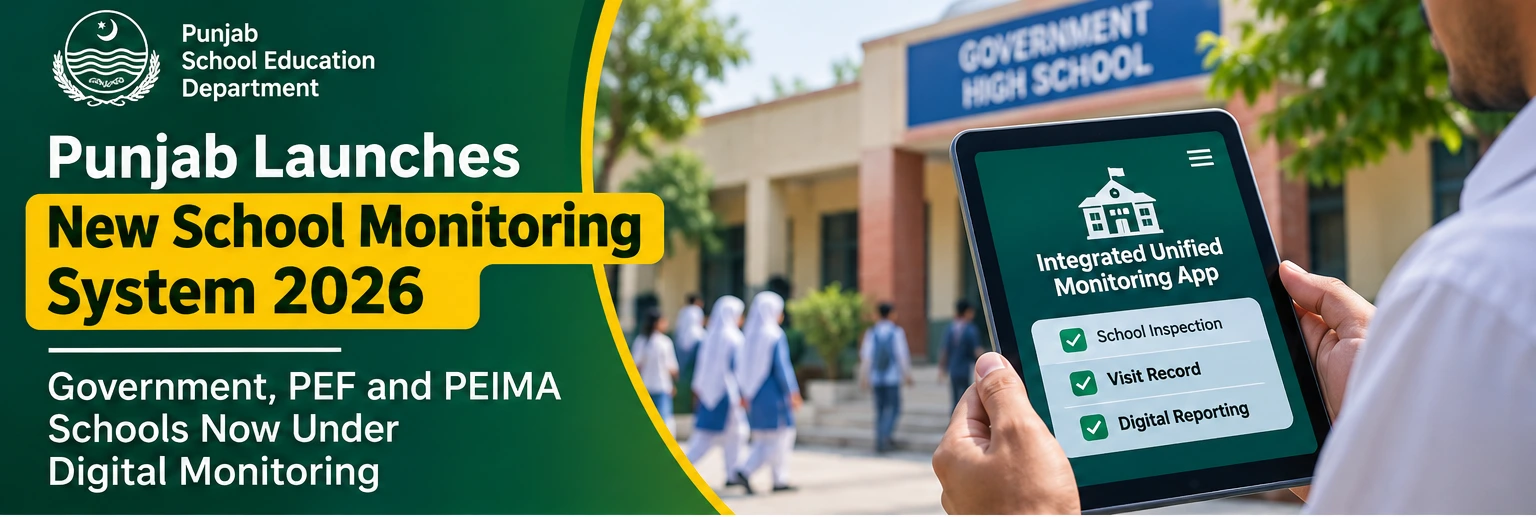
The Punjab School Education Department has introduced new school monitoring rules for government, Punjab Education Foundation (PEF), and Punjab Education Initiatives Management Authority (PEIMA) schools. Under the updated system, Assistant Education Officers (AEOs) must inspect every school in their assigned area at least once a month and record their visits through the Integrated Unified Monitoring App.
The revised monitoring arrangements took effect on 2 November 2026 , with instructions issued to district education authorities to ensure regular inspections, accurate digital reporting, and accountability for officials who fail to follow the new procedures.
The initiative is part of Punjab's efforts to strengthen educational supervision, improve transparency, and identify problems affecting teaching standards and school facilities.
Punjab School Monitoring System 2026 Key Details
| Monitoring Details | Updated Information |
|---|---|
| Department | Punjab School Education Department |
| Monitoring System | Integrated Unified Monitoring App |
| Effective Date | 2 November 2026 |
| Latest Instructions | 3 November 2026 |
| Schools Covered | SED, PEF and PEIMA schools |
| Responsible Officers | Assistant Education Officers (AEOs) |
| Minimum Monthly Visits | One visit to every assigned school |
| Daily Requirement | At least one school visit per working day |
| Reporting Method | Digital monitoring application |
| Third-Party Validation | Monitoring and Evaluation Assistants (MEAs) |
| District Evaluation | Recorded visits and notified performance indicators |
Government, PEF and PEIMA Schools Included in New Monitoring System
The expanded monitoring system covers schools operating under three major educational organisations in Punjab.
School Education Department (SED): Government schools administered through Punjab's public education system are included in the monitoring arrangements.
Punjab Education Foundation (PEF): Schools working under PEF programmes, including relevant privately operated and outsourced partner schools, are also covered.
Punjab Education Initiatives Management Authority (PEIMA): Schools managed through PEIMA's educational partnership arrangements will be monitored under the same integrated system.
Bringing these institutions into one monitoring framework is intended to improve coordination and provide education authorities with more consistent inspection records.
Punjab has also introduced other measures to strengthen institutional accountability. A related development is the revised monitoring and reporting structure for Assistant Education Officers .
New Monthly School Inspection Rules for AEOs
Under the updated Standard Operating Procedures (SOPs), Assistant Education Officers are responsible for monitoring schools within their assigned Markaz, or administrative area.
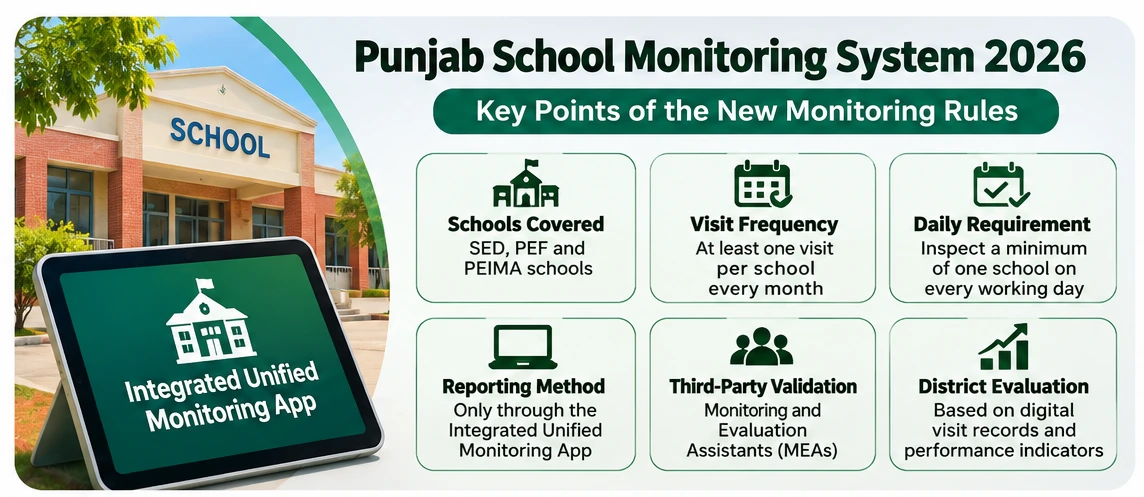
Every school must receive at least one monitoring visit each month. AEOs must also inspect a minimum of one school on every working day.
If an officer is responsible for several schools, more than one institution may be visited in a single day to complete the monthly inspection round.
After completing the first round, officers must use any remaining working days to revisit schools where appropriate. These additional visits are intended to support continued monitoring of educational standards.
The new instructions establish a consistent inspection schedule rather than leaving school visits entirely to individual officers' discretion.
Only Digitally Recorded School Visits Will Be Accepted
One of the most significant requirements is the compulsory use of the Integrated Unified Monitoring App.
Under the revised instructions, only school inspections recorded through the application will count as recognised monitoring visits.
This means that conducting a physical inspection without recording it in the designated system will not satisfy the digital reporting requirement.
The application provides education authorities with a centralised record of school monitoring activities. It is designed to help officials review inspection coverage and identify institutions requiring further attention.
Punjab has also introduced separate digital initiatives for classroom supervision, including an application for monitoring teacher performance .
How the Integrated Unified Monitoring App Works
The monitoring application brings inspection functions for SED, PEF and PEIMA schools into one digital platform.
Reported features allow authorised education officials to access assigned school information and record observations relating to educational performance and school conditions.
The broader application is designed to support monitoring of student learning, classroom teaching, enrolment information and school infrastructure.
These features can help education administrators identify areas requiring improvement. However, the availability of digital information alone does not establish that teaching quality or school facilities have already improved.
Effective implementation will depend on accurate reporting, regular inspections and appropriate action on identified problems.
District Education Authorities to Be Evaluated Through Digital Reports
The updated arrangements also introduce clearer responsibilities for district education authorities.
AEO monitoring reports submitted through the application will serve as official monitoring information for District Education Authorities (DEAs).
Meanwhile, monitoring conducted by Monitoring and Evaluation Assistants (MEAs) will be treated as third-party validation.
This distinction allows authorities to use AEO inspection records for routine monitoring while considering MEA findings as an additional validation mechanism.
District performance rankings will be based on visits recorded in the application and performance against the notified indicators.
The department has also directed district education leadership to ensure implementation of the new instructions. Officers who fail to comply may face accountability under the departmental arrangements.
What the New Monitoring Rules Mean for Teachers and School Administrations
For school heads and teaching staff, the revised system means more structured and regularly documented inspections.
School administrations should be prepared to cooperate with authorised monitoring officers and provide accurate information during visits.
The monitoring process may help authorities identify problems involving classroom conditions, educational resources, student learning and school management.
However, school inspections should also consider the practical challenges faced by institutions, particularly those operating with limited resources.
For example, shortages of cleaning staff in Punjab government schools highlight an area where regular monitoring could identify deficiencies requiring administrative support.
Similarly, the effectiveness of monitoring will depend on whether identified problems are addressed rather than simply recorded.
How Will the New System Affect Students and Parents?
Students and parents are not required to complete any registration process under the announced AEO monitoring instructions.
The system is primarily intended for authorised education officials responsible for inspecting schools and reporting their findings.
For students, more regular inspections could help authorities identify weaknesses in teaching arrangements, learning environments and available facilities.
Parents may also benefit indirectly if monitoring reports lead to timely improvements in school administration and educational standards.
Punjab has previously linked school accountability discussions with examination performance. The provincial review of poor Class 9 results provides additional context for the government's focus on educational outcomes.
Nevertheless, improvements in student performance will need to be assessed over time. The introduction of an inspection system should not be treated as proof of improved examination results.
School Monitoring and Educational Accountability in Punjab
The new monitoring requirements form part of wider efforts to improve school administration and accountability.
Regular inspections can provide authorities with information about problems that might otherwise remain unresolved. Digital reporting can also make it easier to identify schools that have not received the required visits.
Other education policies address related concerns, including school security and institutional management.
For example, Punjab has issued additional school security instructions involving monitoring responsibilities for education officers.
The government has also announced performance-based recognition for leading schools in Punjab , reflecting a broader policy emphasis on evaluating institutional performance.
The success of the latest monitoring arrangements will ultimately depend on consistent implementation, reliable inspection data and meaningful responses to problems identified in schools.
Frequently Asked Questions About Punjab School Monitoring System 2026
What is the new Punjab School Monitoring System 2026?
The Punjab School Monitoring System 2026 uses the Integrated Unified Monitoring App to record and manage inspections of government, PEF and PEIMA schools. It requires regular visits by authorised education officers and digital reporting of monitoring activities.
When did the new school monitoring system start in Punjab?
The expanded Integrated Unified Monitoring App arrangements took effect on 2 November 2026. Updated monitoring instructions were issued on 3 November 2026.
How many times must an AEO visit each school?
Every Assistant Education Officer must visit each school in their assigned Markaz at least once per month. Officers must also inspect a minimum of one school on every working day and may conduct additional visits when necessary.
Are private schools included in Punjab's new monitoring system?
The arrangements include government schools and relevant PEF and PEIMA partner institutions, including privately operated schools covered by those programmes. The announcement does not establish that every independently operated private school in Punjab is included.
Is recording school visits through the monitoring app compulsory?
Yes. Under the updated instructions, only visits recorded through the Integrated Unified Monitoring App will count toward official monitoring records and district performance evaluation.
What is the role of MEAs in the new monitoring system?
Answer: Monitoring and Evaluation Assistants provide third-party validation of school monitoring information. Their reports serve a different purpose from the routine inspection records submitted by AEOs.
Do parents or students need to download the monitoring app?
No public registration or downloading requirement for parents and students was announced in the revised monitoring instructions. The application is intended for authorised education personnel.
What happens if education officers fail to follow the new monitoring rules?
The Punjab School Education Department has directed district education authorities to ensure compliance. Officers who fail to follow the monitoring instructions may face departmental accountability. Specific penalties were not detailed in the reported instructions.