

 Home
Home
 National
 International
 Merit list
 Date Sheet
 Result
 Admission
 Study Abroad
.jpg)


Punjab Extends Exam Opportunities for Matric and Intermediate Students: 6 Attempts Allowed in 4 Years
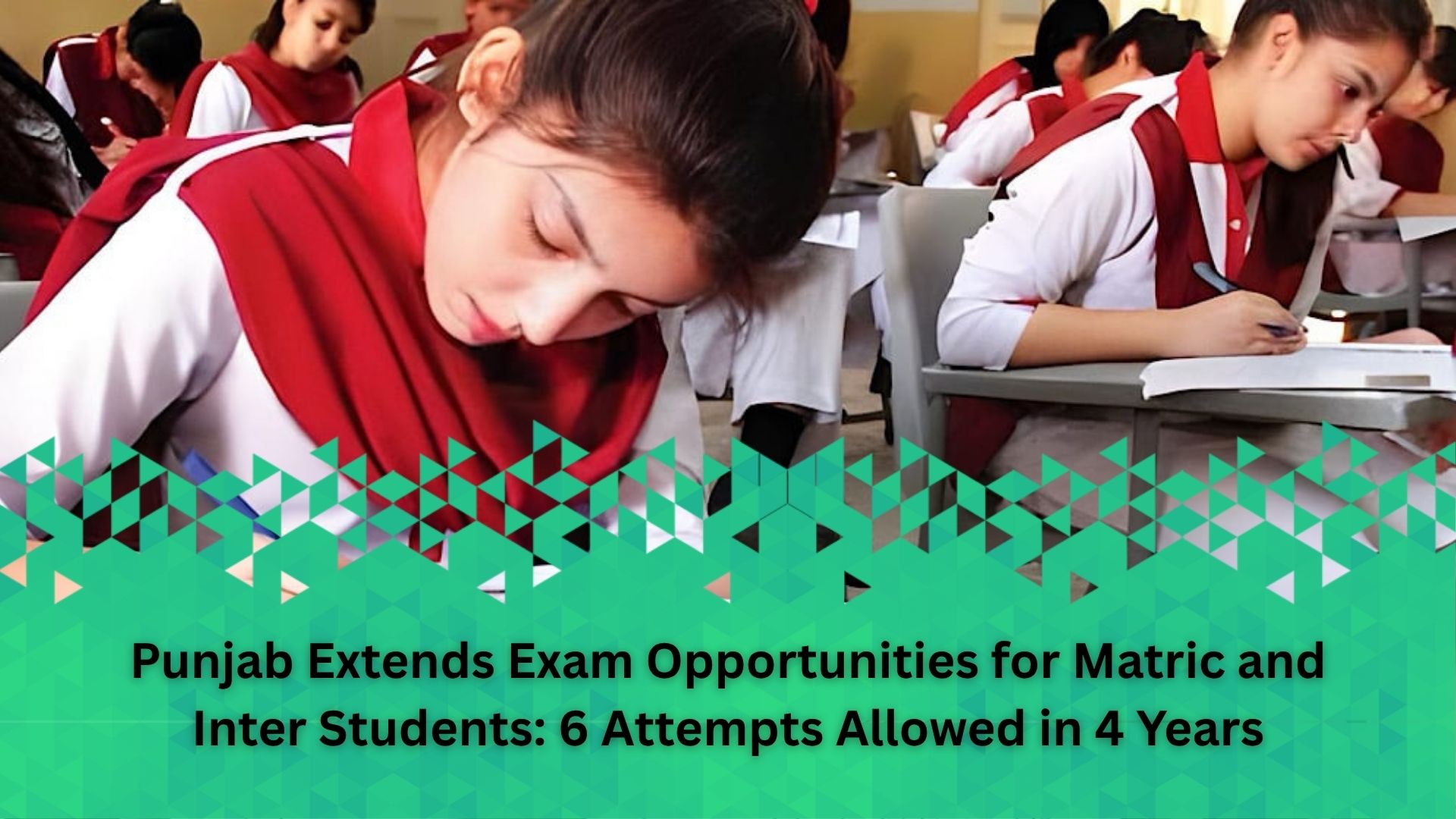
The Punjab education department has officially expanded examination opportunities for secondary and higher secondary school students. The new policy permits Matric and Intermediate candidates to appear in their board exams up to six times within a four-year period , a significant increase from the previous limit of four attempts.
The move, which applies uniformly across all educational boards in the province, has been widely welcomed by students, parents, and academic experts. Officials describe it as a major academic facilitation designed to provide learners with greater flexibility to improve their results without facing undue pressure.
Key Highlights of the New Exam Policy
Under the revised framework, students enrolled in Matriculation (9th and 10th grades) and Intermediate (11th and 12th grades) will now have six chances to clear their examinations. These opportunities must be utilized within a rolling window of four years from the date of first registration.
Previously, students were restricted to only four attempts, which often left high-achieving but slow-progressing learners with limited options. The new system eliminates that bottleneck, allowing candidates to reappear, improve their grades, or clear previously failed subjects without having to repeat full academic years unnecessarily.
Applicability Across All Boards and Programs
The updated policy is not limited to a single board or group. According to official notifications, the six-attempt rule will be implemented uniformly across all educational boards in Punjab, including the Board of Intermediate and Secondary Education (BISE) Lahore, Multan, Faisalabad, Rawalpindi, Gujranwala, Sargodha, Bahawalpur, Dera Ghazi Khan, and Sahiwal.
Furthermore, the regulation extends to students enrolled in Cambridge-affiliated O Level and A Level programs under the purview of Punjab’s educational oversight. This ensures a level playing field for all secondary and higher secondary students, regardless of their chosen curriculum or study group (Pre-Medical, Pre-Engineering, Humanities, or Commerce).
Examination Syllabus and Conduct Remain Unchanged
While the number of permitted attempts has increased, education boards have clarified that the examination structure, grading system, and syllabus will remain consistent with existing standards. Students will be tested on the same curriculum as prescribed for their respective year of admission.
Officials emphasized that the conduct of exams including practical assessments, theory papers, and marking schemes will follow the same protocols as before. The only modification is the extended attempt ceiling, which is expected to reduce dropout rates and improve overall pass percentages over time.
Rationale Behind the Decision
Speaking on condition of anonymity, a senior official from the Punjab Education Department explained that the previous limit of four attempts often forced capable students to abandon their academic careers after repeated failures within a short timeframe.
“Many students face personal challenges, health issues, or financial constraints that temporarily affect their performance. The old system did not account for these realities. With six attempts over four years, we are aligning Punjab’s examination policy with international best practices that prioritize learning outcomes over rigid timelines,” the official stated.
Education experts have also praised the move, noting that it reduces exam-related anxiety, which has been linked to rising stress levels among teenagers in the province. By decoupling academic success from a limited number of attempts, the policy encourages students to focus on conceptual understanding rather than rote memorization aimed at passing within a narrow window.
Impact on Students and Academic Planning
For students, the new rule means they can plan their reappearances strategically. For example, a student who fails in one or two subjects can now focus on those specific papers in subsequent attempts without having to retake all subjects. The four-year period also allows for part-time work, vocational training, or preparatory classes between attempts.
Parents have expressed relief as well, noting that the policy reduces the financial burden of repeating full academic years. Instead of paying for an entire year’s tuition and fees, families can support targeted exam preparation for the remaining attempts.

Implementation Timeline and Official Guidelines
The Punjab Education Department has confirmed that the policy is effective immediately for all ongoing and future examination sessions. Students currently within their four-year eligibility window will be granted the remaining number of attempts up to the new maximum of six.
Boards have been directed to update their student portals and registration systems to reflect the extended attempt limits. Candidates seeking to utilize their additional chances must follow standard registration procedures and meet existing fee structures for reappearance.
A Forward-Looking Reform
The extension of exam opportunities from four to six attempts marks a progressive shift in Punjab’s academic policies. By prioritizing student well-being and long-term success over rigid administrative limits, the province sets a precedent for other regions to follow.
As the new academic year approaches, students and parents are encouraged to consult their respective BISE offices for detailed schedules and registration deadlines. With greater flexibility now in place, the focus can finally shift from chasing limited attempts to achieving genuine learning and skill development.





.jpg)