




 Home
Home
 National
 International
 Merit list
 Date Sheet
 Result
 Admission
 Study Abroad


.jpg)
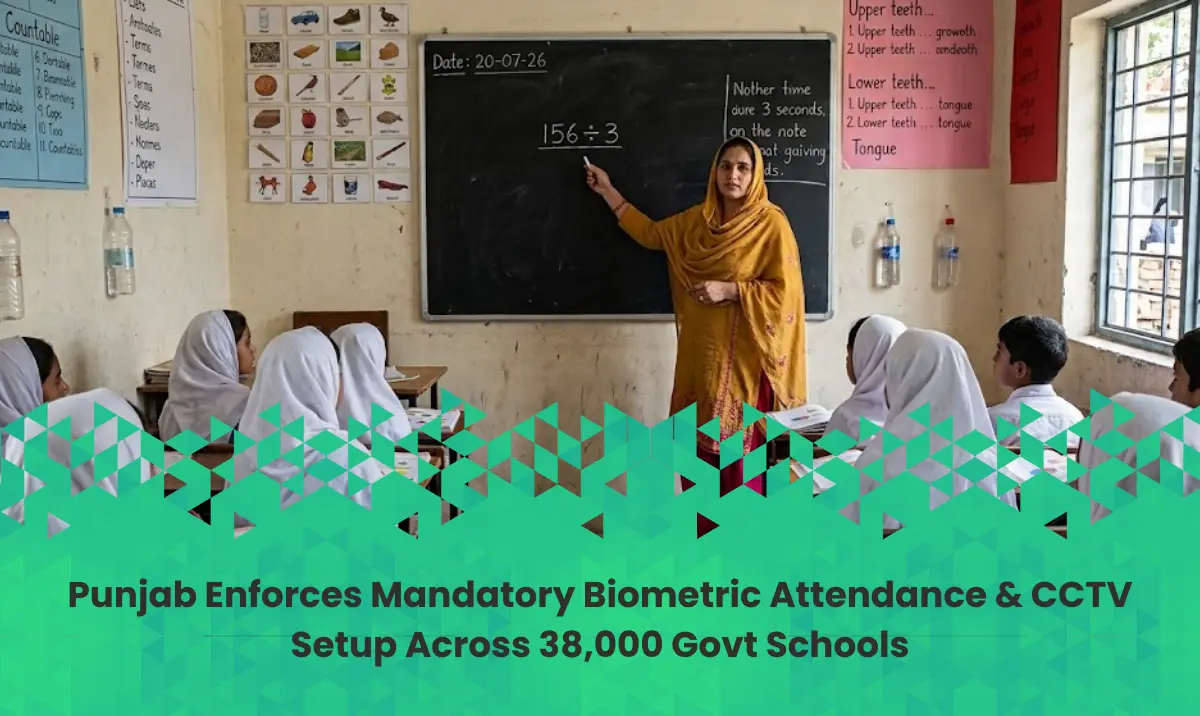
Punjab Government Mandates Biometric Attendance and CCTV Surveillance for Teachers in All Government Schools
In a decisive move to modernize public education administration, ensure workforce discipline, and enhance institutional security, the Punjab government has officially made a biometric attendance system mandatory for teachers across all government schools in Punjab . Directed by the School Education Department (SED), the initiative spans approximately 38,000 public educational institutions throughout the province, marking one of the largest digital governance overhauls in Pakistan's primary and secondary education sector.
Under the new directives, all District Education Authorities (DEAs) have been instructed to execute the installation of biometric verification devices and high-definition CCTV surveillance in schools within a strict one-month timeframe. The comprehensive mandate aims to eliminate ghost teaching staff, curb absenteeism, streamline operational oversight, and establish an unalterable digital paper trail for faculty management.
Transforming Public Education Through Digital Oversight
For decades, public sector education across Pakistan has grappled with administrative inefficiencies, including informal absenteeism, proxy attendance, and delayed reporting mechanisms. By replacing traditional manual registers with real-time digital verification, the Punjab government is laying down a robust framework for teacher attendance monitoring .
The introduction of the biometric attendance system ensures that every educator's arrival and departure times are logged digitally into a centralized database managed by the School Education Department . This real-time data integration minimizes human manipulation, allows administrative officers to track staffing trends instantaneously, and provides clear insights into faculty presence across urban and remote rural facilities alike.
Key Objectives of the New Attendance Mandate
The decision to install biometric devices and integrated security systems serves multiple strategic purposes designed to upgrade overall institutional efficiency:
1. Eliminating Absenteeism and Non-Reporting Staff
Unannounced absences and non-reporting faculty severely compromise classroom learning quality. With fingerprint or facial-recognition biometrics, teachers must physically present themselves at school to record check-ins and check-outs, preventing proxy marking and unexcused leaves.
2. Enhancing School Security and Safety
Alongside attendance terminals, installing CCTV surveillance in schools boosts internal safety for students and educational staff. Closed-circuit monitoring helps maintain campus order, deters unauthorized trespassers, and provides administrators with situational awareness during daily school hours.
3. Streamlining Payroll and Administrative Data
Digital logs integrated with the province’s human resource management databases streamline payroll processing. Punctuality and presence records can directly inform performance evaluations, promotions, and routine compliance checks under public efficiency regulations.
Strict 30-Day Deadline for District Education Authorities
To prevent procedural delays, the School Education Department has set a firm 30-day implementation window for all District Education Authorities . Chief Executive Officers (CEOs) of DEAs across all 36 districts of Punjab have been designated as primary oversight officers responsible for procurement, hardware deployment, and network configuration.
District officers are required to submit regular progress updates to ensure uniform execution. Non-compliance or deliberate delays by school administrators or regional authorities could trigger administrative reviews under the Punjab Employees Efficiency, Discipline, and Accountability (PEEDA) Act.
Broader Context of Education Reforms in Punjab
This automated attendance initiative is part of a larger, systemic drive toward digital governance and education reforms in Punjab . Over recent years, the provincial government has launched several technological upgrades to modernize its public services.
-
Digital Learning Platforms: Integrating online learning tools, digital textbooks, and tablet-based assessments for classrooms.
-
School Information System (SIS): Centralizing student enrollment, infrastructure audits, and staff data onto unified software platforms.
-
Board Examination Security: Applying digital verification and monitoring protocols during matriculation and intermediate examinations across the province.
By combining physical campus surveillance with digital attendance records, the provincial authorities seek to build an interconnected ecosystem where administrative transparency directly translates into better learning outcomes for millions of students.
Strategic Impact on Teachers, Students, and School Management
The transition to technology-driven management reshapes daily operations across all public educational tiers:
|
Stakeholder Group |
Primary Operational Shift |
Strategic Benefit |
|
Teaching Faculty |
Mandatory digital check-in/out on physical hardware terminals. |
Fair, unbiased recording of presence; protection against unfair attendance disputes. |
|
Students |
Consistent teacher availability and structured daily schedules. |
Increased classroom instruction hours and improved academic consistency. |
|
School Administration |
Automated report generation via central portals. |
Reduced manual paperwork and instant oversight capability. |
|
District Authorities |
Real-time monitoring across all rural and urban schools. |
Faster identification of understaffing and streamlined resource distribution. |
Potential Challenges and Implementation Roadmap
While the directive has drawn widespread support from education policy advocates and civil society groups, smooth execution across nearly 38,000 facilities presents practical considerations:
-
Infrastructure and Power Availability: Schools in remote rural sectors require uninterrupted power supplies or solar backups to keep biometric terminals and cameras functional throughout operational hours.
-
Internet Connectivity: Synchronizing biometric records with central databases necessitates reliable cellular or broadband data links at every facility.
-
Hardware Maintenance: Establishing rapid technical support channels is essential to address device malfunctions or physical wear without disrupting daily check-ins.
To mitigate these challenges, the School Education Department is collaborating with provincial IT bodies to provide localized technical support, off-line backup logging, and streamlined hardware replacement procedures.







Share your comments & questions here
No comments yet. Be the first to comment!