




 Home
Home
 National
 International
 Merit list
 Date Sheet
 Result
 Admission
 Study Abroad


.jpg)
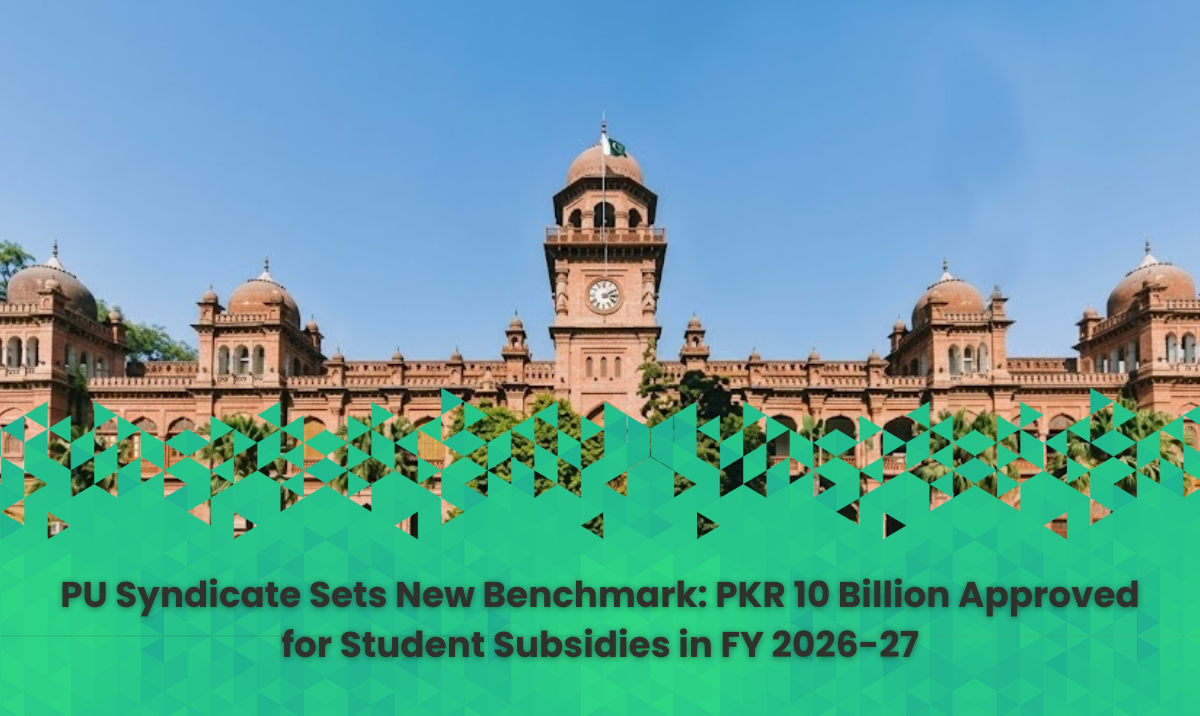
Punjab University Approves Historic PKR 20.87 Billion Budget: Massive PKR 10 Billion Allocated For Student Subsidies and Scholarships
In a monumental development aimed at safeguarding the academic future of thousands of youths, the University of the Punjab (PU) has formally recommended a massive PKR 20.87 billion budget for the upcoming fiscal year 2026-27 . The most striking feature of this comprehensive fiscal framework is the unprecedented allocation of PKR 10 billion in subsidies and scholarships , aimed exclusively at easing the financial pressures on its on-campus student body.
The strategic financial blueprint was evaluated and finalized during the high-profile 1761st Punjab University Syndicate meeting , which took place under the leadership of the esteemed Vice Chancellor, Professor Dr. Muhammad Ali . This landmark session brought together key academic leaders, administrative officials, and syndicate members to review the university’s economic trajectory, implement structural reforms, and lay down a sustainable roadmap for higher education funding.
Direct Relief for Students: The PKR 10 Billion Financial Cushion
The core pillar of the newly proposed Punjab University budget 2026-27 is its unwavering focus on student welfare. Out of the total recommended budget of PKR 20.87 billion , nearly half—a staggering PKR 10 billion —has been earmarked strictly for student subsidies and scholarships .
This multi-billion rupee relief package is meticulously structured to cushion the on-campus student community from contemporary inflationary trends. Recognizing that economic hardships often derail bright academic journeys, the PU Syndicate actively pushed for substantial increases in both merit-based and need-based financial assistances.
Breaking Down the Internal Funding
Beyond overall figures, the administration has demonstrated a strong commitment to self-reliance. The university has directly allocated PKR 341 million for scholarships entirely out of its own generated revenue streams. This dedicated fund ensures that students from marginalized backgrounds, alongside high-achieving individuals, can pursue their higher education degrees without the looming anxiety of unaffordable tuition or campus utility costs.
Fiscal Discipline: Deficit Slashed to PKR 1.6 Billion
While prioritizing student support, the university management has simultaneously achieved a significant milestone in fiscal discipline and corporate governance. The budgetary evaluations revealed a remarkable turnaround in the institution’s overall financial health.
According to official data reviewed during the 1761st Syndicate meeting , the university’s budget deficit, which heavily strained operations in previous terms, has taken a downward trajectory. During the fiscal year 2025-26 , the PU budget deficit successfully fell from a worrying PKR 2.2 billion down to PKR 1.6 billion .
This notable recovery reflects a rigorous internal audit system, smart resource management, and aggressive cost-cutting measures spearheaded by Vice Chancellor Professor Dr. Muhammad Ali . By systematically shrinking the deficit by hundreds of millions, the university has created the necessary fiscal space to redirect vital capital back into student-centric initiatives rather than sinking into institutional debt.
The Strategic Vision of Vice Chancellor Dr. Muhammad Ali
The vision behind the higher education Pakistan funding restructuring relies heavily on establishing equitable access to learning. Chairing the syndicate meeting, Vice Chancellor Professor Dr. Muhammad Ali reiterated that a public sector university’s ultimate metric of success is not its financial surplus, but the accessibility of its classrooms.
Under his leadership, the administration has maintained that despite macroeconomic challenges facing public sector universities across Pakistan, students must not bear the brunt of rising operation costs. The syndicate’s recommendation to substantially amplify student financial relief Pakistan models sets a vital benchmark for other educational bodies nationwide. It demonstrates that with the right combination of state-backed grants, internal commercial optimization, and rigorous spending tracking, universities can keep costs low while elevating the quality of research and campus facilities.
Long-Term Implications for Higher Education in Pakistan
The approval of the Punjab University budget 2026-27 comes at a crucial moment for Pakistan's academic landscape. With high living costs impacting families across the province, public universities are seeing an exponential rise in financial aid applications.
By scaling up Punjab University subsidies to the 10-billion mark, PU is actively preventing a potential dropout crisis among deserving candidates. This comprehensive funding approach is expected to have multi-fold positive outcomes:
-
Enhanced Retention Rates: Ensuring that students enrolled in technical, scientific, and humanities programs finish their degrees without mid-semester dropouts due to unpaid dues.
-
Equal Opportunities: Levelling the playing field for rural and underprivileged students who secure admissions on merit but struggle with hostel, food, and book expenses.
-
Boosted Research Output: Allowing scholars to focus heavily on innovation and publication rather than working multiple off-campus jobs to make ends meet.
As the recommendations move forward for final statutory approvals, the decisions taken during this 1761st Punjab University Syndicate meeting will undoubtedly be remembered as a turning point where student welfare was positioned as the primary financial focus of the historic institution.










Share your comments & questions here
No comments yet. Be the first to comment!