


 Home
Home
 National
 International
 Merit list
 Date Sheet
 Result
 Admission
 Study Abroad


.jpg)
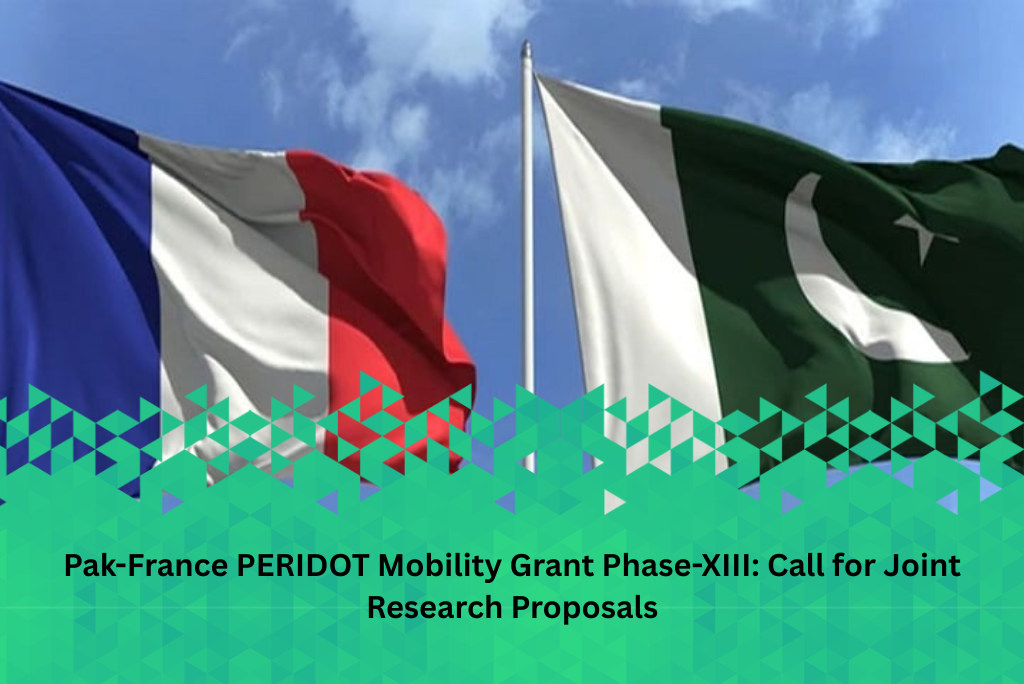
HEC Announces Phase-XIII of Pak-France PERIDOT Mobility Grant Program
The Higher Education Commission (HEC) of Pakistan, in collaboration with French counterparts, has officially opened applications for Phase-XIII of the prestigious Pak-France PERIDOT Mobility Grant Program . This initiative serves as a bridge for academic excellence, fostering high-level scientific and technological cooperation between researchers from Pakistani and French higher education institutions and research laboratories.
Administered jointly by HEC Pakistan, the French Ministry of Europe and Foreign Affairs (MEAE), and the Ministry of Higher Education and Research (MESR), the Phase-XIII PERIDOT Grant provides a vital platform for faculty members to build sustainable, international research networks.
Understanding the PERIDOT Mobility Grant Program
The PERIDOT program is the Franco-Pakistani iteration of the Hubert Curien Partnership (PHC), a signature French diplomatic and scientific initiative implemented globally. Launched originally in 2014, the program has successfully completed multiple cycles, transforming the research landscape in Pakistan by exposing local scholars to cutting-edge Western laboratories and methodologies.
Unlike full-scale research grants that cover equipment costs or laboratory setups, this specialized HEC faculty mobility program focuses strictly on the human element of research: mobility and collaboration . It funds the travel and living expenses of principal investigators, co-investigators, and doctoral students traveling between Pakistan and France, enabling intense, hands-on collaborative work that cannot be achieved remotely.
Priority Thematic Areas for Phase-XIII (2026)
For the Phase-XIII call, the joint committee has identified three critical sectors aligned with global societal challenges and Pakistan's development goals. Special priority is given to cross-cutting projects addressing environmental and climate transformations, as well as proposals featuring a broader European network dimension.
The designated priority sectors for this cycle include:
-
Health Sciences: Advanced medical research, epidemiology, public health innovations, pharmacology, and biomedical engineering aimed at solving complex health issues.
-
Sustainable Energy, Agriculture, and Food Security: Innovations in renewable energy, climate-resilient crop yields, smart agricultural tech, and sustainable food supply chains.
-
Economics of Climate Change: Research evaluating socioeconomic vulnerabilities, mitigation policies, green finance models, and policy reforms required to tackle climate crises.
For Pakistani Applicants:
-
Employment Status: The Principal Investigator (PI) must hold a full-time, regular faculty position at an HEC-recognized public or private sector university. Faculty members on clear contracts equivalent to the project duration may also apply.
-
Academic Qualification: The applicant must hold a PhD degree (or equivalent, such as FCPS/MCPS/FRCS in medical fields) in a discipline relevant to the proposed research.
-
Single Project Rule: A single Principal Investigator can submit a maximum of one research project application for funding during this cycle.
For the Research Team & Host Institutions:
-
Involvement of Young Researchers: A primary objective of the HEC Pak-France PERIDOT Mobility Grant is nurturing the next generation of scholars. Proposals must actively include young researchers, particularly registered PhD students working under the supervision of the PI.
-
Institutional Capacity: The host institutions in both countries must officially guarantee that they possess the physical infrastructure, equipment, and workspace necessary to comfortably accommodate the visiting fellows.
Financial Breakdown and Funding Structure
The Phase-XIII PERIDOT Grant operates on a strict model of cost-sharing and reciprocity. The structural funding is granted on an annual basis for a maximum of two or three consecutive years , contingent on successful annual progress reviews.
| Expense Category | Covered by HEC (Pakistani Side) | Covered by Campus France (French Side) |
| Pakistani Researchers Traveling to France | Airfare (Round-trip economy including inland transit) | Daily living allowances / per diem in France (~€125/day short stays; ~€50-60/day long stays) |
| French Researchers Traveling to Pakistan | Daily living allowances / per diem in Pakistan (~Rs. 8,000–10,000/day depending on stay duration) | Airfare (Round-trip up to a maximum limit of €1,500) |
How to Apply: Step-by-Step Submission Process
To secure consideration for HEC research grants 2026 , applicants must carefully follow a parallel bilateral submission protocol. Unilateral applications—where only one country's team submits—will be rejected immediately without review.
1.Establish Partnership: Pre-application Phase.
The Pakistani faculty member must independently identify, contact, and establish a formal collaborative link with a suitable research partner based in a French laboratory. Together, both PIs will draft a single, unified joint research proposal in English.
2.French Side Submission: Campus France Portal.
The French Principal Investigator must submit the joint application package electronically via the official Campus France online portal (campusfrance.org/fr/peridot).
3.Pakistani Side Submission: HEC Research Portal.
The Pakistani Principal Investigator must log into the HEC online portal (research.hec.gov.pk), complete the required research profile, and fill out the PERIDOT application forms.
4.Upload Synchronized Documents: Finalizing the HEC Application.
The Pakistani PI must upload the exact copy of the joint application package that was submitted to Campus France into the document section of the HEC portal. Submit the application online before the official deadline.
Vital Timeline and Deadlines
Timely action is critical when coordinating across international borders. Keep the following timeline in mind to avoid technical or administrative bottlenecks:
-
Application Call Launch: July 01, 2026
-
Closing Date for Submissions: September 30, 2026
-
Evaluation & Independent Peer Reviews: October 2026 – February 2027
-
Joint Committee Selection Meeting: Early March 2027
-
Official Dissemination of Results: March 2027
-
Commencement of Approved Projects: March 2027



Share your comments & questions here
No comments yet. Be the first to comment!