




 Home
Home
 National
 International
 Merit list
 Date Sheet
 Result
 Admission
 Study Abroad


.jpg)
The Punjab government has introduced significant reforms to the appointment process of vice chancellors at public sector medical universities by revising the eligibility criteria under the Public Sector Medical Universities (Amendment) Act, 2026. The updated law aims to improve governance, strengthen institutional leadership, and ensure greater transparency across medical universities in the province.
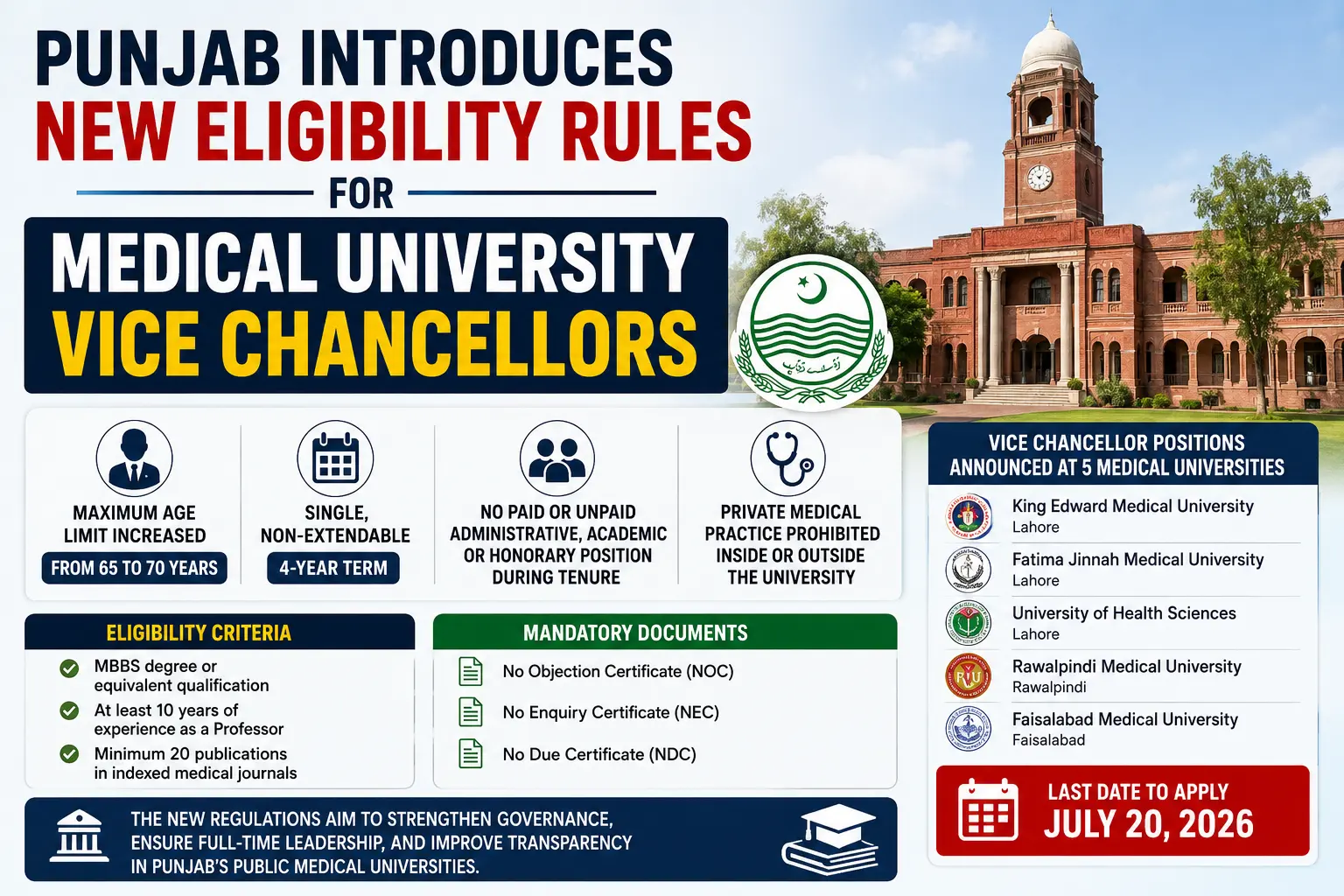
Following the amendments, the provincial government has invited applications for vice chancellor positions at five leading public medical universities. Interested and eligible candidates can submit their applications until July 20, 2026.
The newly announced rules include changes to the maximum age limit, tenure, professional restrictions, and academic qualifications required for applicants.
Vice Chancellor Vacancies Announced at Five Medical Universities
The Punjab government has advertised vice chancellor positions for the following public sector medical universities:
- King Edward Medical University (KEMU), Lahore
- Fatima Jinnah Medical University (FJMU), Lahore
- University of Health Sciences (UHS), Lahore
- Rawalpindi Medical University (RMU), Rawalpindi
- Faisalabad Medical University (FMU), Faisalabad
These institutions are among Punjab's most prestigious medical universities and play a vital role in producing healthcare professionals and promoting medical research.
Maximum Age Limit Increased to 70 Years
One of the most notable changes introduced through the amended legislation is the increase in the upper age limit for vice chancellor appointments.
Previously, candidates above 65 years of age were not eligible to apply. Under the revised law, the maximum age limit has now been increased to 70 years.
The government believes this amendment will allow highly experienced senior medical professionals and educationists to compete for these important leadership positions.
Four-Year Non-Extendable Term Introduced
The Punjab government has also changed the tenure policy for vice chancellors.
Under the previous framework, extensions could be granted after completion of the initial term. However, the new law abolishes this practice by introducing a single four-year non-extendable term.
Officials believe this change will promote accountability, ensure timely leadership transitions, and provide equal opportunities for qualified candidates in future appointments.
Restrictions on Administrative and Honorary Positions
To ensure full-time commitment to university administration, the amended law places strict restrictions on vice chancellors during their tenure.
According to the new regulations, vice chancellors will not be allowed to hold:
- Any paid administrative position
- Any unpaid administrative role
- Academic positions outside the university
- Honorary appointments in any public or private organization
These restrictions are intended to eliminate conflicts of interest and ensure that university leaders remain fully dedicated to their institutional responsibilities.
Ban on Private Medical Practice
Another major reform introduced under the amendment relates to private medical practice.
Vice chancellors appointed under the new law will not be allowed to engage in private clinical practice either inside or outside the university.
However, they may continue participating in academic teaching, clinical training, and educational activities that directly support students and institutional learning.
The government believes this measure will encourage university heads to devote their complete attention to academic leadership and administrative excellence.
Mandatory Documents Required for Applicants
Candidates applying for vice chancellor positions must also submit several mandatory certificates issued by their current employer.
These include:
- No Objection Certificate (NOC)
- No Enquiry Certificate (NEC)
- No Due Certificate (NDC)
The requirement is aimed at ensuring transparency and confirming that applicants have no pending disciplinary inquiries or financial liabilities before assuming office.
Updated Eligibility Criteria for Vice Chancellors
The Punjab government has retained strict academic and professional standards for applicants.
To qualify for the vice chancellor position, candidates must fulfill the following requirements:
- Hold an MBBS degree or an equivalent medical qualification.
- Have served as a professor for at least 10 years.
- Possess a minimum of 20 research publications in internationally indexed medical journals.
- Submit all required clearance certificates from their employing institution.
These qualifications are designed to ensure that only experienced medical academics with strong research backgrounds are considered for leadership positions.
Government Aims to Improve Governance in Medical Universities
The latest amendments reflect the Punjab government's broader strategy to improve governance standards in higher medical education.
Officials believe that introducing stricter eligibility requirements, limiting tenure, preventing conflicts of interest, and ensuring full-time leadership will strengthen institutional performance across public medical universities.
The reforms are also expected to enhance transparency in appointments and promote merit-based selection of vice chancellors.
Application Deadline
The Punjab government has invited eligible candidates to apply for the advertised vice chancellor positions before July 20, 2026.
Applicants are advised to carefully review the revised eligibility criteria and submit all required documents within the prescribed deadline.
The Punjab Medical University Vice Chancellor Eligibility 2026 reforms mark an important step toward improving leadership standards in public medical universities. By increasing the age limit to 70 years, introducing a single non-extendable four-year term, prohibiting private practice and outside appointments, and maintaining rigorous academic requirements, the government aims to ensure transparent, merit-based, and effective leadership.










Share your comments & questions here
No comments yet. Be the first to comment!