


 Home
Home
 National
 International
 Merit list
 Date Sheet
 Result
 Admission
 Study Abroad
.jpg)


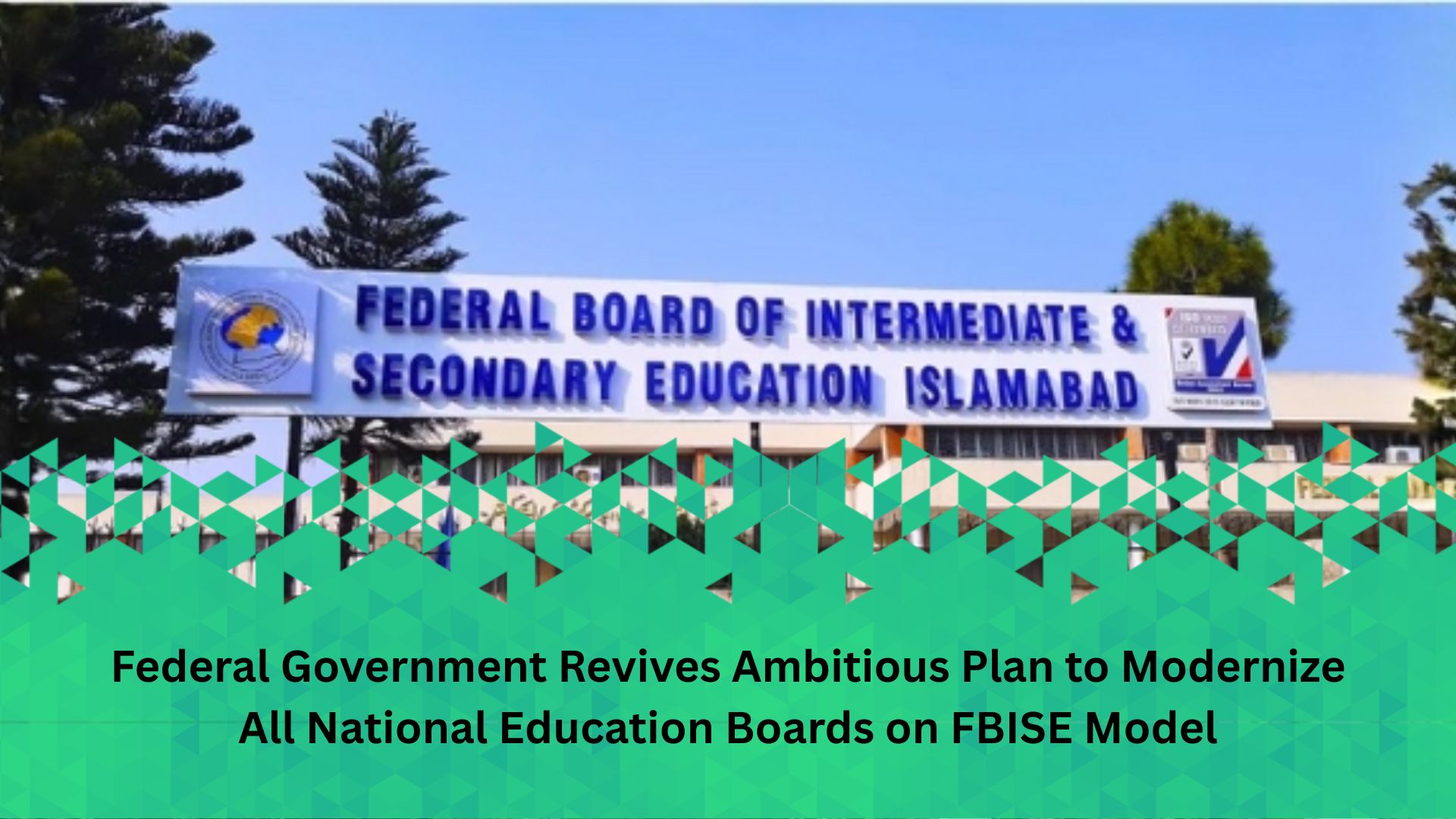
Federal Government Revives Ambitious Plan to Modernize All National Education Boards on FBISE Model
In a significant move aimed at overhauling the country’s educational assessment infrastructure , the federal government is actively considering launching a nationwide project to technologically modernize all provincial and secondary education boards . The initiative seeks to replicate the highly successful modernization model of the Federal Board of Intermediate and Secondary Education (FBISE) , according to official documents and senior officials.
The proposed project, currently in the conceptualization phase, envisages a comprehensive upgrade for approximately 30 examination boards across Pakistan . With an estimated cost of Rs. 2 billion, the plan aims to standardize examinations, enhance transparency, and integrate advanced technologies, including Artificial Intelligence (AI), into the national assessment framework.
Blueprint from a Proven Model
The foundation for this ambitious undertaking is the FBISE’s own “Modernization and Standardization of Examination System,” a Rs. 50 million project executed between 2015 and 2018. Conceived under the leadership of then-Federal Minister for Planning, Development, and Reform, Ahsan Iqbal, the project achieved its targets within three years. It transformed FBISE’s operations through digital infrastructure, automated result processing, and improved security protocols, setting a new benchmark for examination boards in Pakistan.
Despite initial plans by the previous PML-N government to extend this model nationally, the project lost momentum after the 2018 general elections. It was formally shelved in 2019 due to reported lack of provincial buy-in and shifting political priorities.
A Renewed Push with Key Players Back at Helm
The project’s revival coincides with the return of its original architects to pivotal roles. Ahsan Iqbal is once again at the helm of the Planning Ministry, while Dr. Ikram Ali Malik, the officer who spearheaded the initial FBISE modernization as its Controller of Examinations, now serves as the Board’s Chairperson. This reunion has provided fresh impetus to the national expansion plan.
“The FBISE has prepared detailed concept papers for this new initiative and will soon present a comprehensive briefing to the planning minister,” a senior official involved in the discussions stated on condition of anonymity. “The goal is to create a unified, tech-enabled examination ecosystem for the entire country.”
Pillars of the Proposed Modernization Project
The proposed national project outlines a multi-faceted approach to capacity building and technological infusion:
-
Infrastructure Development: The plan includes establishing three robust provincial data centres to serve as hubs for regional boards. This will be supplemented by the provision of high-speed scanners, modern computer systems, and customized software solutions tailored to the needs of each board.
-
Advanced Assessment Tools: A cornerstone of the proposal is the integration of Artificial Intelligence in assessments. This could revolutionize paper evaluation, aid in verbal communication testing for practical exams, and enable sophisticated post-exam analysis to improve curriculum and teaching methodologies.
-
Human Resource Capacity Building: The project emphasizes extensive training programs for board staff and a formal certification regime for examiners to ensure standardization and professionalism.
-
Transparency and Accountability Measures: The initiative proposes regular academic and resource audits of boards and the publication of examiner performance reports, aiming to foster greater accountability and public trust.
Leadership Voices Optimism and Highlights Need for Resources
In conversations with the media, FBISE Chairperson Dr. Ikram Ali Malik confirmed the board’s ongoing role in supporting provincial counterparts. “FBISE is already providing technical assistance and training to provincial boards. However, for a full-scale, nationwide implementation, dedicated new resources, funding, and manpower are essential,” Dr. Malik stated.
He expressed optimism about provincial cooperation, noting a marked shift in attitude. “The ministries of Planning, Education, and FBISE are collaborating closely. We are encouraged that provinces have now shown strong interest in modernizing their examination systems, recognizing its importance for educational quality.”
This sentiment was echoed at the federal level. State Minister for Federal Education and Professional Training, Wajiha Qamar, recently reaffirmed the government’s commitment to technology-driven reforms in education. “Digital transformation of our examination systems is non-negotiable for ensuring transparent, credible, and student-centred processes across Pakistan,” she stated, aligning federal policy with the proposed project’s objectives.
Challenges and the Road Ahead
While the renewed plan has momentum, its success will hinge on securing the substantial Rs. 2 billion funding and, crucially, fostering unwavering consensus and collaboration with provincial governments, as education is primarily a provincial subject under the 18th Amendment. The previous attempt faltered largely due to a lack of provincial interest.
Analysts suggest that framing the initiative as a collaborative, capacity-building partnership rather than a top-down imposition will be key. The demonstrable success of the FBISE model, promising reduced malpractice, faster results, and systemic efficiency, serves as a powerful persuasive tool.
The revival of the plan to modernize all of Pakistan’s educational boards represents a potential watershed moment for the country’s education sector. By leveraging the proven FBISE blueprint and advanced technologies like AI, the government aims to bridge the disparities between federal and provincial boards, creating a more equitable, reliable, and modern assessment landscape for millions of Pakistani students. As concept papers move towards formal approval, the education community watches closely, hopeful that this renewed initiative will overcome past hurdles and finally deliver a unified, 21st-century examination system for the nation.