




 Home
Home
 National
 International
 Merit list
 Date Sheet
 Result
 Admission
 Study Abroad



Punjab 10th Class Result 2026: BISE Rawalpindi Recorded Lowest Pass Percentage Among Provincial Boards
The official declaration of the Punjab 10th Class Result 2026 has generated immense discourse across educational circles, students, and academic analysts throughout the province. While the release of the Secondary School Certificate (SSC) First Annual Examination results brought moments of celebration for thousands of high achievers, it also threw open a broader discussion regarding institutional performance disparities.
Among the primary talking points of this year's academic evaluation is the performance index of the nine intermediate and secondary education boards operating under the Punjab curriculum. According to official result gazettes and statistical summaries compiled following the announcement, the Board of Intermediate and Secondary Education (BISE) Rawalpindi recorded the lowest pass percentage across the entire province, securing the bottom position in the official Punjab education boards ranking 2026 .
Overview of Punjab 10th Class Result 2026
The matriculation examination session for the year 2026 remains one of the largest synchronized academic exercises in the region. Across all nine administrative boards of Punjab—namely Lahore, Rawalpindi, Faisalabad, Multan, Gujranwala, Sargodha, Bahawalpur, Sahiwal, and Dera Ghazi Khan—over 1.34 million candidates appeared for their SSC Part 2 examinations.
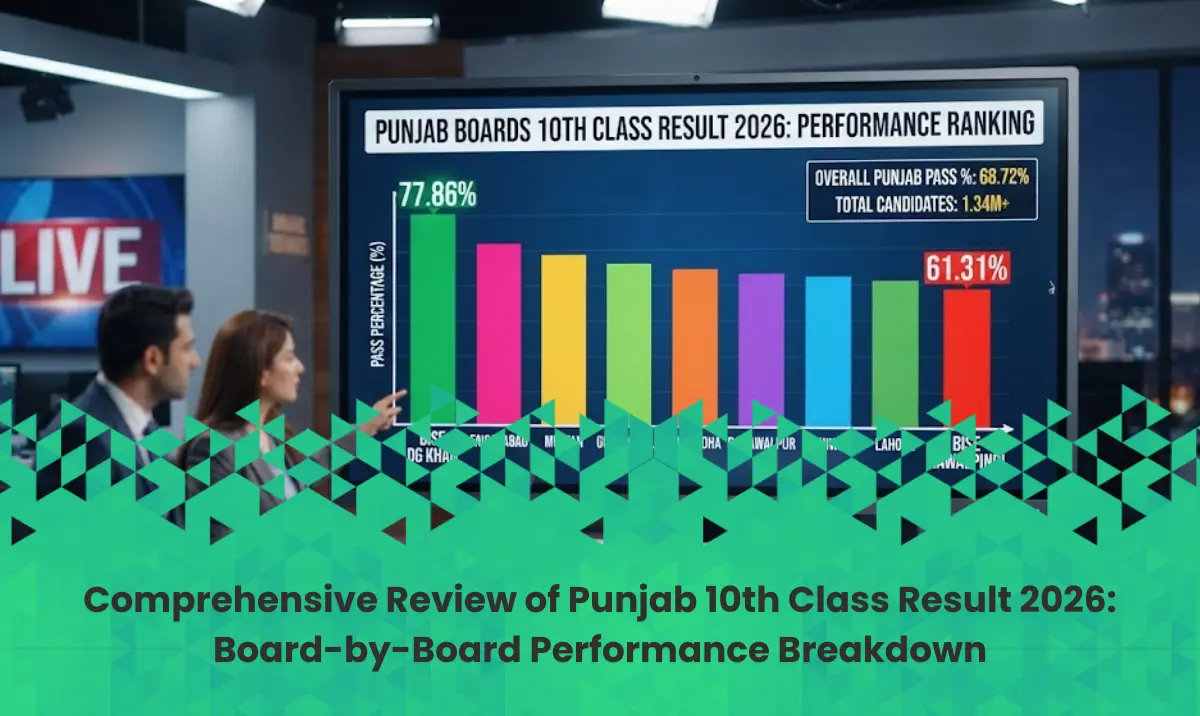
Out of these 1,348,352 appearing candidates, a cumulative total of 926,569 students successfully managed to clear their examinations, bringing the overall provincial pass percentage to approximately 68.72% . While this reflects a resilient educational framework overall, individual board statistics underline sharp variances in regional academic outcomes.
Provincial Board Performance Hierarchy
To understand where BISE Rawalpindi stands, it is crucial to analyze how the rest of the province performed in the Punjab 10th Class Result 2026 . BISE DG Khan emerged at the absolute apex of the provincial ladder, securing a staggering 77.86% pass rate. Following closely behind were major central and southern boards like Faisalabad, Multan, and Gujranwala, which maintained robust passing ratios well above the provincial mean.
|
Rank |
Education Board |
Students Appeared |
Students Passed |
Pass Percentage (%) |
|
1 |
BISE DG Khan |
96,482 |
75,124 |
77.86% |
|
2 |
BISE Faisalabad |
192,925 |
144,089 |
74.69% |
|
3 |
BISE Multan |
133,019 |
96,638 |
72.65% |
|
4 |
BISE Gujranwala |
242,192 |
168,266 |
69.48% |
|
5 |
BISE Sargodha |
100,611 |
68,637 |
68.22% |
|
6 |
BISE Bahawalpur |
96,245 |
63,012 |
65.47% |
|
7 |
BISE Sahiwal |
84,159 |
54,788 |
65.10% |
|
8 |
BISE Lahore |
282,308 |
182,186 |
64.53% |
|
9 |
BISE Rawalpindi |
120,411 |
73,829 |
61.31% |
BISE Rawalpindi at the Bottom: Analyzing the Numbers
The official gazette reports indicate that the BISE Rawalpindi pass percentage settled at 61.31% . Out of a substantial pool of 120,411 candidates who appeared under the Rawalpindi board—encompassing districts such as Rawalpindi, Attock, Chakwal, Jhelum, Murree, and Talagang—only 73,829 students managed to pass all components of the matriculation examination.
This leaves a significant portion of candidates facing failure or compartment slots, creating an urgent need for academic introspection within the region. Securing the 9th position out of nine boards has led social media circles and public commentators to loosely tag the board as the "least intelligent" region in terms of examination outcomes. However, educational experts strongly advise against conflating institutional grading statistics with intrinsic student intelligence.
Debunking the "Least Intelligent Board" Narrative
Labeling any regional educational board as "least intelligent" based purely on annual pass percentages is misleading and fundamentally incorrect. Academic performance in board examinations is a byproduct of numerous socio-economic, administrative, and pedagogical variables rather than a linear measure of human intellect.
Several key factors explain why a board like Rawalpindi might experience a lower pass percentage despite housing some of the brightest academic minds in the country:
-
Strictness of Examination Supervision: Boards vary slightly in their implementation of anti-cheating measures, invigilation controls, and paper-checking strictness. Stricter oversight naturally curtails unfair means, which can temporarily drive down pass percentages.
-
Disparities in Resource Distribution: Access to qualified teaching staff, digital learning tools, and well-equipped science laboratories differs drastically between major urban hubs and remote tehsils under the Rawalpindi Board's jurisdiction, such as parts of Attock and Chakwal.
-
Curriculum and Assessment Shifts: With the implementation of conceptual testing and updated grading matrices, regions heavily reliant on traditional rote memorization often witness a transitional dip in overall clearance rates.
-
Socio-economic Variations: Fluctuations in school attendance, infrastructural damages from weather anomalies, and teacher-student ratios heavily dictate the institutional preparedness of students.
It is equally important to note that despite holding the lowest overall board pass percentage, BISE Rawalpindi nevertheless produced exceptional individual brilliance. Top-tier students like Muhammad Rehan Ihtisham (who scored a phenomenal 1,191 marks out of 1,200) and Zuneera Tahir proved that pockets of academic excellence continue to thrive within the region irrespective of broader statistical trends.
What the New Grading System Means for Students
The release of the Punjab 10th Class Result 2026 also marks the widespread integration of the updated matric grading framework. Moving away from traditional division-based systems, the new policy maps student performance across granular grades ranging from A++ (96% to 100%) down to an Ungraded (U) status for anything scoring below 40%.
For students under BISE Rawalpindi who received disappointing outcomes or found themselves trapped on the wrong side of the 61.31% threshold, this grading system offers clarity on subject-wise deficiencies. Rather than being broadly stamped as failures, students can identify precise performance tiers, utilize supplementary examination channels, and prepare to correct their academic trajectory.
Moving Forward: Lessons from the 2026 Results
The stark contrast between BISE DG Khan's 77.86% success rate and BISE Rawalpindi's 61.31% outcome serves as an eye-opener for provincial policymakers. Education ministries across Punjab must evaluate why regional divides persist and work toward standardizing teacher training programs, resource allocation, and school support mechanisms.
For students, parents, and educational institutions within the Rawalpindi jurisdiction, the Punjab 10th Class Result 2026 should act as a catalyst for reform rather than a source of discouragement. By targeting foundational learning gaps and shifting focus toward conceptual understanding, future academic cycles can bridge the gap and elevate regional performance back to the provincial standard.







Share your comments & questions here
No comments yet. Be the first to comment!