




 Home
Home
 National
 International
 Merit list
 Date Sheet
 Result
 Admission
 Study Abroad


.jpg)
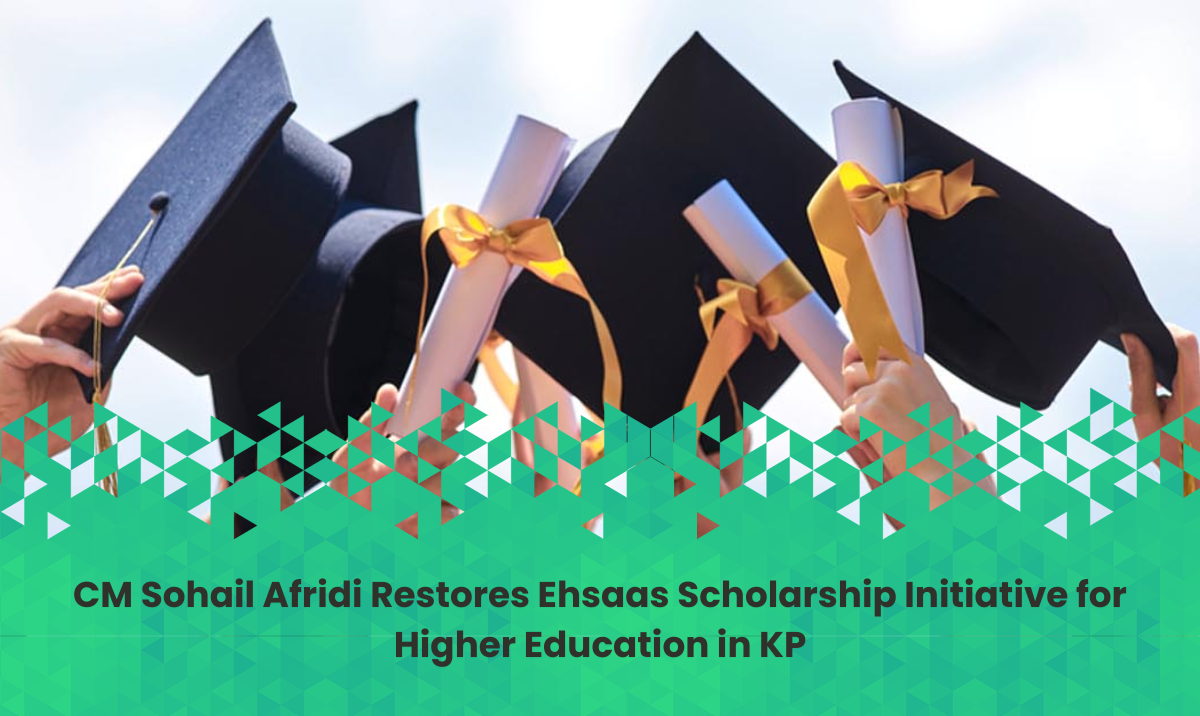
KP Relaunches Ehsaas Scholarship Program for Deserving Students to Empower Higher Education
In a monumental step toward bolstering educational accessibility and human capital development, Khyber Pakhtunkhwa (KP) Chief Minister Muhammad Sohail Afridi has officially announced the revival of the Ehsaas Scholarship Program . Funded entirely through robust provincial resources, this initiative aims to provide essential financial backing to talented, deserving, and underprivileged students across the province.
The landmark announcement was made during a keynote address at the prestigious University of Peshawar’s annual convocation. Surrounded by proud graduates, faculty members, and academic leaders, CM Afridi underscored that the provincial government remains firmly dedicated to expanding educational opportunities, upgrading institutional standards, and ensuring that financial hardships never hinder a brilliant mind from pursuing higher education.
Investing in the Future: The Vision Behind the Revival
Addressing the vibrant academic gathering, Chief Minister Muhammad Sohail Afridi characterized the younger generation as Pakistan’s most valuable and transformative asset. He noted that the ultimate trajectory and prosperity of the nation depend directly on visionary public policy, transparent governance frameworks, and unwavering investments in the education sector.
For decades, structural roadblocks, economic instability, and the inefficient utilization of national assets have constrained the true potential of Pakistan's youth demographic. Recognizing these historical gaps, the current provincial administration—inspired by visionary reforms—has prioritized education and human capital development as the twin pillars of regional uplift.
The relaunch of the Ehsaas Scholarship Program acts as a direct policy response to bridge the inequality gap, ensuring that students hailing from middle-income, low-income, and marginalized families can access top-tier undergraduate and graduate programs without carrying the burden of crushing tuition costs.
Strengthening Higher Education Infrastructure in KP
The revival of the scholarship initiative does not stand in isolation; it is part of a broader, comprehensive strategy engineered by the KP government to overhaul the province's higher education ecosystem. Public universities across Khyber Pakhtunkhwa have historically weathered severe financial turbulence, accumulating heavy operational deficits and massive pension liabilities over the years.
Upon assuming office, Chief Minister Afridi's administration initiated aggressive financial stabilization measures:
-
Clearing Legacy Liabilities: Accumulated pension liabilities spanning from 2017 through mid-2026 have been systematically addressed and cleared.
-
Deficit Reduction: Through prudent fiscal management, the combined financial deficit of public universities has been successfully slashed down from roughly Rs9 billion to approximately Rs4.5 billion.
-
Budgetary Enhancements: Provincial financial allocations dedicated to public universities have experienced a sharp upward trajectory, scaling from Rs10 billion in previous fiscal cycles to a robust Rs12 billion in the current provincial budget.
These heavy injections of funds are explicitly structured to upgrade campus research facilities, enhance teaching methodologies, and build a competitive academic environment that mirrors international standards.
Historic Revenue Growth Enabling Public Welfare Projects
Critics frequently question the sustainability of regionally funded social safety nets, yet the Khyber Pakhtunkhwa government has silenced skeptics through unprecedented fiscal performance. Driven by strict anti-corruption campaigns, rigorous institutional reforms, and transparent revenue administration, the province has shattered historical revenue collection ceilings.
For nearly 75 years, the own-source revenue of Khyber Pakhtunkhwa hovered sluggishly around the Rs68 billion mark. However, systemic administrative overhauls pushed collections to Rs92 billion during the 2024–25 fiscal term without placing any new tax burdens on ordinary citizens. Building on this momentum, despite ambitious targets set for the current fiscal period, actual collections have surged past the Rs150 billion threshold.
This fiscal breathing room has empowered the provincial cabinet to channel capital directly back into public welfare projects, most notably educational support frameworks like the Ehsaas Scholarship Program and the expanded initiatives managed via the KP Education Foundation (KPEF).
Market-Driven Academics and Youth Employment Strategy
Beyond providing financial scholarships, the KP government is heavily focusing on the employability of its graduates. Chief Minister Afridi highlighted that the traditional degree-centric approach must shift toward skill-based and market-relevant disciplines.
To prepare graduates for a fiercely competitive global digital economy, universities across the province are actively promoting emerging sciences, including:
-
Artificial Intelligence (AI) and Data Sciences
-
Cyber Security and Software Engineering
-
Fintech and Allied Health Sciences
By aligning higher education curricula with modern marketplace demands, the government aims to transform graduates from job seekers into active job creators. Furthermore, specialized internship regimes are being rolled out concurrently to bridge the gap between academia and corporate sectors, ensuring that skilled youth transition seamlessly into the professional workforce without facing prolonged unemployment.
Transparent Distribution and Merit-Centric Execution
A cornerstone of the revived Ehsaas Scholarship Program and associated educational grants is absolute transparency. Past welfare programs occasionally suffered from administrative bottlenecks and human intervention discrepancies. To counter this, the provincial government has championed fully digitized, automated application portals.
Utilizing advanced digital quantification systems, the selection process minimizes human oversight, guaranteeing that awards are distributed strictly based on merit, academic capability, and financial need. Special quotas and considerations continue to be reserved for orphans, minorities, persons with disabilities, and transgender students, ensuring comprehensive social inclusion and gender parity across all 49 integrated partner universities.






Share your comments & questions here
No comments yet. Be the first to comment!