Home
 National
 International
 Merit list
 Date Sheet
 Result
 Admission
 Study Abroad




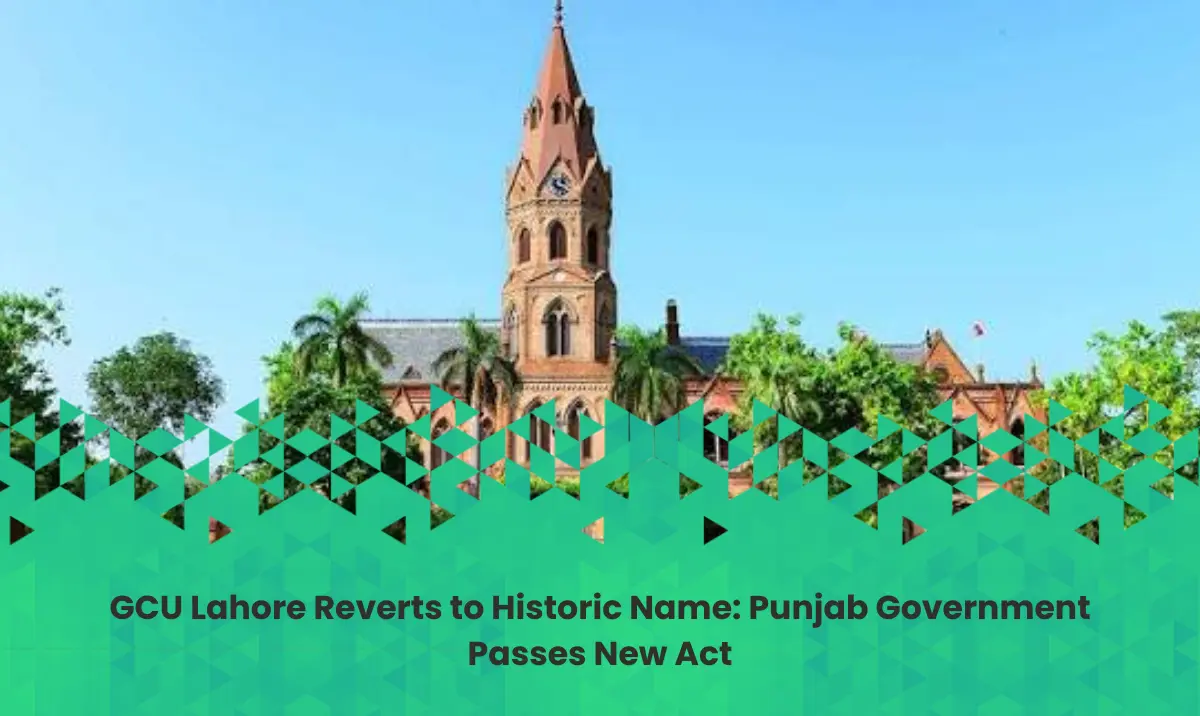
Government College University Lahore Reverts to Historic Identity as "Government College Lahore" Under New Punjab Legislation
For generations of students, alumni, scholars, and academicians across Pakistan, the iconic clock tower, the red-brick heritage blocks, and the sprawling lawns of Government College Lahore have stood as more than just an educational institution—they represent a living archive of the subcontinent's intellectual evolution. In a massive development that has sent ripples of nostalgia and debate through Pakistan's academic circles, one of the country's oldest and most prestigious seats of learning is undergoing a profound structural and symbolic transition.
Under the newly enacted Public Sector Universities (Amendment) Act, 2026, Government College University (GCU) Lahore is officially set to drop the word "University" from its title, reverting to its historic name: Government College Lahore.
This legislative measure, backed by a formal notification issued by the Punjab Higher Education Department on October 23, impacts six major public sector higher education institutions across the province. While the administrative and degree-awarding mandates of these institutions remain completely unaffected, the name change marks a poignant cultural reclamation of a legacy stretching back well over a century and a half.
The Core Legislative Move: What Does the Notification Say?
The notification issued by the Punjab Higher Education Department directs vice chancellors, rectors, and administrative heads of designated public and select autonomous higher education bodies to implement the updated institutional titles in strict compliance with the newly passed legislation.
According to the legal framework of the Public Sector Universities (Amendment) Act, 2026, the state aims to streamline and contextualize institutional nomenclature across the province. Alongside GCU Lahore, five other prominent institutions are included in this sweeping administrative revision:
-
Government College Faisalabad
-
Government College for Women Faisalabad
-
Government College for Women Sialkot
-
Government Sadiq College Bahawalpur
-
Lahore College for Women
Despite the formal dropping of the term "University" from their official titles, the notification clarifies that this change is purely structural and nomenclature-based. It will not alter the academic charters, higher education functions, funding structures, or the validity of degrees issued by these institutions. They will continue to function under their existing degree-awarding charters while bearing their historical titles.
A Glorious Heritage: Tracing the Roots of GC Lahore
To understand why this name change has evoked such deep emotional resonance among Pakistanis, one must look back at the stellar timeline of the institution.
-
Foundation (1864): Government College was established on January 1, 1864, during the British colonial era. In its earliest days, classes commenced with an initial, humble enrollment of just nine students under the auspices of the British administration, operating temporarily inside a building near the Lahore Fort before moving to its iconic permanent campus on Katchery Road.
-
Academic Evolution: Over the decades, the institution grew from strength to strength. It became affiliated with the University of Calcutta and later the University of the Punjab in 1882. It attained formal degree-awarding status in 1997, and finally, on April 2, 2002, it was officially elevated to full university status, becoming Government College University (GCU) Lahore.
-
The Titans of History: The history of GC Lahore is synonymous with the intellectual awakening of South Asia. The institution has been shaped and graced by legendary figures who walked its wooden-floored corridors, including:
-
Dr. G.W. Leitner: The pioneering orientalist, linguist, and first principal of the college, whose vision laid the bedrock for its academic rigor.
-
Allama Muhammad Iqbal: The national poet and philosopher of the East, who studied philosophy at GC Lahore and whose profound poetic and political insights later changed the map of the world.
-
Dr. Abdus Salam: Pakistan’s only Nobel Laureate in Physics, whose foundational academic pursuits began right here in these historic classrooms.
-
Countless prime ministers, diplomats, jurists, scientists, artists, and literary giants, including Faiz Ahmed Faiz, Patras Bokhari, and N.M. Rashid, who defined Urdu literature and Pakistani public life.
-
Gaps, Challenges, and Practical Implications of the Transition
While alumni associations and veteran Ravians have largely welcomed the return of the historic moniker, the transition brings several practical, legal, and administrative questions to the forefront—gaps that educational experts and current students are eager to see addressed by the provincial government and university administration.
1. Documentation and Academic Records for Current Students and Alumni
One of the most immediate concerns raised by scholars and student bodies relates to administrative paperwork. How will the transition be reflected on the academic transcripts, degrees, and registration cards of current students and fresh graduates? A legal modification in an institution's title necessitates meticulous synchronization across official databases, Higher Education Commission (HEC) portals, and international verification bodies. Ensuring a seamless transition without creating administrative discrepancies or visa-processing hurdles for graduating batches will be a critical test for the university's registrar office.
2. Institutional Standards vs. Nostalgia
For many old students, the name change is deeply intertwined with a broader desire to revive the golden standards of the past. As Nadeem Malek, an alumnus of the institution, noted:
"This is an excellent development as it was the wish of thousands of old graduates to restore the old name of this historic institution. It was a top college once but has dropped in recent years. The government should also focus on restoring the historic standard of the college."
While nomenclature carries immense symbolic weight, educationists point out that the real challenge lies in uplifting research output, modernizing laboratory infrastructure, upgrading faculty-to-student ratios, and competing globally in contemporary academic rankings. Alumni hope that the psychological rejuvenation brought by the historic name will serve as a catalyst for a renewed commitment to institutional excellence.
3. Implementation Timeline and Institutional Clarity
As of the current directive, while the notification has mandated compliance under the 2026 Act, it does not outline a rigid completion deadline or explicit operational guidelines for rebranding signages, stationery, digital portals, and official seals. Administrative departments will need a well-coordinated transition period to update institutional branding smoothly.
What Lies Ahead for Ravians?
For the vibrant community of Ravians spread across the globe, the return of the name "Government College Lahore" is a journey back to their roots. It bridges a modern administrative designation with a glorious 162-year-old heritage.
As the university moves forward under its restored title, the focus must inevitably shift toward balancing deep-rooted historical pride with forward-thinking academic innovation. For ilmkidunya readers and students keeping a close eye on higher education trends in Punjab, this monumental shift marks a new chapter in the chronicles of Pakistani academia—one where history and modern legislation meet under the shadow of the iconic clock tower.