

 Home
Home
 National
 International
 Merit list
 Date Sheet
 Result
 Admission
 Study Abroad
.jpg)


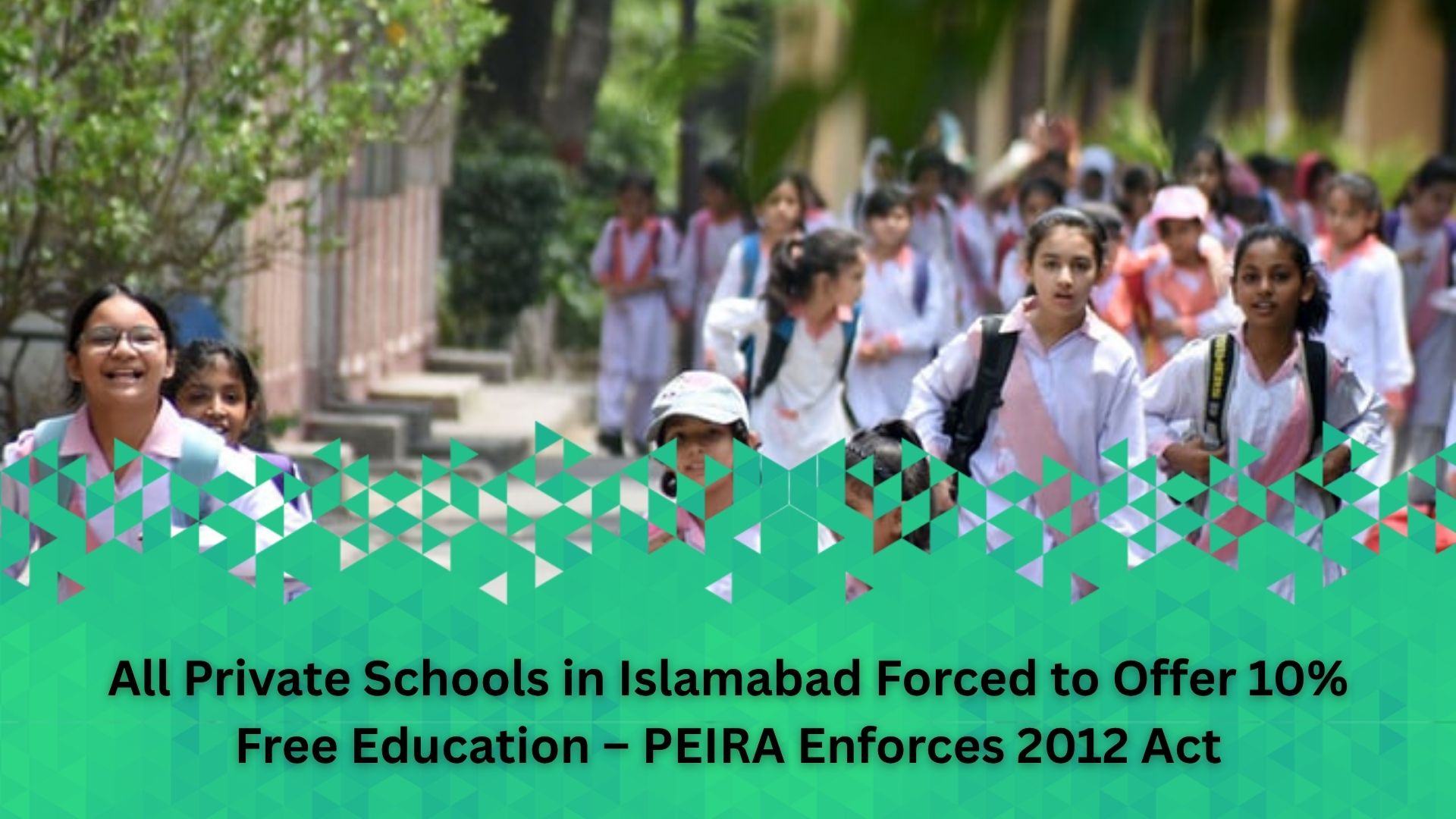
All Private Schools in Islamabad Forced to Offer 10% Free Education – PEIRA Enforces 2012 Act
The Private Educational Institutions Regulatory Authority (PEIRA) has officially begun enforcing the Free and Compulsory Education Act, 2012, compelling all private schools to reserve a 10% quota of free education for underprivileged students.
The directive, which was recently submitted to the Islamabad High Court, marks a decisive shift from voluntary compliance to mandatory enforcement. PEIRA has launched the ambitious “No Child Left Behind” campaign, targeting the enrollment of 25,000 children from marginalized communities into some of the capital’s most prestigious private institutions.
PEIRA Submits Compliance Report to High Court
According to the official report filed by PEIRA before the Islamabad High Court, the authority has confirmed the commencement of implementation proceedings. The report details that there are currently 1,571 private educational institutions operating across five distinct zones of the federal capital. These schools collectively serve a student population of approximately 389,000 children .
To date, 500 of these institutions have submitted comprehensive data regarding their infrastructure and current student strength. This data submission is the first step in a rigorous verification process designed to ensure that the 10% quota is not merely a symbolic gesture but a tangible reality for qualifying families.
Who Benefits? Priority for Orphans and Martyrs’ Children
Under the newly enforced rules, PEIRA has established a clear hierarchy for scholarship distribution. Orphans and the children of martyrs (shuhada) will be given top priority in the allocation of the 10% free education scheme. Following this priority group, seats will be allocated to children from low-income families who cannot afford the rising tuition fees of private schools.
A dedicated monitoring committee has been formed by PEIRA to oversee the verification of admissions under this quota. The committee is tasked with ensuring that schools do not discriminate against quota students in terms of quality of education, facilities, or treatment.
Verification Process Underway for 2025–26 Academic Session
PEIRA has directed all registered private institutions to comply immediately by submitting lists of students admitted under the free quota for the upcoming 2025–26 academic session . The authority has requested detailed data on scholarship students, including their academic records and family backgrounds, to facilitate transparent verification.
“Several institutions have already submitted their lists, and the verification process is currently in full swing,” a PEIRA official stated, adding that the authority is cross-referencing the data to prevent fraudulent claims.
Strict Penalties for Non-Compliance
In a stern warning to educational institutions that might attempt to circumvent the law, PEIRA has made it clear that failure to submit the required data will result in action under the PEIRA Act . Schools that do not comply face potential fines, suspension of registration, or even legal proceedings.
To streamline the process, institutions have been instructed to provide their data through two parallel channels: manual submission (physical documents) and an online portal . This dual-system approach aims to eliminate any excuses for non-compliance while ensuring data integrity.
Legal Background: The Free and Compulsory Education Act, 2012
The Free and Compulsory Education Act, 2012 , which forms the legal backbone of this directive, was originally passed to guarantee free education to children aged 5 to 16 years. However, implementation remained sluggish for over a decade due to lobbying from private school associations and administrative hurdles.
The current enforcement follows a series of petitions filed in the Islamabad High Court by child rights activists, who argued that private schools operating on public land or charging premium fees have a social obligation to integrate children from lower economic strata.
Reactions from Stakeholders
Child rights advocates have hailed the move as a “historic victory for educational justice.” Fatima Karim, an education policy expert, told reporters: “This is not charity; it is a legal right. For years, the 10% quota existed only on paper. PEIRA’s monitoring committee finally gives teeth to the law.”
However, private school associations have expressed concerns about financial sustainability. Some principals argue that without government reimbursement for waived fees, smaller institutions may struggle to maintain operations. PEIRA has not yet announced any subsidy mechanism for schools.
What This Means for Parents
For parents in Islamabad struggling with soaring school fees, this directive is a lifeline. Families seeking admission under the quota must provide documentation of their child’s orphan status, proof of parental martyrdom, or verified income statements.
PEIRA has urged eligible families to approach their nearest private school or the authority’s zonal office directly. The “No Child Left Behind” campaign will also include awareness drives in low-income neighborhoods.
.png)
The Road Ahead
With the verification process ongoing and a deadline looming for the 2025–26 session, all eyes are now on PEIRA’s monitoring committee to ensure accountability. The authority has promised to publish a public dashboard showing quota admissions school-by-school.
This enforcement in Islamabad could set a precedent for other provinces, including Punjab and Sindh, where similar free education clauses exist in provincial laws but remain largely unimplemented.