




 Home
Home
 Education
 Technology
 Relationship
 History
 Business
 Career
 Religion


.jpg)
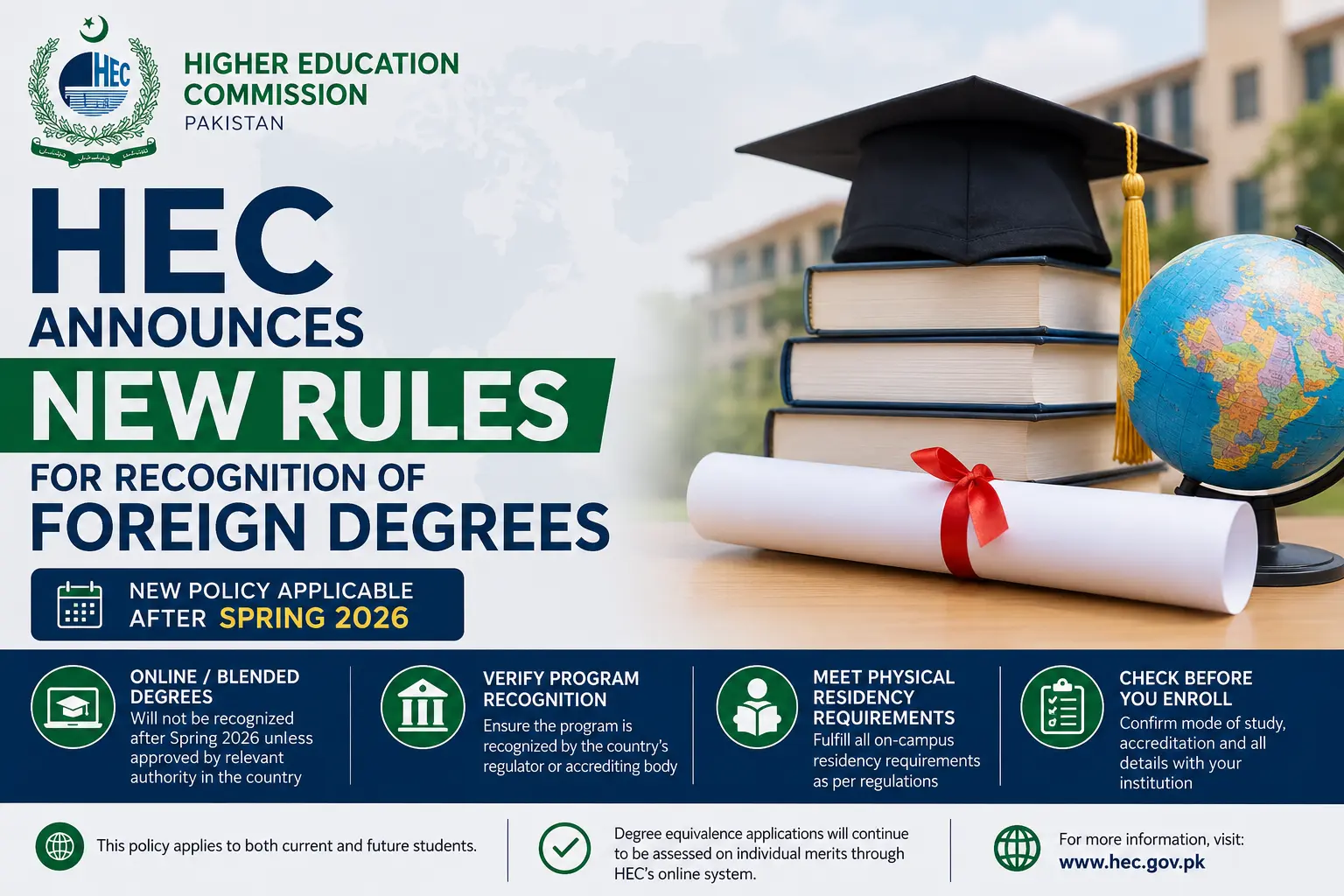
HEC Announces New Rules for Recognition of Foreign Degrees in Pakistan
The Higher Education Commission (HEC) has introduced important changes regarding the recognition of foreign qualifications, urging students to carefully verify the mode of study before enrolling in overseas academic programs. The latest HEC Foreign Degree Recognition Rules 2026 are aimed at ensuring transparency and maintaining academic standards for students pursuing higher education from international institutions.
The announcement comes as more Pakistani students explore online and blended learning opportunities offered by foreign universities. Under the new guidelines, degrees completed through unapproved online or hybrid learning methods may face recognition issues in Pakistan, potentially affecting graduates seeking employment, further education, or professional licensing.
HEC Issues Advisory for Students Planning to Study Abroad
In its latest advisory, the HEC emphasized that students intending to pursue education abroad must confirm whether their chosen program is officially approved in the country where the university operates. The commission highlighted that the mode of study plays a crucial role in determining whether a qualification will be accepted for equivalence in Pakistan.
According to the advisory, degrees that are registered as conventional on-campus programs but are completed entirely through online or blended learning formats will not be recognized after Spring 2026 unless the arrangement has been approved by the relevant regulatory authority or accreditation body in the institution’s home country.
This development makes the HEC Foreign Degree Recognition Rules 2026 particularly important for students considering international degree programs.
Why the New HEC Policy Matters
Over the past few years, online education has become increasingly popular worldwide. Many universities now offer flexible learning options that allow students to complete coursework remotely. While these opportunities provide convenience and accessibility, they have also created challenges for education regulators tasked with ensuring academic quality and authenticity.
The HEC’s updated policy aims to address these concerns by ensuring that students receive qualifications that meet recognized academic standards. The commission wants to prevent situations where students invest significant time and money in degree programs that may not qualify for recognition in Pakistan.
As a result, students are encouraged to thoroughly research their selected universities and verify accreditation details before enrollment.
Degrees Completed Through Online or Blended Learning
One of the key aspects of the new policy relates to programs advertised as traditional on-campus degrees but delivered entirely online or through a blended format.
Under the HEC foreign degree recognition framework, such qualifications may face rejection if the study mode does not align with the program's official registration status. This means students must ensure that any online or hybrid learning arrangements are formally approved by the educational authorities in the country where the institution is located.
Failure to meet these requirements could result in difficulties when applying for degree equivalence in Pakistan.
Important Guidelines for Students
The HEC has advised students to take the following steps before enrolling in a foreign university:
Verify Program Accreditation
Students should confirm that the institution and degree program are recognized by the relevant accreditation or regulatory authority in the host country.
Check the Official Mode of Study
Applicants must verify whether the program is approved as on-campus, online, or blended learning. The mode of study should match the university's official records.
Meet Physical Residency Requirements
Many international degree programs require students to spend a specified period on campus. The HEC advises students to comply with these residency requirements to avoid future recognition issues.
Consult the University Directly
Students should seek written confirmation from universities regarding study mode, accreditation status, and residency obligations before making enrollment decisions.
Impact on Current and Future Students
The advisory applies not only to prospective students but also to individuals who are already enrolled in foreign institutions. Existing students are encouraged to review their program structures and ensure compliance with the new requirements.
For many learners, particularly those enrolled in distance education programs, understanding the implications of the foreign degree equivalence Pakistan policy will be essential. Early verification can help students avoid unexpected complications when applying for recognition after graduation.
Degree Equivalence Applications Will Continue
Despite the policy changes, the HEC has clarified that degree equivalence applications will continue to be processed through its online system. Each application will be evaluated on its own merits, considering factors such as accreditation status, mode of study, academic requirements, and compliance with relevant regulations.
This means that while the new policy introduces stricter standards, students still have the opportunity to present their qualifications for assessment under the established equivalence process.
What Students Should Do Next
Students planning to pursue international education should treat the HEC advisory as an important reminder to conduct thorough research before selecting a university or degree program. With growing interest in online education, understanding the recognition requirements has become more important than ever.
The HEC advisory for students abroad highlights the need for careful planning, accurate documentation, and compliance with international academic standards. By verifying accreditation, study mode, and residency requirements in advance, students can protect their educational investments and ensure that their qualifications are recognized in Pakistan.
Conclusion
The newly announced HEC Foreign Degree Recognition Rules 2026 represent a significant step toward strengthening quality assurance in higher education. The policy emphasizes the importance of approved study modes, recognized accreditation, and compliance with residency requirements for foreign qualifications.
As more students seek educational opportunities abroad, understanding the latest HEC degree verification and recognition requirements will be essential. By following the commission’s guidelines and verifying program details before enrollment, students can avoid future equivalence challenges and secure the value of their international degrees in Pakistan.










Share your comments & questions here
No comments yet. Be the first to comment!