




 Home
Home
 National
 International
 Merit list
 Date Sheet
 Result
 Admission
 Study Abroad


.jpg)
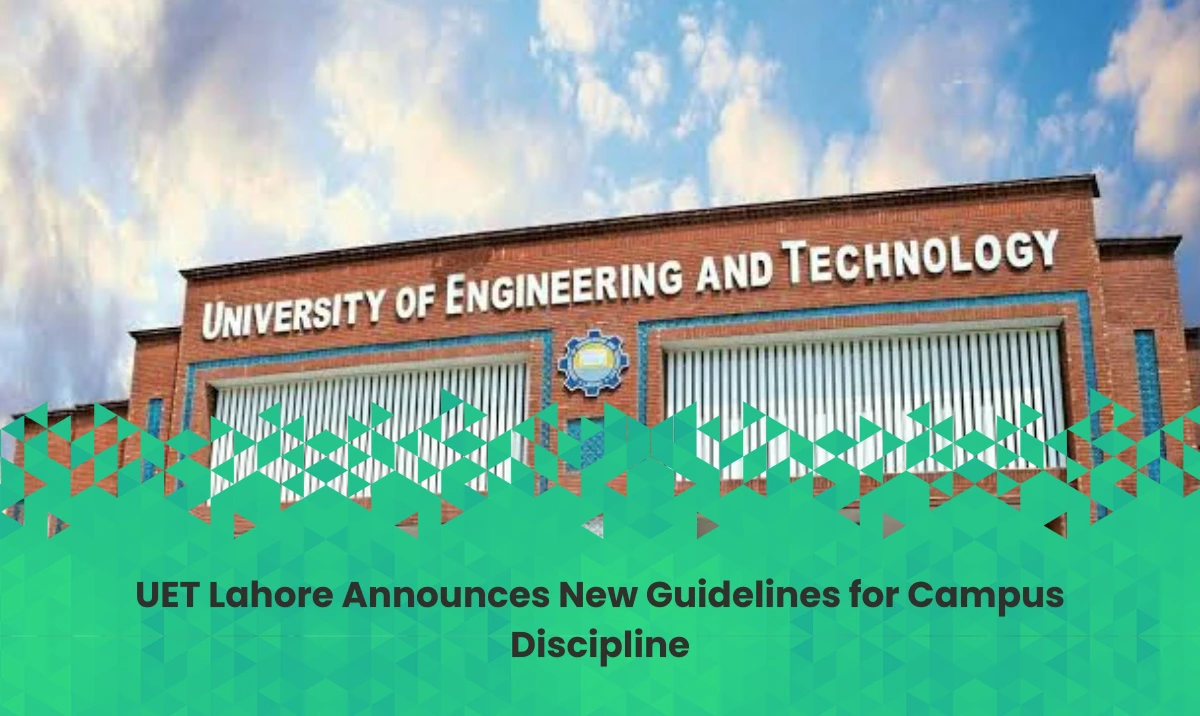
UET Lahore Responds To Claims Over Student Disciplinary Cases
The University of Engineering and Technology (UET) Lahore has formally rejected claims circulating in various circles suggesting that its recent disciplinary actions were designed to target students for raising concerns, expressing academic disagreements, or voicing dissent against the university administration. In an official and detailed statement released to address the growing controversy, the institution underscored its absolute commitment to fairness, institutional transparency, and the rule of law within all its campuses.
Addressing Allegations of Targeted Actions
In recent weeks, social media discussions and various student forums raised concerns regarding punitive measures taken against specific individuals. Critics alleged that the administration was utilizing disciplinary frameworks to suppress freedom of expression and silence students who questioned administrative policies.
Refuting these assertions completely, the UET Lahore administration clarified that disciplinary steps are never initiated based on personal opinions, ideological differences, or peaceful expression of thought. Instead, the university emphasized that any action taken is strictly a response to violations of established code-of-conduct guidelines, institutional protocols, and campus security regulations.
"The university deeply values constructive discourse and respects the democratic rights of its academic community. However, crossing boundaries into breach of discipline, property damage, or violation of institutional bylaws warrants institutional review," a senior university official noted.
Transparent Review Mechanism and Committees
To dispel rumors of bias or arbitrariness, the university administration elaborated on the rigorous procedure governing every penal decision. According to the official statement, UET student disciplinary cases are never handled unilaterally or hastily.
Instead, every single case is independently processed and reviewed by specialized relevant committees comprising senior faculty members, academic administrators, and student affair representatives. These bodies operate under predefined charter guidelines designed to ensure natural justice and provide a fair opportunity of defense to the accused parties.
The review procedure incorporates multiple layers of verification, ensuring that decisions are anchored strictly in facts rather than assumptions or external pressures.
Comprehensive Evaluation of Evidence
A core aspect of UET’s defense against the bias claims lies in the exhaustive nature of its investigative protocols. The university highlighted that disciplinary committees do not rely on hearsay or circumstantial complaints. Before any final verdict or penalty is finalized, the committees thoroughly investigate all available empirical evidence.
The evaluation framework includes:
-
CCTV Footage: High-definition security camera recordings from campuses to establish chronological sequences of events and identify specific actions.
-
Witness Statements: Testimonies gathered objectively from academic staff, security personnel, and fellow students present during incidents.
-
Written Responses: Formal explanations, defense pleas, and written accounts submitted directly by the students facing inquiries.
-
Social Media Records: Digital footprints, shared posts, and public digital broadcasts evaluated to determine if instigation, defamation, or rule breaches occurred online.
By adopting this multi-faceted evidentiary standard, the university aims to guarantee that innocent students are fully protected while those proven guilty of misconduct face standardized consequences under institutional law.
Balancing Freedom of Expression and Campus Discipline
As one of Pakistan's premier engineering institutions, UET Lahore houses thousands of ambitious young minds across its main Lahore campus and sub-campuses like Kala Shah Kaku and Narowal. Maintaining a peaceful, conducive academic environment remains a top priority for the management.
Educationists and university stakeholders have frequently debated the fine line between lawful student activism and administrative discipline. While student bodies often argue for broader spaces for debate, university authorities must balance these demands with the preservation of public property, prevention of academic disruption, and the safety of the wider student body.
UET’s latest clarification serves as a strong reminder that while intellectual disagreement and academic discussions are welcome components of higher education, they must be conducted within the legal framework of the university’s constitution.








Share your comments & questions here
No comments yet. Be the first to comment!