


 Home
Home
 National
 International
 Merit list
 Date Sheet
 Result
 Admission
 Study Abroad
.jpg)


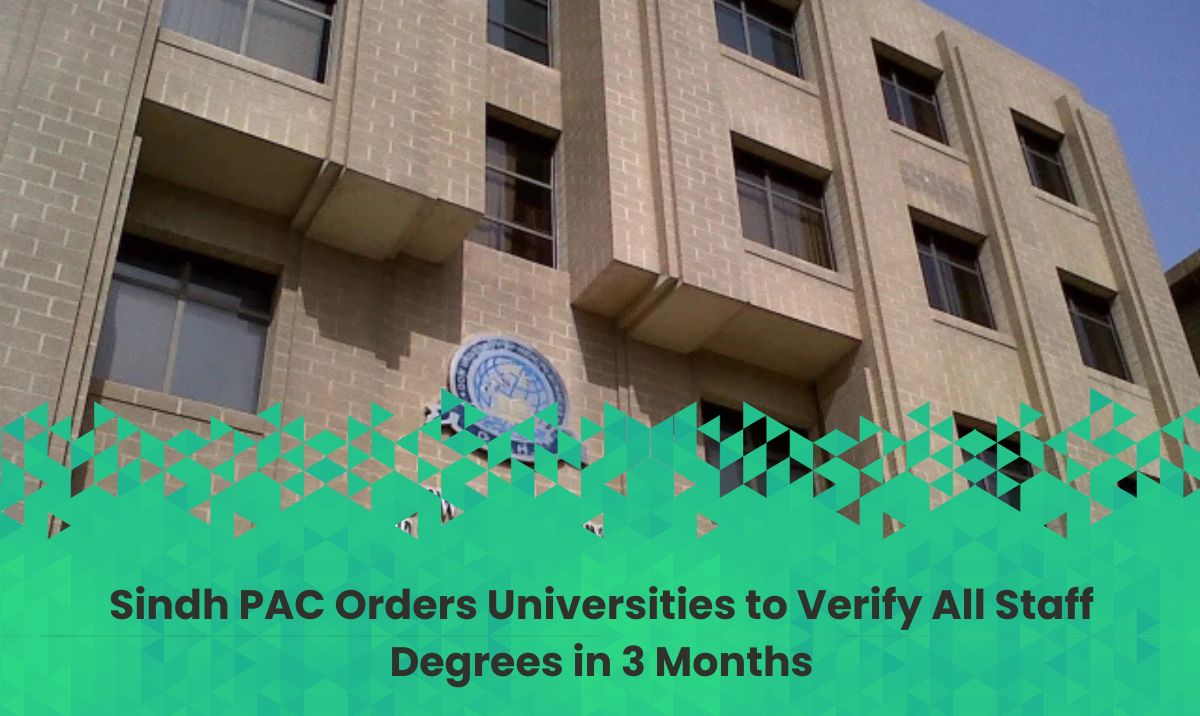
The Public Accounts Committee (PAC) of the Sindh Assembly has directed all public universities across the province to complete the verification of their employees’ educational degrees through the Higher Education Commission (HEC) within the next three months. The strong mandate comes in response to alarming revelations regarding fake academic credentials discovered at the Dow University of Health Sciences (DUHS), triggering renewed scrutiny over hiring practices, transparency, and academic integrity in Sindh’s higher education sector.
The committee issued the directive during a detailed review of DUHS’s audit reports for the fiscal years 2021 to 2023. During the session, PAC members were informed that 10 DUHS employees had secured jobs using fake degrees, exposing serious gaps in the university’s recruitment and verification mechanisms. This revelation not only raised questions about internal accountability but also cast a shadow over the credibility of the institution’s human resource practices.
Only 450 Out of 3,500 DUHS Staff Verified So Far
Audit officials briefed the committee that DUHS had verified the academic credentials of only 450 employees out of a total 3,500, meaning more than 3,000 staff members had never undergone proper background or educational checks. The audit department expressed concern that a significant portion of the university’s workforce, particularly contractual employees, had been appointed without HEC verification or personal background screening, creating opportunities for individuals with fraudulent credentials to enter the system.
PAC members emphasized that such negligence not only undermines the credibility of the institution but also poses risks to students, patients, and academic programs that rely on qualified and genuine professionals. The committee also noted that DUHS spends approximately Rs2.33 billion annually on employee salaries, making it essential that taxpayers’ money is spent on legitimate and qualified personnel.
Audit Department Had Flagged the Issue Last Year
According to officials, the audit department had formally pointed out the degree verification lapses in June of the previous year. However, DUHS reportedly failed to submit a comprehensive response or take corrective measures in a timely manner. The PAC expressed dissatisfaction over the delay and stressed that repeated warnings should compel public institutions to take urgent corrective action.
Committee members stated that if the issue had been addressed earlier, several questionable appointments could have been avoided. The lack of timely verification also highlighted procedural weaknesses within the university’s administrative framework.
DUHS Explains Delays in Verification Process
During the meeting, DUHS officials explained the reasons behind the delay in completing the verification process. The university management revealed that they had issued three separate tenders inviting firms to handle the degree verification task, but no company submitted bids. With no bidders willing to undertake the project, DUHS entered into a direct contract with HRSG Outsourcing Company to carry out the verification process.
The contracted firm has now begun the task, and according to DUHS, several employee degrees have already been verified. University officials assured the committee that the verification process will be expedited and completed within the required timeline.
Action Taken Against Employees With Fake Degrees
DUHS Vice Chancellor Dr. Nazli Hussain briefed the PAC on the disciplinary action taken against employees found guilty of possessing forged academic credentials. She confirmed that eight of the 10 employees identified with fake degrees have been terminated from service. The remaining two individuals have been issued showcause notices and are expected to be dismissed shortly after completion of the due process.
Dr. Hussain emphasized that DUHS maintains a zero-tolerance policy toward fraudulent documentation and assured the committee that the university is committed to strengthening its hiring, verification, and compliance systems.
Over 3,000 Employees Hired on Contract in Four Years
Another significant revelation made during the PAC briefing was that DUHS hired 3,023 employees on a contractual basis from July 2021 to June 2025. Out of these, only 54 have been regularised. The PAC expressed concerns over the large-scale contractual hiring, noting that temporary appointments often bypass strict verification protocols, increasing the risk of forged documents and irregular employment practices.
Committee members stressed that universities must streamline their recruitment procedures, ensure transparency, and adopt standardised verification mechanisms to prevent misuse of contractual hiring.
PAC Orders Province-Wide Verification in Public Universities
Recognizing that the issue is not limited to DUHS alone, the PAC issued a province-wide directive requiring all public universities in Sindh to verify the academic degrees of their employees through HEC within three months. The committee emphasized that every public institution must ensure that its faculty, administrative staff, and technical personnel hold authentic and verifiable degrees.
The PAC also urged HEC to facilitate universities by improving verification timelines and enhancing coordination channels. Universities have been instructed to submit progress reports to the committee regularly to ensure compliance.
Ensuring Transparency and Academic Integrity
The latest developments have sparked a broader debate about the governance structure and accountability frameworks in Sindh’s higher education sector. Education experts and policymakers argue that systematic reforms—such as digital record-keeping, centralised verification databases, and stricter hiring protocols—are essential for sustaining academic credibility.
The PAC’s directive signals a major step toward restoring trust and enforcing discipline within public universities. With thousands of degrees yet to be verified, the coming months will be crucial in determining the effectiveness of the new measures and the commitment of institutions to uphold transparency and quality standards.