




 Home
Home
 National
 International
 Merit list
 Date Sheet
 Result
 Admission
 Study Abroad



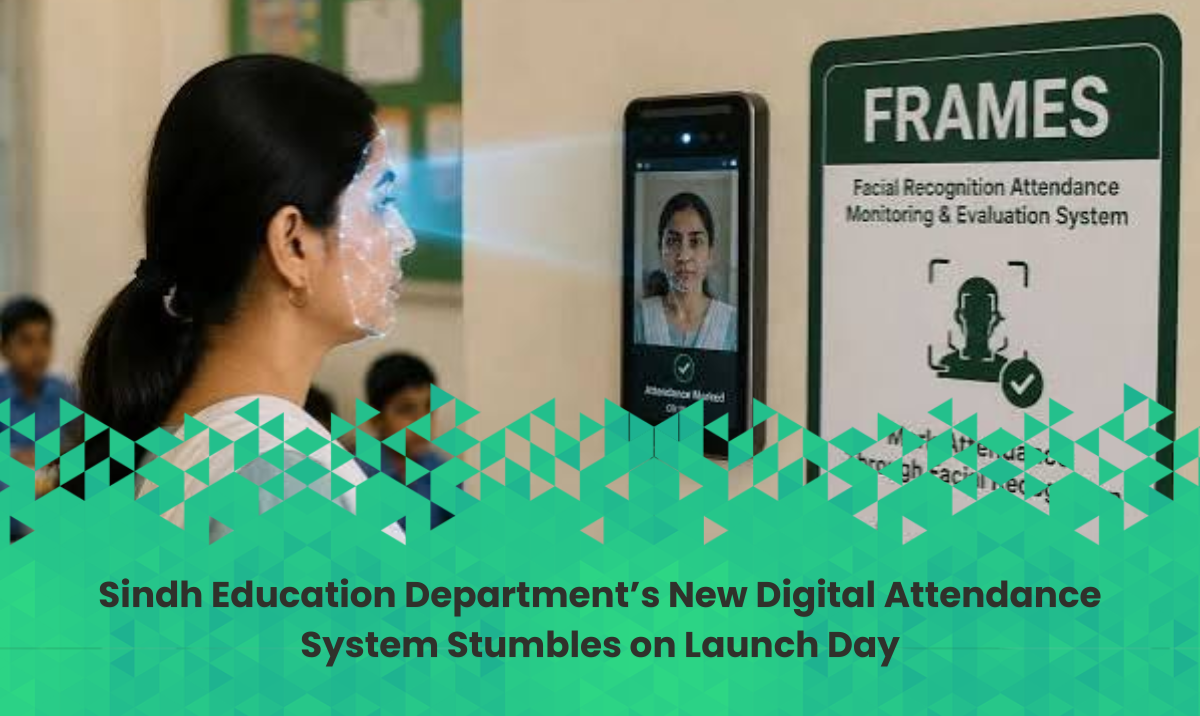
Sindh’s New Facial Recognition Attendance System Fails on First Day
The much-publicized rollout of Sindh’s digital transformation in the education sector encountered an immediate roadblock on Monday as technical glitches marred the launch of the Facial Recognition Attendance Monitoring and Evaluation System (FRAMES). Designed to curb chronic absenteeism and bring transparency to public schools, the pilot phase’s debut left numerous teaching and non-teaching employees unable to log their arrival, forcing schools to temporarily fall back on traditional paper-based registers.
The Pilot Rollout and Initial Expectations
The government initiative, spearheaded by the School Education & Literacy Department, was rolled out on a pilot basis across six diverse districts of the province: Karachi East, Hyderabad, Naushahro Feroze, Jacobabad, Ghotki, and Umerkot. This initial phase covers 49,565 teaching and non-teaching personnel.
Under the standard operating framework of FRAMES, staff members are mandated to log their daily check-ins and check-outs using a specialized mobile application that verifies identity through facial mapping. Officials previously highlighted that the software was built to operate even in low-connectivity offline environments, syncing data automatically once a stable internet connection is restored. Furthermore, the platform integrates employee leave applications and offers downloadable monthly logs.
Technical Glitches and Ground Realities
Despite extensive pre-launch training sessions, the first morning of implementation exposed severe server-side vulnerabilities. At multiple institutions, such as the Idara Sharqia Government Girls Secondary School located in Jacob Lines, Karachi, educators attempting to record their attendance were greeted with frustrating error notifications.
Common prompts included warnings such as "Server is busy, please wait a few seconds and try again" alongside error notices reading "School not assigned to user". Because helpline numbers and attempts to contact technical administrators went unanswered during early morning hours, school administrators had no alternative but to pull out traditional attendance registers to prevent chaos.
Reactions from Educators and Stakeholders
While public school teachers have largely voiced support for digital accountability—noting that automated tracking helps isolate ghost employees who draw salaries without stepping foot in classrooms—the shaky debut has raised serious concerns regarding infrastructure readiness.
Education administrators supervising the pilot emphasized that teething troubles are common during large-scale technological shifts. However, critics argue that foundational server capacities must be heavily reinforced before linking attendance data directly with treasury payroll processes, where system errors could unjustly trigger salary deductions or administrative disputes.
As the School Education & Literacy Department reviews day-one feedback from the six pilot districts, teachers and staff union representatives hope that system bottlenecks will be systematically resolved before provincial expansion moves forward.
Would you like me to adjust the length or focus of this news piece to target a specific publication style?










Share your comments & questions here
No comments yet. Be the first to comment!