




 Home
Home
 National
 International
 Merit list
 Date Sheet
 Result
 Admission
 Study Abroad


.jpg)
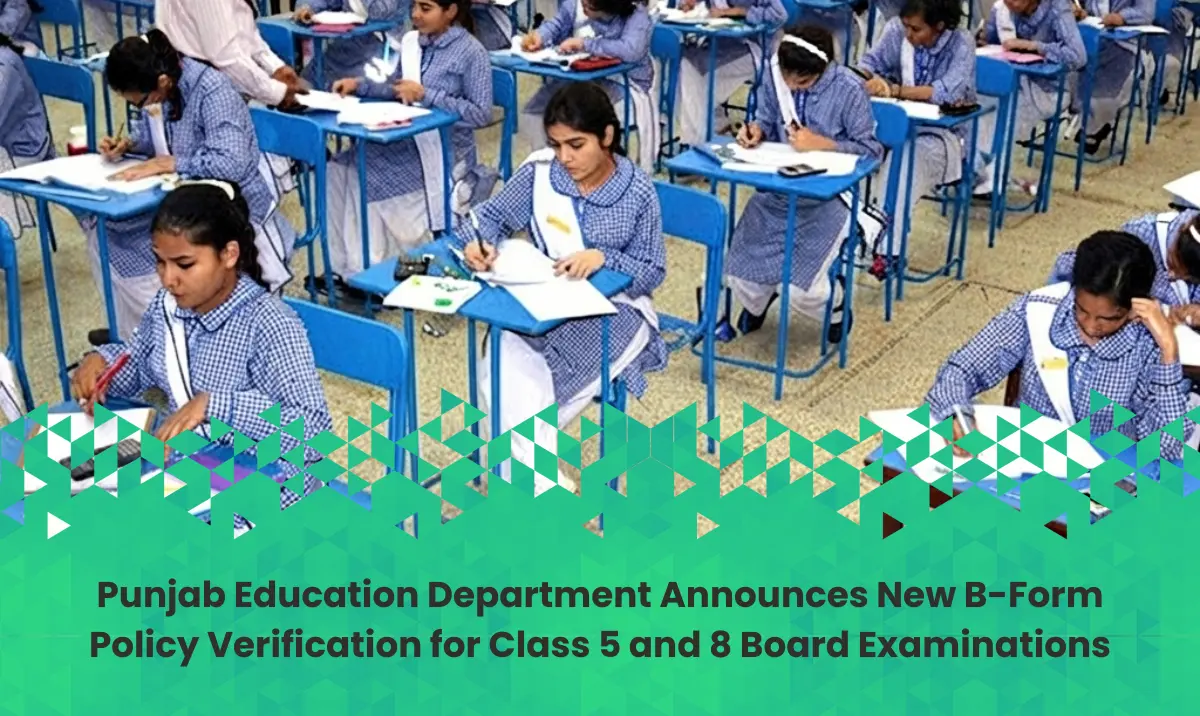
Punjab Enforces Strict B-Form Policy for Class 5 and 8 Board Examinations
The educational landscape in Pakistan’s largest province is undergoing a massive administrative overhaul. In a recent directive that impacts hundreds of thousands of students, the Punjab B-Form policy has been revised to make the National Database and Registration Authority (NADRA) issued B-Form number mandatory for the registration of students appearing in Grade 5 and Grade 8 board examinations .
According to reports from educational monitors and media outlets like City42, the Punjab Education, Curriculum, Training and Assessment Authority (PECTAA) has automated its portal to weed out incomplete profiles. Under the newly implemented protocols, educational institutions across the province can no longer complete a student’s formal registration for annual evaluations without entering a verified, authentic B-Form or Child Registration Certificate (CRC) number.
The Core of the New B-Form Policy
For years, schools often allowed students to enroll in institutional databases using local birth certificates, manual school leaving certificates, or temporary affidavits, pending the acquisition of official NADRA documents. However, the provincial government has clamped down on this practice to streamline data transparency, eliminate ghost students, and establish a foolproof digital registry.
Key highlights of the updated regulatory framework include:
-
Mandatory B-Form Field: The digital registration portals managed by PECTAA will reject any submission where the B-Form number is missing, invalid, or mismatched with NADRA records.
-
Automatic "Unverified" Status: The registration system has been programmed to automatically flag and mark any student who was previously registered without a valid B-Form as unverified .
-
Strict Institutional Compliance: School administrators, headmasters, and principals have been instructed to treat data correction as an emergency task. Failing to update these credentials risks barring students from sitting in the upcoming board assessments.
Why Punjab Introduced This Reform
The introduction of this stringent policy stems from broader initiatives by the Punjab government to overhaul the public education sector. Following scrutiny over fluctuating academic standards and discrepancies in student enrolment numbers, educational authorities have sought absolute transparency.
1. Eliminating Ghost Enrollments
In the past, discrepancies between physical attendance registers and actual board appearances often led to administrative loopholes. By tying every single student's academic identity directly to their unique NADRA B-Form , the government can effectively track genuine enrollments and prevent inflated figures submitted by institutions.
2. Standardization of Data
Integrating NADRA’s database with Grade 5 and Grade 8 board exams registration ensures that a child's name, parentage, and date of birth match official state records seamlessly. This minimizes errors that traditionally surfaced later in higher classes, such as during Matriculation or Intermediate board registrations under various Boards of Intermediate and Secondary Education (BISE).
3. Accountability Under PECTAA
With PECTAA taking center stage in governing foundational assessments and middle-standard examinations, standardization is paramount. Clean data allows the education ministry to analyze performance metrics accurately, design targeted academic improvement plans, and monitor institutional efficiency across different districts.
Challenges Faced by Schools and Parents
While the overarching goal of the Punjab B-Form policy is progressive, the sudden enforcement has sent ripples of panic through both public and private educational circles, as well as households across Punjab.
-
NADRA Office Backlogs: Obtaining or modifying a B-Form requires visiting NADRA registration centers, which are frequently overcrowded. Parents are currently rushing to update biometric records, correct spelling mistakes, or register newborns, leading to long queues.
-
Time Constraints for School Administration: Institutional heads are under immense pressure to collect, verify, and input accurate data onto the portal before strict deadlines close. Teachers find themselves doubling as administrative coordinators, helping families navigate bureaucratic hurdles.
-
Financial and Access Barriers: For underprivileged families, managing travel costs to NADRA centers and taking time off daily labor to secure a B-Form presents a distinct socioeconomic challenge. Failure to do so risks a child missing a crucial academic year.
Steps for Parents and Schools to Ensure Compliance
To avoid administrative disqualification from the upcoming examinations, stakeholders must take immediate action:
-
Check Current Status: Parents should coordinate immediately with their child’s school head or class teacher to confirm whether their admission entry is marked as verified or unverified on the portal.
-
Immediate NADRA Visit: If a child lacks a B-Form or if there is a discrepancy in the spelling of names or dates of birth, parents must visit their nearest NADRA office on a priority basis to apply for a fresh or modified CRC.
-
Prompt Data Submission: Once the B-Form is issued, the document must be handed over to the school administration instantly so that IT staff can input the correct details into the PECTAA portal before the final cutoff date.





Share your comments & questions here
No comments yet. Be the first to comment!