

 Home
Home
 National
 International
 Merit list
 Date Sheet
 Result
 Admission
 Study Abroad
.jpg)


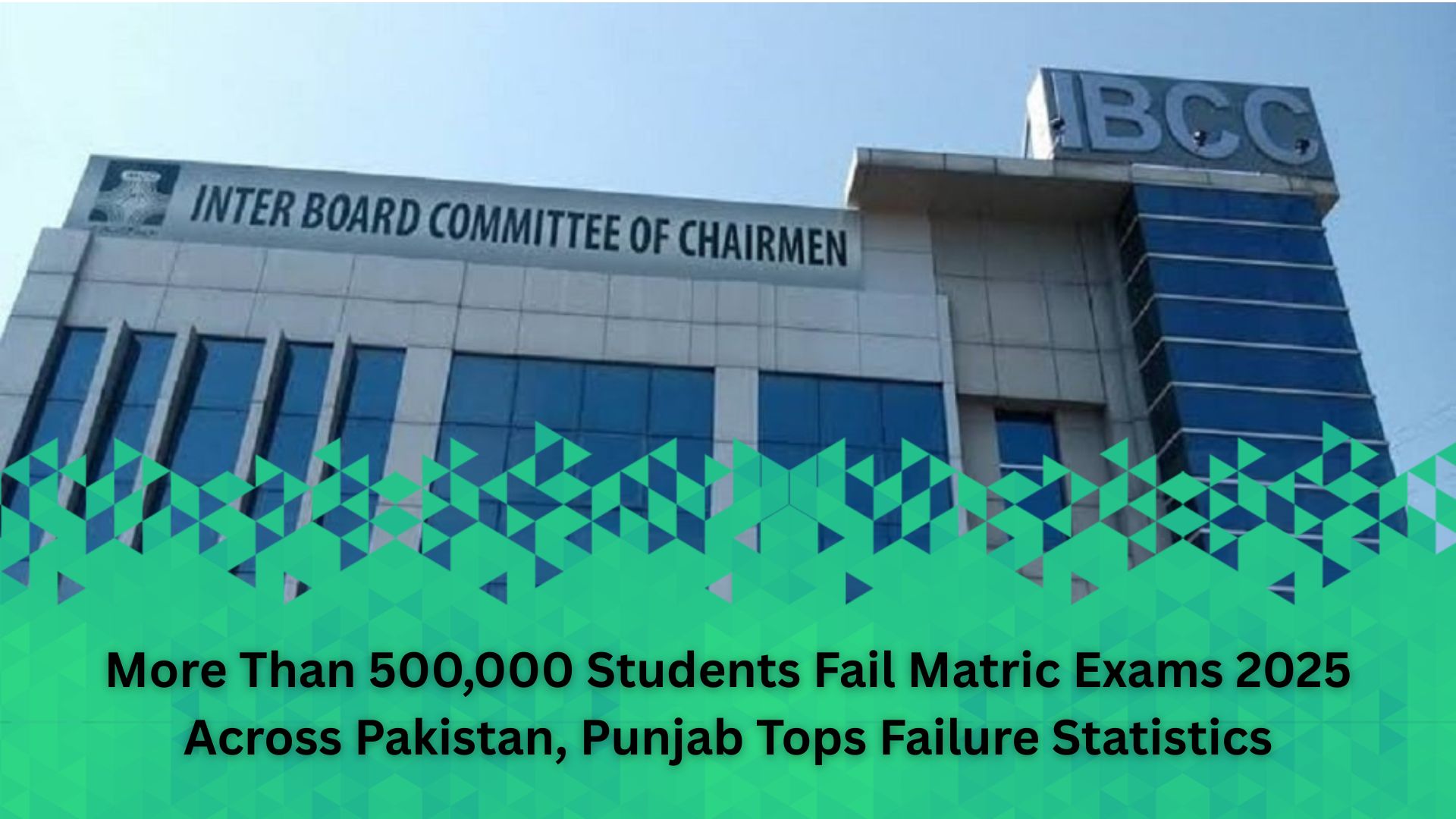
The release of the Matriculation Annual Examinations 2025 results has sent shockwaves through Pakistan’s education sector. According to an official report published by the Inter-Board Coordination Commission (IBCC) , more than half a million students have failed the secondary school certificate examinations across the country. The data reveals a deeply concerning decline in academic performance, with the nine education boards of Punjab recording the highest failure rate among all provinces.
The detailed performance analysis, which aggregates data from all major educational boards, shows that out of nearly 2.4 million students who appeared for the exams nationwide, a staggering 516,772 were unable to secure passing marks. Officials have described the figures as a “red flag” for the standard of secondary education in the country.
Detailed Board-Wise Failure Records (Matric Annual Exams 2025)
Below is the complete table of candidate failure records for each major board as reported by the IBCC.
| Board | Total Candidates Appeared | Total Students Failed | Failure Rate (%) |
|---|---|---|---|
| PUNJAB (9 Boards Combined) | 1,226,000 | 358,000 | 29.2% |
| BISE Lahore (Specific) | 253,000 | 87,419 | 34.6% |
| SINDH (6 Boards Combined) | 450,000 | 51,000 | 11.3% |
| KHYBER PAKHTUNKHWA (8 Boards Combined) | 444,000 | 80,558 | 18.1% |
| FEDERAL BOARD (FBISE - Islamabad) | 137,000 | 15,798 | 11.5% |
| QUETTA (Balochistan Board) | 78,839 | 9,797 | 12.4% |
Punjab Leads With Over 358,000 Failures
The Matric fail students 2025 Punjab board data is particularly alarming. Punjab, which has the highest number of enrolled students, saw over 1.226 million candidates sit for the annual exams. Out of this population, more than 358,000 students failed to pass. This accounts for nearly 70% of the total national failures.
Within Punjab, the Lahore board reported the most significant number of failures. At the Board of Intermediate and Secondary Education (BISE) Lahore, 253,000 candidates appeared, of which 87,419 students were unsuccessful. This high ratio has prompted parents and teachers to demand an urgent review of examination patterns and grading systems.
Education experts in the province are questioning whether the issue lies in student preparedness or systemic issues. Many are seeking clarity on matric standards to ensure alignment with student capabilities. Currently, the total marks of Matric 2025 Punjab Board remain consistent at 1,100 (Theory 550 + Practical 550), but the failure rate suggests students are struggling with conceptual clarity rather than just total marks.
Khyber Pakhtunkhwa and Sindh Data
Moving to the northwestern province, around 444,000 students took the exams under eight education boards in Khyber Pakhtunkhwa. The report recorded 80,558 failures in the province. While lower than Punjab in raw numbers, the percentage of failures in several KP boards was still significantly above national averages.
The results were comparatively better in Sindh, where six education boards reported approximately 450,000 candidates. Around 51,000 students failed in Sindh. Specifically, data regarding Matric fail students 2025 Karachi board (Board of Secondary Education Karachi - BSEK) showed a mixed performance, but overall, Karachi’s failure rates were lower than those of Punjab’s major cities. This has led to discussions about differing marking standards between provincial boards.
Balochistan and Federal Board Show Improvement
In contrast to the high failure rates in Punjab and KP, the situation in Balochistan and the Federal boards was relatively more stable. Under the Quetta board in Balochistan, 78,839 students appeared, with 9,797 failing. Meanwhile, the Federal Board of Intermediate and Secondary Education (FBISE) in Islamabad recorded the lowest failure rate, where only 15,798 students failed out of a total of 137,000 candidates.
The Federal Board often follows a different curriculum and marking scheme. In Matric, the same principle applies usually, passing marks are 33% in each subject. The higher success rate in the Federal Board suggests that uniform application of these passing criteria might be affecting provincial results.
Date of Results and Stakeholder Reaction
Regarding the Matric fail students 2025 date , the results were officially compiled and released by the IBCC in the last week of July 2025, with the detailed breakdown made public earlier this week. The delay in the detailed report was to ensure cross-verification of data from all 26 boards.
The report has sparked a fierce debate among education stakeholders. The Pakistan Teachers’ Alliance has called for an emergency conference, suggesting that the high failure rate is a symptom of post-pandemic learning losses that were never adequately addressed. Conversely, examination boards argue that promoting unqualified students would devalue the certificate.
.jpg)
The Way Forward: Reforms Needed
The sheer volume of Matric fail students 2025 Pakistan has highlighted the urgent need for systemic reform. Experts argue that simply focusing on the total marks of Matric 2025 Punjab Board or strict passing percentages is not enough. There is a growing consensus on the need for standardized teacher training, bridging courses for slow learners, and a potential revision of what constitutes passing marks.